
How To Turn A Brief 'Interested' Reply Into A Phone Interview
Only 40–60% of “interested” replies convert to interviews because candidates treat a first “yes” as a win and then stall with weak sequencing, slow follow-up, or vague nudges. The fix - and key takeaway - is to track conversions and run a structured 3–5 message follow-up sequence spaced 2–4 days with a concrete ask on every note (use a tracked email, spot reply types, and check deliverability) to turn warm replies into scheduled calls.
- Most Candidates Blow Their Shot: Only 40-60% of...
- The Real Mechanics Behind a ‘Warm Reply’: Why...
- Convert ‘Interested’ Into a Phone Interview: The Six-Step...
- Where Candidates Get Ghosted: Five Data-Driven Mistakes That...
- Tools That Turbocharge Your Reply-to-Interview Rate: Automate Sequencing,...
- If You Nail the Follow-Up, You Win the...
Most Candidates Blow Their Shot: Only 40-60% of ‘Interested’ Replies Become Interviews - Here’s How to Change That
Up to 60% of “interested” replies never lead to a real interview. The numbers are clear: only 40–60% of positive responses turn into actual phone calls or meetings. If you’re chasing reply rates but not tracking conversions, you’re wasting effort and losing opportunities.
Most candidates relax after that first “yes.” That’s where momentum dies. The gap is real - every unconverted reply is a missed shot at a job, not just a stat. The problem? Weak sequencing, slow follow-up, and poor timing turn warm interest cold fast.
This guide shows you how to take a lukewarm reply and lock in a call. You’ll get the exact tactics - follow-up structure, timing, and reply management - that top performers use to turn curiosity into scheduled conversations. Want more detail? See our full process for moving replies forward. For the bigger strategy, read the proactive job search playbook. If your conversions need work, check out three reply handling mistakes that kill momentum and how we measure outreach performance to improve conversion.
The Real Mechanics Behind a ‘Warm Reply’: Why Most Candidates Stall Out Here
A ‘warm reply’ means you’ve received a positive or interested response - nothing more. It’s not the finish line. Most candidates stall at this point. They slow down, start sending wishy-washy messages, or fail to move things toward a real meeting. Treating a short “interested” note as a win leaves results on the table.
Here’s what actually happens: 58% of replies hit after the first message, but 42% only show up through steady follow-ups. The best outreach campaigns don’t quit after the first “yes.” They keep each touch specific, add something useful, and maintain momentum. Research shows that sequences with 4–7 touchpoints can triple your odds of moving from reply to scheduled call - compared to sending just one or two messages. The ideal rhythm? Leave 2–4 days between messages. Each note should bring a new angle or a clear next step.
The main pitfall: sending “just checking in” emails with no direction. Empty nudges get ignored. Every message after a reply needs a clear ask - propose a call time, share a relevant resource, or offer a new perspective. Each reply should move the hiring manager closer to a scheduled call. Keep the thread alive with a tight structure and consistent timing. For specifics, see the step-by-step reply handling process. For the full system, check out the proactive job search playbook.
- Set up a tracked email account (not your main personal address).
- Know how to spot reply types - interested, vague, or stalling. Each one needs a different next step.
- Build a follow-up sequence of 3–5 short, specific messages, spaced 2–4 days apart.
- Write a concrete ask for every message. Never leave the next move open-ended.
- Understand basic deliverability tactics so your emails actually reach the inbox.
You’ll see the shift as soon as you use a structured sequence. Need help building yours? Start with these follow-up sequence tactics or break down how to write sharp, confident messages. Want to know what actually gets meetings booked? Study these eight reply templates and review our approach to measuring and testing your process.
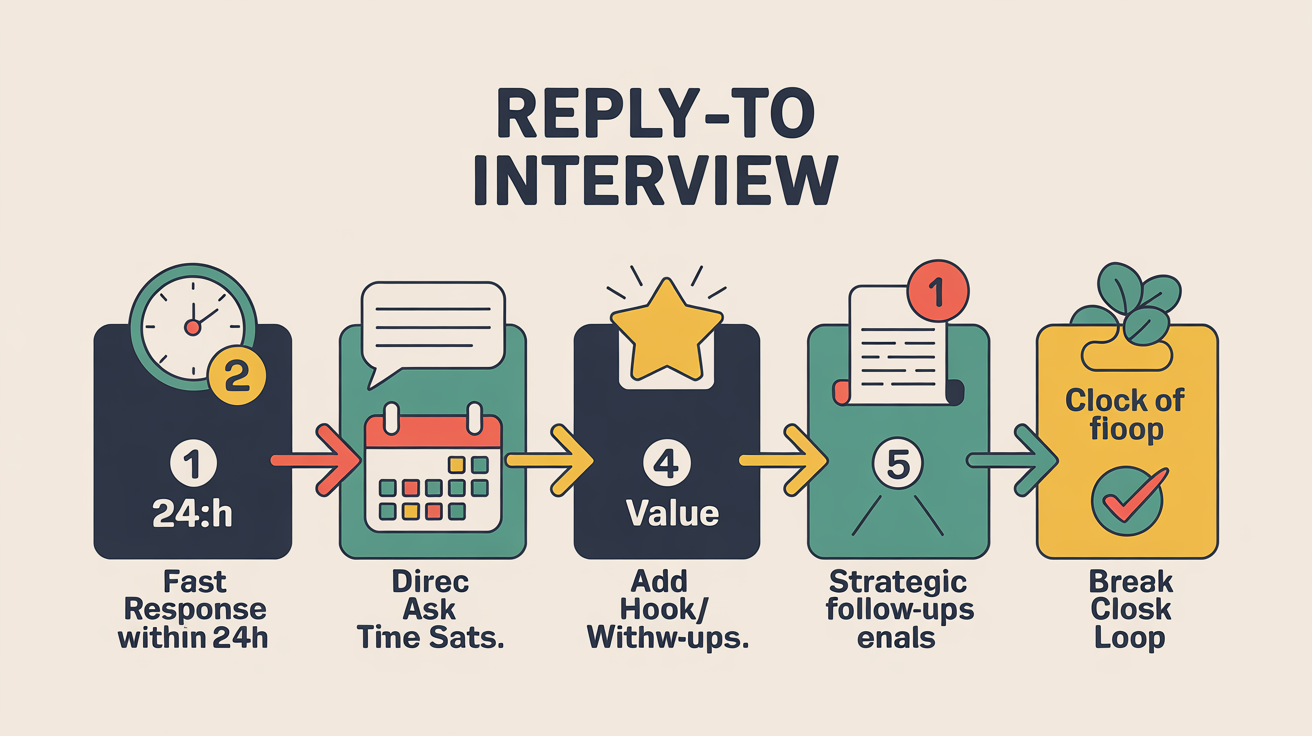
Convert ‘Interested’ Into a Phone Interview: The Six-Step Follow-Up Playbook
Nail these steps and you’ll move a lukewarm “interested” reply to a scheduled phone interview - quickly, with fewer missed chances. Wait too long, get vague, or send a canned message and you’ll lose momentum. Top closers use this approach to book meetings before anyone else even reacts.
- Respond Fast (Within 24 Hours). Reply within a day. That’s the window before interest drops or someone else grabs their attention. Miss 24 hours? Set a reminder and get it done within 48. After that, your odds drop sharply. Long delays signal you’re not serious.
- Reference Their Response. Start by mentioning something specific from their reply - a project, a detail, or even a question. That shows you’re not just pasting a template. If they wrote something generic, find any real detail and anchor to it. No reference? You look automated. Trust evaporates.
- Make a Direct Ask. Give them a clear next step: phone call or video chat. Don’t ask, “let me know when you’re free.” Offer two or three time slots: “Does Thursday at 2pm or Friday at 10am work?” If they share their schedule first, confirm fast and lock it in. Unsure on time zones? State yours and ask if it fits.
- Add a Hook or Value. Keep it to two sentences. Restate why you’re a fit, mention a quick win, or share a recent, relevant result. For example: “I helped a team like yours ramp up new hires in half the time - happy to share what worked.” Tie it to their business if you can. If not, use a sharp, specific story from your last role. Skip the life story - long pitches get ignored.
- Space Follow-Ups Strategically. No reply? Wait 2-3 days, then send a second message. If still nothing, stretch the next touch to 7-10 days. Each message needs something new - a question, useful link, or short case study. Never send the same ask twice. Repeat yourself and you’ll hit the spam folder. For examples, see the follow-up sequence tactics.
- Close the Loop. After three or four touches with no response, send a brief, polite break-up note. Example: “I haven’t heard back - should I close the loop on this opportunity?” This triggers urgency. Many hiring managers reply here because you’ve shown persistence without nagging. Push past this point and you risk burning goodwill. More on this in how we coach replies into interviews.
This process builds momentum from a “maybe.” Most people slip up by waiting too long, sending bland nudges, or making vague asks. Each message should feel like a new, intentional step - not a copy-paste job. For timing and sequence details, check the proactive job search playbook and see how to write sharp, confident messages.
Track exactly which approaches get replies and which stall out. Run A/B tests on subject lines and hooks. Change one thing at a time, watch results, then iterate. Build your process around what actually works - not what feels safest. For benchmarks and specific tactics, review how we measure outreach performance and run tests that improve reply rates.
Not sure if a reply is truly qualified, or what to do with a half-hearted “maybe”? Walk through what counts as a qualified reply and how to prioritize responses. Seeing interest drop off before calls get booked? Audit your process for three reply handling mistakes that kill momentum.
Where Candidates Get Ghosted: Five Data-Driven Mistakes That Shut Down Your Follow-Up
Slow response time sabotages job search momentum. Wait more than 48 hours to follow up, and your odds nosedive - reply rates drop sharply after two days. Ghosting has patterns. Most of it comes down to predictable, avoidable mistakes. These are the five missteps that push candidates into the void - and how to avoid each one.
Slow Response Kills Momentum
Wait several days to reply, and you’re forgotten. Leads cool off fast. Nearly 90% of email replies come within 48 hours - after that, you look checked out or disinterested.
Reply within 24 hours. Every time. This keeps you top of mind, shows urgency, and marks you as decisive. Too many threads? Set calendar reminders or use a tracking system so nothing slips. For step-by-step tactics, see how the proactive job search playbook schedules fast, consistent follow-ups.
Vague or Passive Next Steps
“Let me know if you’re interested” puts the burden on them. Passive phrasing gives no urgency and stalls the process. Candidates use it to avoid looking aggressive, but it kills momentum.
Drive the process. Propose two or three specific times for a call, or ask a direct question tied to their timeline. Remove friction. For scripts that actually get responses, see how to write sharp, confident messages hiring managers will actually answer.
Repeating the Same Ask in Each Follow-Up
Sending “Just checking in” on repeat is a fast track to being ignored. Repetition signals desperation, and adds no value. Most candidates fall into this because they scramble for something to say, then default to the same ask.
Change it up. Each follow-up should introduce something new:
- Share a quick success story tied to their pain point.
- Link to a short article or resource relevant to their industry.
- Ask a question about their team’s priorities or upcoming challenges.
Sending Too Many or Too Few Follow-Ups
One follow-up isn’t enough - 80% of replies come after the second or third message. But flood their inbox with seven or more, and you look out of touch. Both extremes damage your odds.
Stick to three or four well-timed, value-driven follow-ups over 10-14 days. After that, send a polite break-up note and move forward. This cadence keeps you professional and remembered for future roles. For more on timing, see our outreach testing framework.
Ignoring Negative or Neutral Replies
Most freeze or over-press when they get a “maybe” or flat “not interested.” Some candidates keep pushing. Others ghost themselves. Both waste time and burn bridges. These replies are feedback - use them.
Qualify every reply. If it’s a clear no, thank them and move on. If it’s ambiguous, ask a clarifying question and only pursue if there’s real interest. Double down on the warmest leads, triage the rest. For reply management systems, see how we coach replies into interviews and how to prioritize responses.
Tools That Turbocharge Your Reply-to-Interview Rate: Automate Sequencing, Track Replies, and improve with One Cold Email
High-performing outreach depends on more than just sending emails. You need automation that sounds personal, reply tracking you can trust, and analytics that highlight what actually lands interviews. Anything less means missed opportunities and wasted time.
Sequencing and Follow-Up Automation
Manual follow-up? Too slow. A sequencer lets you pre-schedule every touch, mix up timing, and hit pause the moment someone replies. Forget calendar reminders and copy-paste routines - they won’t scale. With automation, you can build 3-5 step campaigns that react to real behavior: send a nudge if there’s no reply, offer extra value if they clicked but stayed silent, or close the loop with a break-up if you’ve reached your limit.
Look for sequencing tools that let you:
- Schedule 3-5 follow-ups with custom delays and varied content
- Drop in case studies, articles, or questions tailored to each step
- Pause sequences instantly when someone writes back
- A/B test subject lines and copy, tracking what converts
This level of control turns a trickle of replies into a steady flow of interviews. For tactics on building sequences that actually get answers, see how to engineer follow-ups that reclaim lost opportunities.
Reply Tracking and Triage
Missed replies mean lost interviews. Basic tracking works for low volume - a spreadsheet can map status and next steps. But as your outreach ramps up, you’ll need tools that scan replies, flag intent, and keep every thread visible. Unified inboxes or simple CRMs do the trick: no more searching, no more dropped leads. The best platforms tag replies by stage - “requesting interview,” “needs more info,” “not interested” - so you can focus on the right prospects. For job search, this means you always know who’s close to booking a call and who needs a push.
Ready for volume? Use a platform that spots positive replies, tracks ambiguous ones, and lets you triage in seconds. For step-by-step tactics, see how we coach replies into interviews and how to prioritize responses.
Analytics and Continuous Optimization
Analytics aren’t just dashboards - they drive your next move. The right platform shows reply rates, open rates, and timing per step. Run A/B tests on subject lines, content, and send times. Adjust based on what actually works, not on gut feel. Even a spreadsheet helps if you log outcomes and review weekly. For advanced performance testing, check how we measure and improve cold outreach.
Don’t chase stats alone. Focus on the right outcomes: interviews booked, strong replies - not just polite “not now” messages. Use your analytics to tweak scripts and timing for sharper results. Need a system for constant improvement? See how to run a modern job search that lands interviews - fast.
One Cold Email brings sequencing, reply tracking, triage, and analytics together. All in one workflow. Built for job seekers and operators who want control - and results - without chaos. You’ll see exactly where to refine next, and book more interviews along the way.
If You Nail the Follow-Up, You Win the Interview: The Real Outcome of Proactive Reply Handling
Follow-up wins interviews. Most people quit after one email - so they never see what happens next. Persistent, targeted follow-up multiplies your response rate. The research backs it: over half of all replies come from a follow-up, not the first touch. Add just one follow-up, and your reply rate jumps by 22% on average.
Silence isn’t a “no.” It’s usually bad timing or a buried inbox. Your job: resurface with value, not nagging. Respond fast to positive or neutral replies - short, direct, and clear on next steps. For cold outreach, use a sequence: each follow-up should add something new. Share a fresh insight, answer an objection, or make the ask easier. Never send “just checking in.” Every touch should move the conversation forward.
Track every reply. Tag outcomes - “interested,” “not now,” “objection,” “no reply.” Data tells you which messages convert to real conversations or interviews. Don’t leave threads open-ended. Prioritize the right replies, and close the loop. Want a breakdown? See what counts as a qualified reply and how we coach replies into interviews. For the full system, check how we run a modern job search.
If you want the entire workflow - sequencing, triage, analytics, follow-up templates - handled automatically, that's what One Cold Email is built for. You'll stop losing leads to silence and turn more replies into real interviews.
Build an Unfair Advantage Proactively and Update Your Job Search Strategy to Today's Job Market.
$197
Learn MoreFrequently Asked Questions
Can you share 2–3 exact follow-up message templates to send immediately after a short “interested” reply (examples for email, LinkedIn DM, and SMS)?
Email - Subject: "Quick next step?" Body: "Thanks [Name] - great to hear you're interested. Are you available for a 20‑minute call to review [specific outcome]? I can do Wed 10:00–10:20 AM or Thu 2:00–2:20 PM - which works, or should I send a one‑page summary first?" LinkedIn DM: "Thanks [Name], glad to hear it - quick Q: would you prefer a 15‑min call to walk through how we [benefit], or a 1‑page summary first? If call, I'm free Wed 10am or Thu 2pm - which suits you?" SMS: "Thanks [Name]! Great to hear - can you do a 15‑min call Wed 10am or Thu 2pm to discuss how we can [benefit]? Reply with your preferred time or text 'SUMMARY' and I'll send a one‑pager."
Should I include a calendar/scheduling link in my first follow-up, and if so how do I present it so it feels helpful rather than pushy?
Yes - include a scheduling link if you wait 2–3 days and make it optional rather than prescriptive. Present it as a convenience: offer 2–3 specific time windows (with the recipient’s time zone) and/or add a calendar link with copy like “If helpful, pick a time that works for you” and an explicit alternative (“or reply with preferred times”). Keep the tone low-pressure, focused on value, and stop after about three follow-ups if there’s no response.
How should I prioritize which ‘interested’ replies to pursue first when I have limited time and multiple opportunities?
Prioritize replies that show a clear next step and high intent first - e.g., “When are you available?”, “Let’s talk”, or “Tell me more” - then prioritize decision‑makers and anyone who states a timeline or urgency. Respond quickly (within 24–48 hours - many conversions happen when you engage in the first 2 days) and tackle high-value, low‑friction opportunities first while moving lower‑intent “interested” threads into a scheduled nurture cadence. Use a simple score (e.g., +3 scheduling asks, +2 “tell me more”, +1 generic interest; +1 for decision‑maker, +1 for opens/clicks) and pursue highest scores first.
What’s the best way to respond if the recruiter asks for salary expectations or a job description before agreeing to a phone call?
Give a researched salary range or ask them to send the job description and target salary range before a call. Back your range with market data (for example Hays Salary Guide, Glassdoor or PayScale) and present a 10–15% span that reflects your experience; alternatively request the JD and the employer’s range and offer a brief 15-minute call to confirm mutual fit.
If the recruiter proposes times that don’t work for me, what’s the most professional way to offer alternatives without losing momentum?
Thank you - offer 2–3 specific alternative slots (days, dates, times) in the next week and include your time zone, plus say you’ll send a calendar invite or a Calendly link. Ask them to confirm which option works (or to propose another time), state you’re happy to be flexible for an afternoon/evening if needed, and request a brief response window (e.g., “please let me know within 48 hours”) to keep the process moving.
Are there different follow-up cadences or wording I should use for a reply received via LinkedIn vs. email vs. InMail?
Yes - use different cadences and wording: LinkedIn messages and InMails (which live inside LinkedIn and can’t be automated the same way as email) should be shorter, more informal, mirror the prospect’s tone, and be answered quickly (ideally within 24 hours). Email replies can be more detailed, include attachments/proposals, explicitly recap prior points and offer 2–3 calendar slots, and email is the best backbone for multichannel automation. If you don’t get a response, follow email best-practices (3–5 follow-ups over 2–3 weeks), but always add new value and shift channels based on engagement.
How long should I keep following up before assuming the opportunity is dead, and what’s a good final “breakup” message to send?
Send a polite break-up after 4–8 touches (commonly on the 5th touch), roughly 2–4 weeks from your first outreach; if they don’t reply within a week after that message, remove them from active follow-ups and move them to a long‑term (quarterly) nurture. Template: "Hi [Name], I haven’t heard back so I’ll assume [your solution/this topic] isn’t a priority right now - I’ll stop reaching out, but if priorities change or you’d like to revisit, I’m just a reply away; best of luck with [specific initiative]."
Luis Gamardo built a modern job search framework for a broken recruiting system. His approach teaches how to send cold emails at every stage of the hiring process, so qualified candidates can get noticed by the right people at the right time - including before jobs are even posted.
Sources
- isazeni.com
- autobound.ai
- instantly.ai
- instantly.ai
- trykondo.com
- community.hubspot.com
- artemisleads.com
- woodpecker.co
- expandi.io
- fyxer.com
- quora.com
- herohunt.ai
- tradepressservices.com
- mailforge.ai
- artisan.co
- chatterworks.com
- careerlaunchpad.io
- askamanager.org
- instantly.ai
- payproglobal.com
- salesmotion.io
- allegrow.co
- listkit.io
- boostmediagroup.com
- hubsell.com
- growthlist.co
- leadspicker.com
- listkit.io
- instantly.ai
- superhumanprospecting.com
- gmass.co
- upwork.com
- saleshandy.com
- findem.ai
- instantly.ai
- indeed.com
- pursuenetworking.com
- resources.workable.com
- gem.com
- exclaimer.com
- instantly.ai
- writemail.ai
- scale.jobs
- trykondo.com
- scribbl.co
- indeed.com
- theundercoverrecruiter.com
- tario.ai
- coursera.org
- betterproposals.io
- wallstreetoasis.com
- indeed.com
- indeed.com
- quora.com
- ignitionapp.com
- liveagent.com
- indeed.com
- quora.com
- saleshandy.com
- sparkle.io
- levelingup.com
- gem.com
- propellercrm.com
- sendr.ai
- onepagecrm.com
- tealhq.com
- reply.io
- lockedinai.com
- sujanpatel.com
- quickmail.com
- highspot.com
- quora.com
- herohunt.ai
- hailleygriffis.com
- openarc.net
- nureply.com
- resumly.ai


