
Our Framework For Writing Short, Confident Messages Hiring Managers Will Read
Despite professionals receiving 121 emails daily, concise, personalized cold outreach still nets 21–24% opens (over 30% with genuine personalization) and typical reply benchmarks of 2–5%, with LinkedIn offering higher reply rates (7–15%). The most important takeaway: use short (50–125 words), value-first messages with specific subject lines and a clear ask, combine email for scale and LinkedIn for trust, and follow the guide’s frameworks and pre-send checklist to materially boost responses.
Build an Unfair Advantage Proactively and Update Your Job Search Strategy to Today's Job Market.
$197
Learn MoreWhy Short, Confident Outreach Gets Read - Even In A 121-Email-Per-Day Inbox
The average professional wades through 121 emails per day. Yet cold outreach still pulls a 21–24% open rate - and with genuine personalization, that jumps beyond 30%. Even in crowded inboxes, concise and targeted messages get noticed. Everything else fades into the background.
Most job seekers miss this. They send walls of text, skip the research, or never clarify the ask. Hiring managers tune out. But when you cut the fluff, speak to the recipient’s world, and get to the point, your message moves to the top. Short, relevant outreach can slip past gatekeepers and reach the real decision-makers - often before a job even exists publicly.
This guide breaks down how to write emails that cut through noise. You’ll see frameworks for subject lines that draw clicks, practical breakdowns of the two-minute email format, and a pre-send checklist for message quality. You’ll get data-backed A/B test results and see why value-focused messaging drives replies. We flag the common mistakes that kill response rates and show how to adjust your tone for each audience - seasoned pro or career changer.
For a full system, see the complete proactive outreach playbook. Want to go granular? Check how subject line tweaks, personalization strategies, and well-timed follow-ups open direct lines to hiring managers. If you’re done sending emails into the void, this hub shows how to build real traction.
The Modern Cold Email: Types, Benchmarks, And What Actually Works
Outreach succeeds or fails on four fronts: channel, relevance, subject line, and personalization. Cold email still scales like nothing else, but hitting today’s benchmarks - 15–25% opens, 2–5% replies - takes precision. Generic templates and bad timing? You’re invisible. Align message, audience, and context, and you get replies. Here’s how each piece works - and where to focus.
Channel Selection: Email vs. LinkedIn
Cold email wins on scale - hundreds or thousands per campaign, low cost, quick iteration. LinkedIn flips the script: less volume, higher reply rates (7–15%), but daily limits and manual work. Use both. Email gets you in the door. LinkedIn builds trust and gets faster responses. See the full strategy in the multi-channel playbook for breaking through to decision-makers.
Types Of Messaging: Value-Focused, Transactional, And Conversation-Starters
Most job seekers blast “me-focused” emails - a résumé in message form. Top performers reverse it. They lead with value: the recipient’s needs, pain points, and priorities. Transactional asks (“Can you refer me?”) sometimes work, but relevance lifts response rates. For the mechanics, see value-focused messaging frameworks that drive actual replies.
Subject Line Strategy And Message Length
Subject lines decide your fate. Short, specific, relevant - reference a trigger, a shared contact, or a real priority. The body? 50–125 words wins. Anything longer usually gets ignored. For real data and examples, check subject line breakdowns and the two-minute email format.
Personalization: Surface-Level vs. Deep Context
It’s not just about using a name. Real personalization shows you did your homework - reference a product launch, a hiring surge, or a company milestone. One sharp line of context beats a block of fluff. For tactical moves, see tone and context by audience and the message quality checklist to catch weak spots before sending.
Benchmarks, Testing, And Optimization
Cold outreach moves fast. Average open rates hover at 20%, but top campaigns A/B test subject lines, structure, and CTAs to land 3–5% replies. If you’re not iterating, you’re fading. For real numbers and pivots, see A/B test results and optimization tactics. The usual killers: over-automation, off-tone copy, ignoring reply data. Catch mistakes early with the messaging mistakes checklist.
Audience Fit And Timing
Recipient and timing matter as much as copy. Nonprofits often see 40% open rates - e-commerce, closer to 29%. Segment by industry. Changing fields? Your message and channels shift, as shown in the career changer intro guide. For timing, see how to research and prioritize companies to catch warm signals and open doors others miss.
For the full outbound system, the complete proactive outreach playbook breaks down every step - targeting, messaging, follow-up - so you can build a repeatable, data-driven process that lands replies.
- Checklist-driven prep? Use the ten-point pre-send checklist.
- Coaching replies into interviews? Start with reply-to-interview scripts and timing.
- Scaling without losing the personal touch? See personalized outreach tactics.
Tradeoffs That Matter: Personalization, Message Format, And Campaign Scale
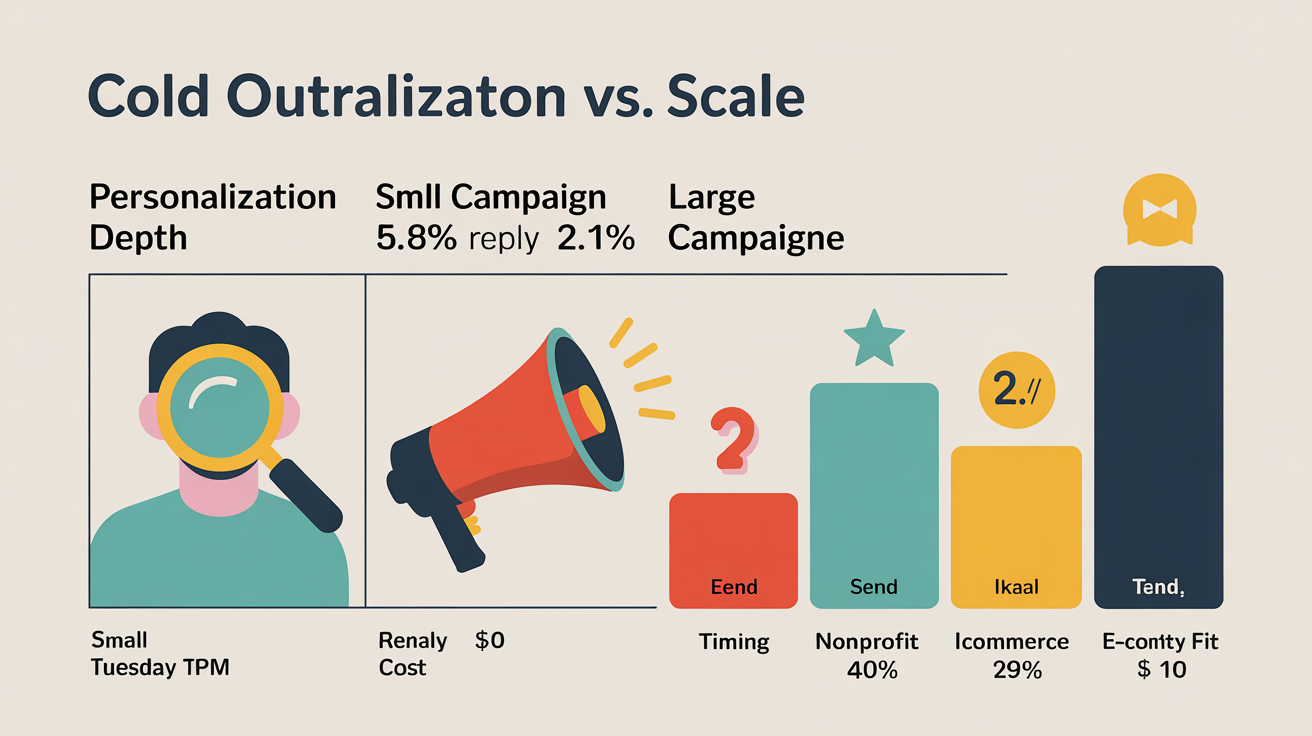
The core decision in outreach: personal or scalable? Small, targeted campaigns can double or triple reply rates compared to mass blasts. But every layer of personalization adds time and cost. Mass messaging fails - results follow when your system matches your audience, message, and resources.
Personalization Depth vs. Speed
Deep personalization lifts replies. It also slows you down. Reference industry context, recent company news, or mutual connections - these beat name-only tweaks, but cost minutes per contact. Most teams settle on segment-based variants: tweak by role, industry, or trigger, then add a line unique to each recipient. Segment-first, personal-second. This beats both generic templates and hand-crafted one-offs. See personalization at scale for practical segmentation and timing strategies.
If “real” personalization feels fuzzy, check the pre-send checklist and messaging mistakes guide. Both show how to avoid surface tweaks that get ignored.
Choosing The Right Channel And Message Format
Your channel sets format, cost, and trust. Cold email scales fast and stays cheap. LinkedIn InMail costs more (about $10 per send) but builds credibility. Use both - email for reach, LinkedIn for trust - and you’ll need message variants and cross-system tracking. Compare costs and fit with the cost analysis and campaign playbook.
Short messages work best. Two-sentence emails win attention, especially with busy decision-makers. See the two-sentence email guide and subject line benchmarks for proven structures. Adjust length and tone by channel: plain text for email, direct but conversational for LinkedIn. Use the tone adaptation guide to match audience expectations.
A/B Testing And Follow-Up Strategy
Guessing kills campaigns. A/B test subject lines, calls-to-action, and timing to see what moves the needle - gains can hit 12% or more. Test one variable at a time, with at least 100 sends per variant. For benchmarks and live results, review A/B test stats and outreach performance data.
- Spot underperforming steps - subject lines, structure, or follow-up timing.
- Review reply and open data weekly, then adjust based on the trends.
- Don’t skip follow-ups. Timed nudges recover missed opportunities. See follow-up sequence design for details.
Message focus changes results. Value-focused messaging - connecting your ask to what matters for the recipient - drives more conversions. See value-focused messaging and outreach for career changers to sharpen your approach by audience.
Common Cold Email Mistakes That Kill Your Shot - And How To Avoid Them
Pitch too soon and you’ll get ignored - or worse, flagged as spam. Generic, desperate, or self-centered messages kill reply rates and damage your sender reputation. Most cold emails disappear because they sound like every other lazy blast in a crowded inbox.
- Targeting the wrong contacts or roles burns your outreach budget and tanks your domain reputation. Prioritize carefully - see how to prioritize companies and contacts before you send anything.
- Sending generic emails with zero personalization drops replies below 2%. Fix this with the two-sentence email structure and the breakdown of common cold message mistakes.
- Weak or misleading subject lines get your email deleted or filtered. Study real subject line benchmarks for what hiring managers actually open.
- Ignoring technical setup - missing SPF, DKIM, or skipping inbox warmup - can get your domain blacklisted. Check the deliverability checklist for job seekers before you launch anything.
- Forget to follow up and you’ll miss 40% of total replies. Use strategic follow-up sequences to recover missed opportunities.
Protect yourself. Use a detailed pre-send checklist to catch mistakes in targeting, tone, structure, or technical setup before you hit send. Adjust your approach with the tone adaptation guide and keep every sentence focused on the recipient’s priorities using value-focused messaging. Changing industries? The guide to writing outreach as a career changer covers what actually works. For real reply and open rate data, see the A/B test results roundup. These aren’t minor issues - ignore them and you risk deliverability, reputation, and interviews. Review the complete proactive outreach playbook before your next campaign.
Your Messaging System Starts Here: Pick Your Next Tactical Move
If you want replies, not just opens, start with the two-sentence outreach tutorial. That structure forces relevance, clarity, and a direct ask. Most job seekers miss one of those - and their reply rates tank.
Already have a draft? Use the ten-point pre-send checklist to catch mistakes before they hit someone’s inbox. Need to shift your tone for a different audience or industry? The tone adaptation guide covers credibility and fit. Common outreach errors? The messaging mistakes breakdown flags the traps that kill replies. Want to see what actually works? Check real subject line benchmarks or review A/B test results from thousands of sends. If you’re pivoting careers, the career changer outreach guide breaks down what gets traction. For sharper asks, use value-focused messaging.
Want the full system - targeting, research, follow-up, scaling? The complete proactive outreach playbook covers every step. You’ll see how research, company prioritization, and performance metrics fit together. One Cold Email’s approach was built for people who want each message to matter - no guesswork, no wasted effort, just a repeatable system that drives results.
Frequently Asked Questions
How can I personalize messages at scale without losing authenticity?
Build a foundation: define clear buyer personas, maintain clean data, and create a reusable content library of role-specific value props, case studies, and industry talking points (e.g., CNC, lean, Six Sigma for automotive) so reps can assemble relevant language instead of writing from scratch. Then use smart automation (74% of sales teams use personalization tech) - modular templates with dynamic fields/snippets, guardrails that force a custom sentence for high-value accounts, deliverability/compliance checks, and continuous A/B testing and response tracking to keep messages scalable yet authentic.
What is the best time and day to send my cold outreach to maximize response?
Send B2B cold outreach midweek - ideally Tuesday or Thursday - timed to arrive mid-morning (≈10:00 AM local) for active engagement or very early (4:00–8:00 AM) to top the inbox; emails sent 4:00–8:00 AM show the highest open rates (42.7%) and Tuesday has the highest response day (~27.5%). Adjust by industry (SaaS often best Tue/Thu 2–3 PM; professional services Mon/Tue 8–10 AM), always send in the prospect’s time zone, avoid end-of-quarter/holiday windows, and follow up 2–3 business days after the first send.
What metrics should I use to track my cold outreach performance?
Track deliverability (bounce rate/domain reputation), open rate, CTR/link clicks, reply/response rate, meeting/demo conversion rate (meetings ÷ responses), time-to-first-response, unsubscribe/spam rate, downstream pipeline metrics (qualified leads/SQLs and revenue per lead), and behavioral intent signals (page views, video watch rate, scroll depth). Benchmarks: B2B SaaS opens ~25–40%, replies ~5–10%, unsubscribe/spam <0.2%; monitor trends, A/B test subject lines/openers/CTAs, and prioritize contacts showing strong real-time engagement.
How many follow-up emails should I send to a hiring manager, and what’s an effective sequence (timing + short scripts) to get a response?
Send 2–3 follow-ups: a thank-you within 24 hours (after an interview) or immediately after first contact, a first check-in about 3–7 days after your last message or ~1 week after the expected decision date, and a final “break-up” follow-up one week later if still no reply. Thank-you (24h): “Thank you for meeting today - I enjoyed discussing [specific project/role]. I’m excited about how my [skill/experience] fits your needs; please let me know next steps. - [Name]” First check-in (3–7 days/≈1 week after expected decision): “Following up on my application/interview for [Role]; I remain very interested and wanted to confirm your hiring timeline or if you need any additional info. Thanks for the update - [Name]” Final break-up (one week later): “Checking one last time on [Role]; if the position’s filled or timing’s different, could you please let me know or point me to the right contact? Appreciated - [Name].” Keep every message <150 words, add one specific value or reminder each time, and stop after the final note if you get no response.
What are the fastest 3 research steps I can do (under 5 minutes) to personalize outreach so a hiring manager notices it’s relevant?
Do these three quick checks: (1) open the hiring manager’s LinkedIn and note their current title plus one recent post or comment to quote, (2) scan the company’s news/LinkedIn or Crunchbase page and capture one recent event (funding, product launch, hire), and (3) read the job posting and pick one explicit requirement or metric you can directly address. Spend ~60–90 seconds per step, then write a one-line opener that (a) quotes their post or title, (b) references the company event, and (c) ties a specific job requirement to a concrete result you’ve achieved.
Should I attach my resume or include portfolio links in the initial outreach, and how should I present them concisely to avoid cluttering the message?
Include a single, hyperlinked portfolio or LinkedIn URL in initial outreach and avoid attaching your resume unless you’re formally applying or the contact specifically requests it. Place the link in your email header or on one line immediately after a one‑sentence pitch (e.g., “Portfolio - agardner.portfolio.com”), use a short clickable label, and if you must attach a resume send a PDF named like First_Last_Resume.pdf.
How should I change tone and phrasing when I’m a career changer versus an experienced candidate so I still sound confident and credible?
Frame your tone as confident and learning-oriented when you’re a career changer - emphasize transferable accomplishments, recent upskilling, and quick wins with concrete metrics (e.g., “applied X to cut Y by Z%”), avoid apologetic hedging, and use verbs like adapted, applied, partnered and accelerated learning. As an experienced candidate, use authoritative, outcome- and leadership-focused phrasing that highlights judgment and people skills (employers increasingly value those traits), quantify scope and impact, and prefer verbs like led, designed, scaled and owned. Tie either approach into a one-minute professional narrative that connects past achievements to the role, and for changers explicitly call out continuous learning and reverse-mentoring or network bridges to boost credibility.
Luis Gamardo built a modern job search framework for a broken recruiting system. His approach teaches how to send cold emails at every stage of the hiring process, so qualified candidates can get noticed by the right people at the right time - including before jobs are even posted.
Sources
- hubspot.com
- artisan.co
- indeed.com
- koncert.com
- arminsworld.medium.com
- belkins.io
- superhumanprospecting.com
- pclub.io
- autobound.ai
- zaphyrpro.com
- sendr.ai
- gem.com
- growthlist.co
- mailtrap.io
- close.com
- leadspicker.com
- seekout.com
- superhumanprospecting.com
- artisantalent.com
- sopro.io
- getmagical.com
- criminallyprolific.com
- isazeni.com
- sales-mind.ai
- salescaptain.io
- cleverly.co
- saleshandy.com
- donemaker.com
- heyreach.io
- expandi.io
- martal.ca
- executivestrategygroup.com
- trykondo.com
- leadcrm.io
- outreach.io
- skrapp.io
- salesrobot.co
- zanatemarketing.com
- abstraktmg.com
- saleshive.com
- sendmails.io
- mailshake.com
- trykondo.com
- salesroads.com
- generect.com
- sparkle.io
- artemisleads.com
- outreach.io
- decisionfoundry.com
- sendr.ai
- instantly.ai
- influencer-hero.com
- ghosh.com
- nureply.com
- prospeo.io
- joinvalley.co
- b2brocket.ai
- oppora.ai
- getboomerang.ai
- upwork.com
- reachgiant.com
- hubsell.com
- instantly.ai
- instantly.ai
- phoneburner.com
- forbes.com
- leavemealone.com
- tario.ai
- zackarnold.com
- instantly.ai
- mailpool.ai
- mailreach.co
- saleshandy.com
- aisdr.com
- anyleads.com
- support.outreach.io
- timify.com
- growleady.io
- toptechnewsletter.com
- warmforge.ai
- payproglobal.com
- linkedsavvy.com
- mailforge.ai
- herohunt.ai
- sashandcompany.com
- monday.com
- coldemailgenerators.com
- qubit.capital
- blog.hubspot.com


