
Why Your Follow-Ups Fail: Seven Common Sequence Mistakes
Skipping follow-ups can forfeit up to 46% of replies - most positive responses arrive after the first or second follow-up, and job-seeker reply rates already hover at only 8.5–12%. To reclaim those opportunities, use a humanized sequence (first follow-up 2–3 days after the initial message, then progressively longer gaps with varied days/times), avoid bland one-liners by adding specific context or a new value-driven angle under 150 words, and keep replies in-thread or change subject lines when needed.
The Real Cost of Follow-Up Mistakes: Missed Replies and Lost Opportunities
Skip a follow-up and you leave up to 46% of replies behind. Research shows most positive responses in cold outreach arrive after the first or second follow-up, not the initial message. For job seekers, reply rates hover between 8.5% and 12% - already low. Miss a touchpoint, and you’re burning hard-won opportunities.
These aren’t small errors. Every missed reply is a potential interview, offer, or connection lost to someone else who followed up with structure. Consistent follow-ups aren’t just a nice-to-have - they drive the majority of replies. Most candidates quit after one attempt and never realize what slipped away. If you’re trusting memory instead of a system, you’re already behind.
Most people drop the ball mid-sequence. You’ll see why, and exactly how to fix it. The numbers, the common mistakes, the sequence structure - broken down so you can start getting those replies you’ve already earned.
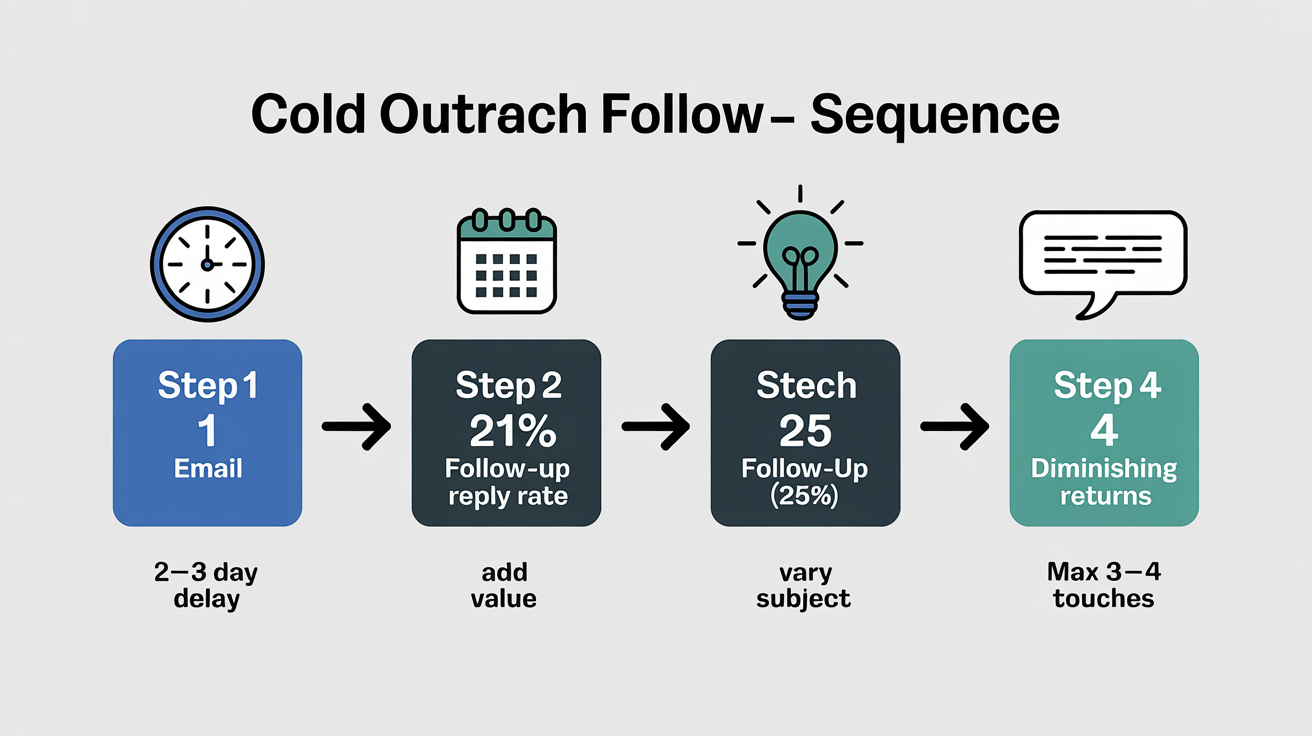
Three Sequence Killers: Over-Optimizing Timing, Bland Messaging, and Ignoring Context
Reply rates drop when your follow-ups feel robotic or disappear in a crowded inbox. The biggest culprit: sticking to a rigid schedule for every follow-up or firing them off whenever you remember. Both kill momentum. You fade into the background fast.
Sequence Killer #1: Over-Optimizing or Winging Timing
Perfectly spaced calendar? Robotic. Every Monday batch or random send? Just as bad. Too much structure - your emails always land at the same time, training people to ignore you. Too little - you lose track, follow up too soon (annoying) or too late (irrelevant). Most job seekers default to batching on Mondays or sending when they remember. Both dead zones for getting noticed.
Break the pattern. Build a rhythm that mimics real conversation: first follow-up 2–3 days after the initial message, then add an extra day or two between each. Change the day and time for every touch. Example: Tuesday mid-morning, Thursday late morning, Monday early afternoon. Human timing gets you opened. For step-by-step schedules and benchmarks, use evidence-based follow-up intervals for job outreach and tailor to your field.
Sequence Killer #2: Bland, Forgettable Messaging
“Just checking in.” “Any updates?” These phrases say, “I’ve got nothing new.” Recipients archive them without a glance. Spam filter bait. You get ignored. Your target is busy - your message needs to make them care.
- Reference something specific from your last message or their recent activity - show you’re actually paying attention.
- Add a new angle: share a resource, insight, or question tied to their role or current priorities.
- Keep it under 150 words, stay direct, and clarify the benefit to them - not just your need for a reply.
- If your last subject line didn’t get opened, change it. If the thread got a response, reply in the same thread to keep context.
Sequence Killer #3: Ignoring Recipient Context
Sending disconnected nudges - one-liners like “?” or “Just following up” - signals you’re not invested in their goals or timeline. You waste inbox space. Recipients tune you out when you ignore where they are in their hiring process, workload, or recent updates.
Anchor every message in their world. Remind them of your last interaction, reference something timely (recent announcement, hiring update, shared interest), and link your ask or info to what actually matters to them. Example: “Last week you mentioned the team’s focused on Q2 launches - if it’s helpful, I can send a short case study on similar rollouts.” Context signals you’re thinking ahead, not just chasing replies. For more on weaving context and value into each touch, see follow-up message types that re-engage busy hiring managers for examples that get responses.
Missing these fundamentals costs you easy wins. Build sequences that feel human, useful, and anchored in real context. Then scale your process with these proven sequence design principles and the complete playbook for proactive outreach. Want to see how top candidates keep reply rates high? Study short, confident messaging frameworks that hiring managers read.
Sequence Sins: Static Subject Lines, One-Channel Thinking, and Over-Following
Subject line fatigue kills your outreach before it even gets a shot. Repeating the same subject - or bumping the same thread - signals automation to both people and filters. Spam folders love patterns. They punish robotic repetition fast.
Static Subject Lines (Mistake #4)
Reusing the same subject line across your sequence guarantees you’ll be ignored. Recipients tune out. Spam filters fingerprint the monotony and classify your approach as bulk. Open rates tank, not because your offer is weak, but because your email blends into digital wallpaper. Algorithms now flag repeated phrasing as non-human. If your subject lines match, you get filtered out before you even compete.
Switch it up every time. Each follow-up gets its own subject line - match it to your angle. Start with “Quick intro re: [Role].” Next? Try “Still relevant for Q2 hires?” or “Resource for your new [initiative] team.” These shifts show intention, not autopilot. Small subject tweaks help you dodge spam clustering and boost deliverability. For proven tactics, check sequence design principles that actually land in inboxes.
One-Channel Thinking (Mistake #5)
Sticking to email alone - even with sharp copy - means you miss key moments. Decision-makers might skip emails but check LinkedIn or answer calls at odd hours. Single-channel outreach leaves you at the mercy of crowded inboxes and stricter filters, while others show up where your contacts already spend time.
- Map your channels: Find where your target actually responds - email, LinkedIn, phone, maybe SMS or in-person events.
- Stagger your touches: Pair emails with LinkedIn messages, profile views, or calls - space them out so it feels organic, not like a blitz.
- Keep your story straight: Every channel should build on the last touch. No disconnected pitches. Reference what you said before - consistency builds trust.
- Double down on what works: Track replies by channel and adjust your mix. Review how we measure outreach performance for real-world reply drivers.
Over-Following (Mistake #6)
Sending five, six, or more follow-ups in a row - especially with recycled asks - moves you from persistent to pest. Today’s inboxes fight back: velocity triggers, AI filters, and manual spam flags cripple your sender reputation. Too much outreach, not enough substance. Data is blunt - after three or four thoughtful touches, reply rates collapse and spam complaints surge.
Cap your sequence at three or four messages unless you have something genuinely new to offer. Each follow-up should deliver a distinct question, benefit, or insight. Don’t just nudge. After two emails and a LinkedIn message, close with a short “breakup” note: “If now’s not the right time, I’ll pause here. Happy to reconnect if priorities shift.” This approach protects your brand, keeps deliverability high, and leaves the door open for future outreach. For timing and spacing, see the best follow-up cadences for job outreach and the data on sequence length and reply rates.
Sharpen your sequence. Rotate subject lines, use multiple channels, and end before you wear out your welcome. Details make the difference between intentional and annoying. For the full system, study the complete playbook for proactive outreach and the sequence design fundamentals that drive results.
Build a Fail-Proof Follow-Up Habit: The Sequence Review Framework
Mistakes don't just appear - they show up when your process runs on autopilot. Consistency and higher replies demand a review habit. Treat your review like a firewall: a quick check-in every week stops problems before they stack up. You won't just maintain; you'll actually improve.
- Sketch your entire sequence once a week. Make sure follow-ups land 2–5 days apart, with each step spaced out a bit more than the last. This keeps your pacing steady and avoids overwhelming inboxes.
- Reread every subject line and message. Each step needs fresh context and value, not recycled asks. If a message feels like a mere poke, rewrite it - share an insight or ask a sharper question.
- Switch up your channels by the third touch. Still no reply? Add LinkedIn, a voicemail, or even a text. Mixing channels raises your odds without bombarding any one place.
- Check open and reply rates for every message. If a step flops twice, cut it or test a new version. Use the metrics that actually move your sequence to guide your tweaks.
- Set a hard follow-up ceiling. Cap it at three or four attempts - unless you have something genuinely new to offer. This keeps your sender reputation clean and your prospects engaged, not annoyed.
Weekly reviews aren't busywork. They're the sharp edge that keeps your outreach effective. You catch weak links before they drag you down. Over time, this habit pays off: your messages stay sharp, replies climb, and you sidestep the classic errors outlined in the sequence design fundamentals. For the bigger picture, see the complete proactive outreach playbook and watch how a disciplined review habit drives results.
The #1 Follow-Up Mistake - and the Simple Framework That Fixes It
The biggest follow-up mistake? Treating it like an afterthought. Ghosting after one message drops you off the radar. Hammering the same ask, no context, irritates decision-makers. No tracking, no pacing, no value - now you’re just another ignored message in the pile.
Fix it with a review loop. Space each message, switch up your format, and always add fresh context - don’t just repeat yourself. Stop after a few touches unless you have something new to offer. This approach keeps your outreach on target, never stale or overwhelming. That’s the core of effective sequence design.
Automate the review habit. Build your process on these principles and watch your response rate climb while others get ignored. Stay systematic. Use the proactive outreach framework and keep refining. Results follow.
Frequently Asked Questions
How can I write and rotate subject lines across follow-ups to improve open rates without sounding spammy?
Use 3–5 subject-line variants per follow-up sequence (mix personalization, question, result-oriented, light humor and urgency), A/B test on a 10–20% sample and promote the winner; aim for 36–50 characters and lead with action verbs when useful. Keep follow-ups 1–3 in the same thread (use "Re:") for context, then break the thread on step 4 with a fresh subject; include location/date/purchase data to personalize but avoid ALL CAPS, excessive punctuation and common spam trigger words and only use real deadlines. Measure opens and replies (not just clicks) and iterate weekly - questions can lift opens ~10%, numerals up to ~45%, subject lines alone drive ~47% of opens but misleading lines cause many spam complaints (~69%).
What’s the best way to re-engage someone who initially replied but then went silent - what wording and timing work without being pushy?
Use short, polite follow-ups on a tight cadence - 1st follow-up 3–5 days after the initial message, a value-added follow-up 7–10 days later, and a final “close your file” note 7–14 days after that - each message under 3–4 sentences and sent in the same thread. Example value follow-up: “Hi [Name], since we last spoke I found a case study on [specific issue/industry] that directly addresses the ROI challenge we discussed - want me to send it?” Example close note: “Hi [Name], I haven’t heard from you since [last touchpoint]; should I close your file for now? If [original pain point] is still on your radar, reply and we’ll reconnect. - [Your Name]”
Which mix of channels (email, LinkedIn, phone, SMS) is most effective for follow-ups, and in what order should I try them?
Use an email-led, multi-channel mix (email first, then LinkedIn, then phone, with SMS only for warm/consumer contacts or scheduling) and run a 4–6 touch sequence. Space touches roughly 3 days after the first email, then 5 days, then 7–14 days (research shows 58% of replies come from the first email and follow-ups generate the remaining 42%), and stop after 3–4 follow-ups unless the prospect stays engaged. Between emails send a brief LinkedIn connection/message after the second email and a voicemail/short call before or after the third email; each touch must add value and end with a clear CTA.
What specific metrics should I track to measure whether my follow-up sequence is working (and what are realistic benchmarks)?
Track reply rate (overall and by follow‑up number), open rate and click‑through rate per send, conversion rate to meetings/opportunities, bounce/deliverability, and unsubscribe/spam complaint rates. Realistic benchmarks: overall reply rates of 5–10% are solid; Instantly reports 8.3% for campaigns with 3–5 follow‑ups versus 4.1% for single emails, and top teams with 4–7 touches often exceed 10%; roughly 40–55% of replies typically come from follow‑ups. For deliverability aim for bounce <2–5% and spam complaints <0.1–0.3%, and use per‑step open/reply lift to decide when to stop or change messaging.
How can I personalize follow-ups at scale - what are safe, high-impact personalization signals and quick techniques?
Use safe, high‑impact signals like recent company announcements (funding, product launches, exec hires), role‑specific metrics or pain points, recent LinkedIn posts/engagement, mutual connections/referrals, publicly listed customers or tech stack - avoid personal/sensitive topics (family, health, politics). Operationalize with a standardized research checklist and template, a three‑tier time allocation (Tier 1: 10–15 min, Tier 2: 3–5 min, Tier 3: <1–2 min), segment‑first messaging plus 1–2 quick personal touches (e.g., reference a recent post + one tailored benefit), and automation/enrichment tools (Clearbit, Apollo, LinkedIn Sales Navigator) plus CRM tags to measure time‑to‑value and engagement.
Are there legal or deliverability rules (CAN-SPAM, GDPR, throttling, spam triggers) I need to consider when sending multiple follow-ups?
Yes - you must comply with legal rules (CAN‑SPAM, GDPR, CASL/PECR) and deliverability best practices when sending follow-ups. CAN‑SPAM requires truthful headers, no deceptive subjects, a physical business address and an unsubscribe honored within 10 business days; GDPR requires a lawful basis (consent or documented legitimate interest), data‑subject rights and recordkeeping for EU recipients; CASL generally requires prior consent (express or implied, with implied consent expiring after 6–24 months). For deliverability, authenticate your domain (SPF/DKIM/DMARC), throttle sends, remove bounces and unsubscribes immediately, personalize and limit follow-ups (common best practice: 2–4 reminders spaced 2–7 days), avoid spammy wording and monitor complaint rates - noncompliance risks fines (CAN‑SPAM up to $53,088/email, GDPR up to €20M or 4% global turnover, CASL up to CAD $10M) and blacklisting.
How should I adapt follow-up timing and tone for different time zones, industries, or seniority levels (e.g., executives vs recruiters)?
Always send during the prospect’s local business hours (mid-week mid-day when possible), avoid holidays/late nights, and wait a couple days after a connection request before following up. Use industry cadences: enterprise - 5–7 touches over 10–14 weeks; SMB - 4–5 touches over 6–8 weeks; startups - 4–5 touches over 4–6 weeks; agencies/services - 5–6 touches over 8–10 weeks. Match tone to seniority: executives get concise, strategic outreach with fewer touches (≈3–4 spaced weeks apart) and clear ROI; recruiters and hiring contacts tolerate quicker, role-specific follow-ups with value/additional details and more touches, and if a sequence goes cold wait 3–6 months before re-engaging; always assume goodwill, vary content (first a nudge, next a value-add), and avoid guilt-tripping language.
Luis Gamardo built a modern job search framework for a broken recruiting system. His approach teaches how to send cold emails at every stage of the hiring process, so qualified candidates can get noticed by the right people at the right time - including before jobs are even posted.
Sources
- warmforge.ai
- lemlist.com
- herohunt.ai
- growthlist.co
- listkit.io
- scribbl.co
- instantly.ai
- hubspot.com
- boostmediagroup.com
- skylead.io
- listkit.io
- instantly.ai
- hubsell.com
- woodpecker.co
- chatterworks.com
- quora.com
- growbots.com
- trykondo.com
- instantly.ai
- criminallyprolific.com
- martal.ca
- prospeo.io
- salesmotion.io
- generect.com
- emailscout.io
- saleshive.com
- mailshake.com
- callboxinc.com
- allegrow.co
- monday.com
- tradepressservices.com
- trykondo.com
- trykondo.com
- pclub.io
- saleshandy.com
- about.crunchbase.com
- instantly.ai
- outreach.io
- pipeline.zoominfo.com
- trykondo.com
- hubsell.com
- qubit.capital
- support.outreach.io
- support.outreach.io
- indeed.com
- lightedge.com
- crossmasters.com
- growthrhino.com
- sessionlab.com
- geeksforgeeks.org
- cirkledin.com
- sparkle.io
- learn.microsoft.com
- opensesame.com
- unlimitedtechsolutions.com
- resumelab.com
- quora.com
- iritt.medium.com
- zerobounce.net
- sentence.yourdictionary.com
- quora.com
- indeed.com
- forum.prosple.com
- quora.com
- synapse.sa.utoronto.ca
- quora.com
- ons.org
- sproutsocial.com
- quora.com


