
Personalization At Scale Checklist: Nine Fields That Should Always Be Tailored
Generic cold outreach nets 1–3% replies, while signal-based personalization using role, timing, company triggers and layered signals drives 5–18% (or higher) and prevents spam/sender-reputation damage. The key takeaway: implement a repeatable system - segmented lists, research-driven triggers, dynamic templates and automated workflows with selective human touches - so outreach scales yet feels 1:1 and lifts reply rates into the top tier.
Build an Unfair Advantage Proactively and Update Your Job Search Strategy to Today's Job Market.
$197
Learn MoreThe Hidden Cost of Generic Outreach: Why One Missed Personalization Can Tank Reply Rates
Miss one key detail in your outreach, and your reply rate drops to 1–3%. That’s not a guess. Generic cold emails still average just 1–3% response, while advanced, signal-based personalization delivers 5–18% - sometimes even higher with layered signals. Skip real relevance, and your email becomes background noise. Worse, you risk landing in spam or damaging your sender reputation.
This checklist is for job seekers and ambitious professionals who are done with high-volume, low-yield outreach. If you want more interviews, better conversations, and a real edge with decision-makers, you need a system that prioritizes relevance over quantity. The goal: not just more messages, but reply rates in the top tier. Momentum others can’t touch.
Every step in this checklist targets the gap between ignored inbox clutter and messages that spark real replies. You’ll see methods that go beyond token mail merges or surface tweaks - backed by current benchmarks and proven tactics. Ready to leave spray-and-pray behind? This is your blueprint. For scaling, see how to grow personalized outreach, and track your progress with practical ways to test and improve reply rates as you go.
Personalization at Scale: What Actually Works in 2024 (And What’s Just Noise)
Context drives replies. Surface-level tweaks - name, title, boilerplate intros - don’t fool anyone. In 2024, real personalization means using role, timing, and signals that show you’re paying attention. The best teams automate the grunt work: triggers, segmentation, and data pulls. They add the human touch only where it moves the needle. Handcrafting every line? Too slow. Blasting the same template to thousands? That’s how your domain gets flagged.
- Segmented lists by role, company, and recent activity - not just a giant CSV
- Access to research tools or AI (Sendr, Clay, Salesforge). Mail merge alone won’t cut it
- Dynamic templates that pull details like recent posts, job changes, pain signals - not just name and company
- Value props tailored for each segment. Skip the guesswork - know what matters to them
Set aside 30–60 minutes for this checklist. Time depends on your list size and how deep you go on research. If you’re still building your segmentation or need better templates, check how to scale personalized outreach efficiently and benchmark examples from high-performing systems. With the right prep, automation, and sharp messaging, your outreach still feels 1:1 - even at scale.
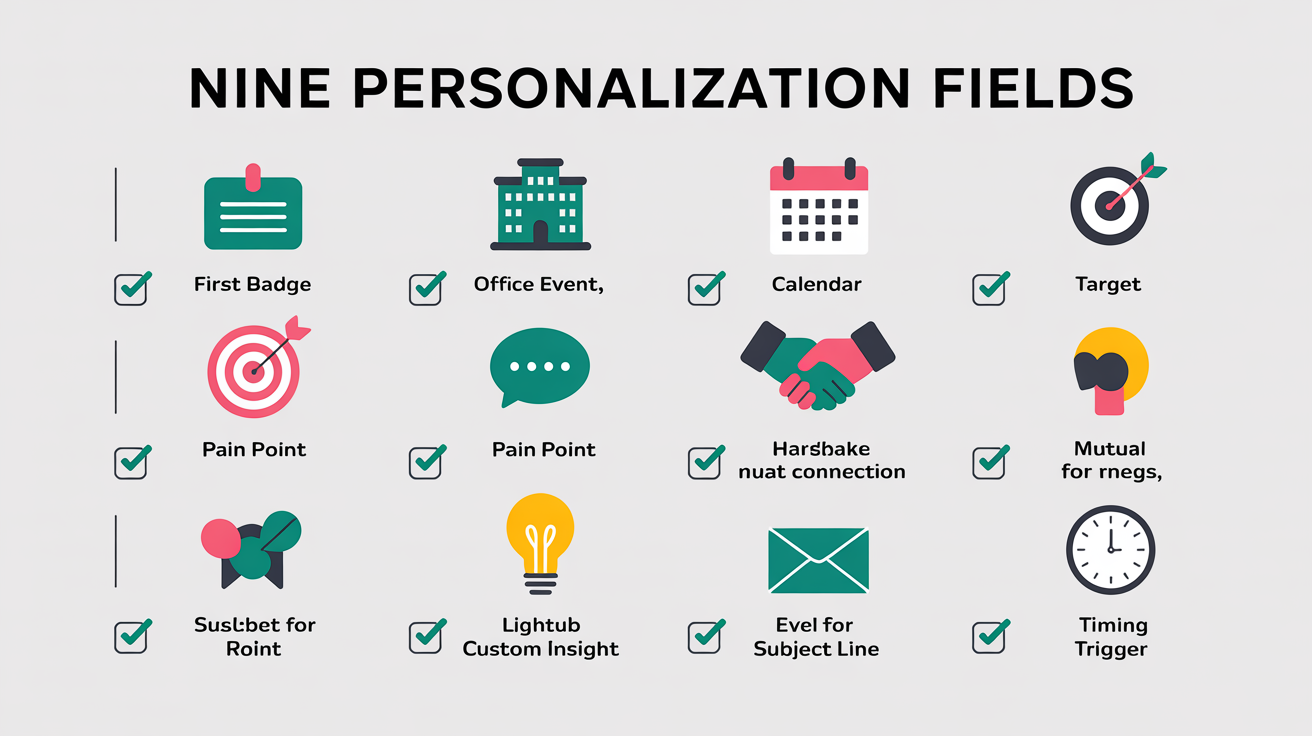
The Nine Personalization Fields That Make Or Break Your Cold Outreach
The first sentence - the hook - decides your fate. Generic opening? You’re ignored. Reference a trigger only they recognize, and reply rates can jump 10x. Skip this, and the rest is wasted effort.
Signal-Based Triggers
- Reference a Recent Company-Specific Event. Mention a funding round, product launch, award, or recent press. This proves you aren’t blasting templates. Use tools like Clay or Salesforge to pull this data at scale. Timely, relevant signals double reply rates compared to generic outreach.
- Call Out a Role Change or Promotion. Spot a new title or department move? Reference it directly (“Saw you just took over GTM at...”). People are more receptive after a job change. Trigger alerts with LinkedIn Sales Navigator or Clearbit - catch these within the first week for best response.
- Reference Content They Created or Shared. Mention a LinkedIn post, podcast, or event where they contributed. Hard to fake. Shows real research. AI tools surface recent activity fast. Personalize a sentence to this point - shortcut to “you did your homework.”
Role and Context Fields
- Tailor by Specific Job Title or Function. Speak to their exact role (“Engineering Manager” vs. “Tech Lead”). Responsibilities shift with seniority and function. Tight list segments and dynamic templates for each title matter. Prospects ignore pitches sent to “everyone.”
- Industry or Vertical Context. Point to trends, regulations, or pain points unique to their sector. Skip vague claims - use specifics (“Fintech compliance costs” or “remote onboarding in healthcare”). Add this context to your merge fields. It signals insider knowledge and screens out low-fit leads.
- Geography or Market Expansion. Reference recent moves into new regions (“Congrats on opening your Berlin office”). Expansion triggers new challenges - localization, hiring, compliance. Use location data in custom fields, monitor press releases. Aligned solutions to current priorities boost replies.
Social Proof and Mutual Connections
- Name a Relevant Mutual Connection or Customer. Mention a shared LinkedIn contact, event, or similar client. Fast trust builder. Cross-check your CRM or sales intelligence tool. Only use high-value ties - don’t force it.
- Showcase Relevant Social Proof. Reference a recognizable customer win or case study (“We helped Acme Corp solve X...”). For mid-market and enterprise, this builds credibility. Connect the proof to their pain, not just a logo drop. Use merge fields only if references are segment-specific - don’t name-drop at random.
Pain and Value Fields
- Surface a Pain Point Unique to Their Situation. Quantify or name a challenge (“Teams like yours waste 10+ hours weekly on manual reporting”). Shows you understand their world. Makes your outreach feel consultative, not transactional. Use data signals or industry reports to pre-fill pain points by segment. Get this wrong, your pitch flops - build use-case libraries and test.
Short on time? Prioritize the first-line hook (trigger or content), role-specific targeting, and pain point fields. These drive the biggest jump in replies. Add mutual connections and social proof for higher-value or hard-to-crack accounts.
Set up research workflows and dynamic templates to manage these fields across 50+ recipients. For step-by-step systems, see how to scale personalized outreach efficiently and benchmark tactics in high-performing personalization frameworks. For segmenting by role or account, check how we research and prioritize companies to find hidden hiring opportunities and tools and templates for scaling outreach. Build this into your workflow. Stop guessing - start executing with precision.
Turning a Checklist Into a Repeatable System: Optimizing, Testing, and Refining Your Process
Stop guessing - use your numbers. After every campaign, pull open and reply rates. Zero in on what’s moving the needle. Change one thing at a time. That’s how you find real wins without blowing up your whole process.
- Split test subject lines and first-line hooks. Run at least 100 sends per variation for data you can trust.
- Check reply, bounce, and opt-out rates every week. Sudden drops? That’s usually fatigue or aiming at the wrong segment. Pause and fix it fast.
- Sort contacts by segment and pain point. Tweak fields for each group, then track which segments respond and why.
- Scrub your lists monthly - clear out bounces, check domains, and flag spam traps before deliverability tanks.
- Review templates every 30 days. Refresh hooks. Rotate case studies. Watch for stale copy - update before replies dry up.
Once a quarter - or after any big campaign - schedule a maintenance sprint. Treat your checklist as a living system: update personalization fields, shift outreach angles, cut what’s dragging performance. Teams that build habits around scaling personalized outreach efficiently and audit reply patterns see reply rates jump - sometimes in weeks, not months. Want advanced systems or troubleshooting? Dig into high-performing personalization frameworks and see testing tactics in how we measure outreach performance and run tests that improve reply rates. Consistency wins - run the playbook, read the data, and keep moving.
Nail These Nine Fields and Leave Generic Outreach Behind - For Good
Personalize every field, and your message gets replies instead of fast deletes. This checklist isn’t about pretty outreach. It’s about emails that land, get read, and trigger real conversations. Hit all nine fields, and you stop being ignored. You’re the one who gets the meeting.
Skip research, and you blend into the noise. Five focused minutes per target flips cold intros into warm starts - every time. Templated outreach dies fast. If you can’t find something unique about the company or person, you’re just adding to their clutter. Need a process? Use our research and prioritization system - it actually moves the needle.
This checklist is your shortcut to a playbook that scales with you. Stick to it, and your process compounds. It iterates, sharpens, and keeps you out of the spam folder. Want to scale results? See our guide on repeatable outreach and proactive job search moves. Don’t chase volume. Chase relevance. That’s what wins you a seat at the table.
Build an Unfair Advantage Proactively and Update Your Job Search Strategy to Today's Job Market.
$197
Learn MoreFrequently Asked Questions
What's the simplest A/B test setup to determine which personalization signals (company news, recent hire, mutual connection) actually increase reply rates?
Split your prospect list randomly into four equal arms: Company-news personalization, Recent-hire personalization, Mutual-connection personalization, and a Generic control. Send identical subject style, body length, CTA and cadence (one initial email + one follow-up after 3–4 days), but include only the single assigned personalization hook in each variant; measure raw reply rate (and qualified-reply rate) as the primary metric. Aim for ~200 prospects per arm to detect a ~5–8 percentage-point lift with ~80% power (use ≥100 if constrained), then compare each treatment to control with two-proportion z-tests or a chi-square and apply a Bonferroni correction (alpha/3) for the three comparisons.
What outreach cadence and send times work best for personalized emails to maximize replies without irritating prospects?
One highly personalized opener plus one follow-up (two touches total), with the follow-up 4–7 days after the first - then stop to avoid irritating prospects. Send on Tue–Thu between ~9:00 a.m.–12:00 p.m. local time (or early 6:00–8:00 a.m. to land at the top of the inbox) and avoid evenings, weekends and rapid successive messages. Expect modest reply rates (B2B cold email ~3–5% typical, 5–10% solid, 15%+ excellent; LinkedIn ~6–7% average, 10%+ excellent), so prioritize deep personalization and trigger-event relevance to lift responses.
How can I use public signals for personalization while staying compliant with GDPR, CCPA and other privacy rules?
Use only public or non‑identifying signals (cohorts, hashed IDs, on‑device context) and avoid combining them with special‑category data or automated high‑risk profiling without safeguards. Establish and document a lawful basis - obtain explicit opt‑in where required (ePrivacy/GDPR for consumer email) or perform a Legitimate Interests Assessment for B2B use - and keep consent logs as GDPR requires. Be transparent in your privacy policy about what you collect and why, provide CCPA/CPRA “Do Not Sell My Info” and other opt‑out mechanisms, honor access/deletion/portability requests, limit retention, secure data (encryption/processor agreements/SCCs for transfers), and run a DPIA when profiling creates elevated risk.
What technical deliverability steps (SPF/DKIM/DMARC, domain warm-up, sending limits) must I follow so personalized campaigns don't land in spam?
Authenticate your sending domain with SPF (include all sending IPs), DKIM (published DNS keys and signing), and DMARC (start p=none with rua reports, then move to quarantine/reject once stable), and ensure each sending IP has a valid PTR/forward DNS and messages include a valid Message‑ID and one‑click unsubscribe. Warm up every new domain and mailbox over 2–3 weeks by gradually ramping volume (common practice: start ≈5 emails/day per mailbox and scale toward ~30/day per mailbox), use dedicated sending domains/mailboxes to spread load, and stagger campaigns. Maintain strict list hygiene (remove bounces, verify addresses), keep spam complaints under ~0.3%, monitor SPF/DKIM/DMARC reports and engagement, and throttle/limit scaling (note providers require strict auth for high volumes - e.g., Gmail/Yahoo rules for>5,000/day).
If I accidentally use incorrect personalization (wrong title, misspelled name), what's the best way to recover credibility and continue the conversation?
Briefly apologize once, correct the name/title, and move on without over‑explaining. Then pivot to a concise, specific benefit tied to their business (for example: “This can significantly cut down your monthly reporting time”), keep a calm professional tone, and close with a question such as “Does that align with what you’re looking to achieve?”
Which additional KPIs should I track besides reply rate to measure the real ROI of personalization (meetings booked, conversion, reply quality, bounce/unsubscribe rates)?
Track these KPIs: meetings booked; positive‑reply rate (replies that advance the conversation); conversion of positive replies → booked meetings; meeting show rate; opportunity creation and pipeline value; win rate and average deal size; sales‑cycle length; CTR/CTA clicks and open rate; bounce, unsubscribe and spam complaint rates and inbox placement; cost per booked meeting and revenue per campaign; and response velocity (time‑to‑first‑reply). Benchmarks to use: aim for 40–60% conversion of positive replies → booked meetings, 75–85% show rates for elite teams, and use reply‑rate goals (e.g., a 5% baseline up to ~19% in top cases) to orient tests. Run systematic A/B tests one variable at a time with at least 100 prospects per variation and always measure downstream outcomes (bookings, pipeline and revenue) because opens or total replies can mislead about true ROI.
When resources are limited, how should I prioritize which accounts, industries, or roles to personalize first for the biggest impact?
Prioritize roles/industries where you can demonstrate measurable 90-day wins (e.g., automating reporting, improving forecast accuracy, accelerating monthly close) and where you already have recruiter or network leverage - those produce the fastest hires and strongest credibility. Focus on 1–2 segments using the 40/40/20 fit model (company culture + your strengths + job level), craft two proof stories, favor 10 well-researched personalized outreaches over 100 generic ones, and track conversion KPIs to adapt weekly.
Luis Gamardo built a modern job search framework for a broken recruiting system. His approach teaches how to send cold emails at every stage of the hiring process, so qualified candidates can get noticed by the right people at the right time - including before jobs are even posted.
Sources
- mailpool.ai
- skrapp.io
- outreach.io
- sendr.ai
- zaphyrpro.com
- sendr.ai
- growbots.com
- generect.com
- growbots.com
- decisionfoundry.com
- salescaptain.io
- outboundly.ai
- prospeo.io
- upwork.com
- oppora.ai
- copper.com
- ghosh.com
- instantly.ai
- influencer-hero.com
- outreach.io
- saleshandy.com
- reachgiant.com
- close.com
- coldemailgenerators.com
- isazeni.com
- mailshake.com
- saleshive.com
- aisdr.com
- herohunt.ai
- mailforge.ai
- sendmails.io
- b2brocket.ai
- expandi.io
- linkedsavvy.com
- warmforge.ai
- sujanpatel.com
- autobound.ai
- nethunt.com
- artemisleads.com
- leadcrm.io
- primeforge.ai
- anyleads.com
- getboomerang.ai
- leadsatscale.com
- creativeperspectivesmanagement.com
- mailtrap.io
- outreach.io
- streak.com
- hunter.io


