
How We Research And Prioritize Companies To Find Hidden Hiring Opportunities
Most hiring happens off public job boards - companies promote internally, hire referrals, or fill roles before posting - so waiting for posted openings means competing late. Company targeting flips the process by profiling high-fit employers, tracking growth/hiring signals, and using data-driven, account-based outreach to reach decision-makers early, increasing response rates and hiring odds.
Build an Unfair Advantage Proactively and Update Your Job Search Strategy to Today's Job Market.
$197
Learn MoreWhy Company Targeting Beats the Traditional Job Search (By the Numbers)
Most jobs never reach a public job board. If you’re chasing only posted openings, you’re competing for scraps - usually after sharper candidates already started conversations.
The hidden job market isn’t a myth. Companies promote internally, lean on referrals, or hire candidates who reach out directly. Posting a job is slow, expensive, and floods employers with generic applications. By the time a role appears online, hiring managers may have a shortlist from their networks or earlier outreach. Sit back, and you’re already behind.
Company targeting flips the process. You reach teams before a role is public. You get in front of decision-makers while others wait for job alerts. This guide shows how to map your target list, research companies, and spot signals that hiring is about to happen. You’ll see the data behind proactive outreach rates and get step-by-step tactics for building a smarter job search. Find out what works, what doesn’t, and how to move first - so you’re always ahead of the curve.
How Modern Job Seekers Identify and Prioritize Target Companies
Top job seekers treat company targeting as a system. It starts with clear profiling, uses market signals, and relies on tech-driven research. If you want strong response rates, you need a method - build your list, then prioritize with intent.
Ideal Company Profiling
Define what “high fit” actually means for you. Skip the default to big names. Instead, profile by industry, company size, growth stage, leadership style, and where your skills meet their actual needs. Sharper profiles cut wasted effort. For a step-by-step process, see this beginner’s guide to company targeting.
Interpreting Growth and Hiring Signals
Timing beats volume. Watch for funding news, product launches, key hires, or sudden team growth. These moves often point to fresh hiring needs - sometimes before job postings appear. Spotting these signals means you reach out before the crowd. For specifics, check seven key signals that a company is about to hire.
Using Tools and Data to Build Your List
LinkedIn alone won’t cut it. Use enrichment tools, contact databases, AI scrapers, and Boolean search to find the right opportunities. Combine public data with advanced filters - think tech stack, market share, or stated growth targets. Want to see a full research workflow? Start with the 12-point research checklist.
Prioritizing and Ranking Your Target Companies
Once your list is built, rank by fit, urgency, and access. Focus your outreach on the top tier - the companies with the best alignment and strongest activity signals. Spreading yourself thin kills reply rates. Use a tested framework to organize and schedule your outreach with this guide to prioritizing target companies.
Account-Based and Competitor Research
Account-based outreach isn’t just for sales teams. Treat each company as a unique market - personalized, research-backed, multi-threaded. You’ll reach decision makers faster and avoid generic gatekeeping. For the basics, see account-based job search explained.
Key Mistakes and Calibration Data
Most job seekers waste effort chasing prestige or blasting generic outreach. Avoid the biggest pitfalls by reading common targeting mistakes and how to fix them. Curious what works? Check real numbers on reply rates, warm intros, and proactive outreach in the latest outreach response data.
Your results depend on how tight your system is - not how many companies you chase. Need the full process? Study the proactive outreach playbook.
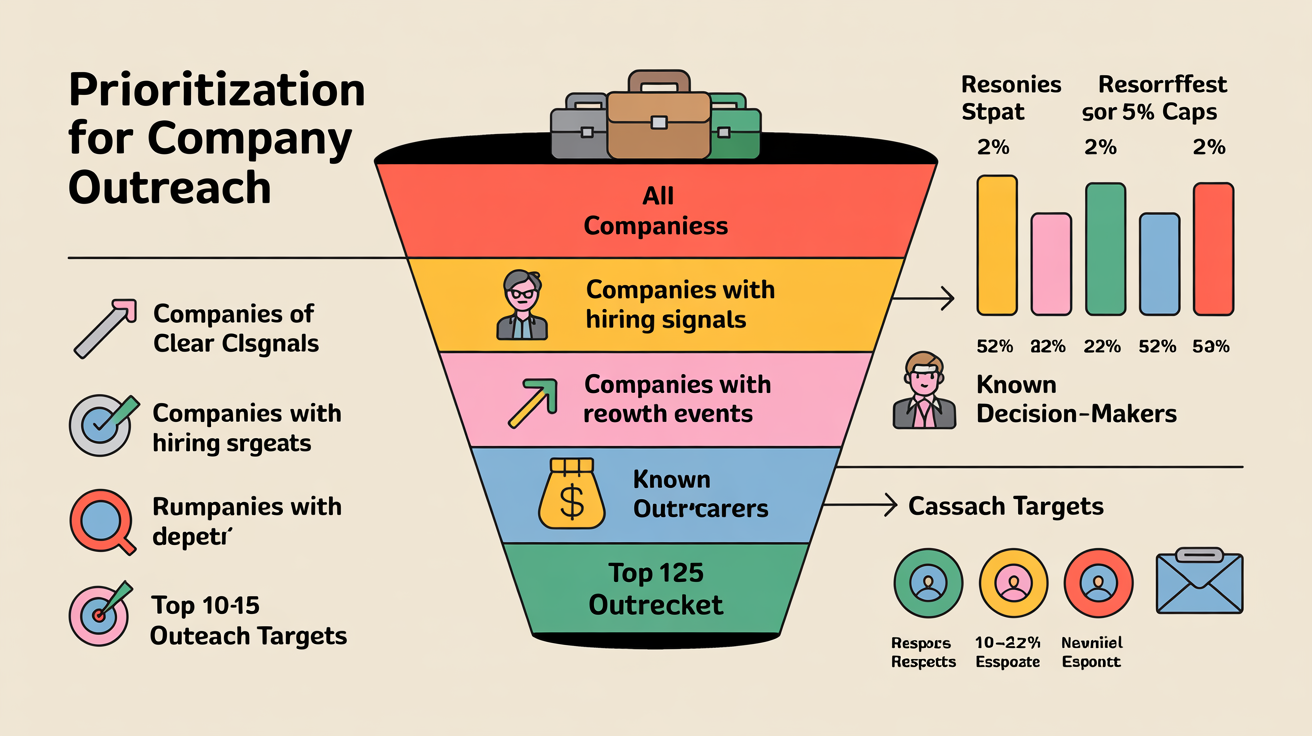
Tactical Choices: What Matters When Prioritizing Companies for Cold Outreach
Pick one: chase volume or chase relevance. Mass outreach gets ignored. Tight targeting gets replies. Top performers build a smaller, sharper list so every message lands with intent.
Volume vs. Fit: Quality Always Wins
Every cold emailer faces the scale-versus-fit tradeoff. Bigger lists feel productive, but reply rates tank as you widen your scope. The data is clear: targeted campaigns pull 8–12% reply rates, while mass blasts rarely cross 5%. Focus on companies showing hiring signals, not just big brands. Use beginner targeting methods to get specific, then add advanced filters from the 12-point research checklist.
How Deep Should Your Research Go?
Ten minutes of research beats hours of copy-paste. Personalization only works if you know the triggers - funding, hiring, launches. Let buying signals lead. Use these seven triggers to avoid dead-end companies. For a full breakdown of shallow vs. deep research, check the smart research tutorial.
Personalization vs. Scale: Balancing Automation
You don’t have to pick between scale and relevance. The best outreach blends frameworks with real context. Short, specific messages referencing recent events drive replies. Want to scale without getting generic? See scalable personalization in outreach for tactics.
Timing and Segmentation: Hitting Companies at the Right Moment
Even perfect emails flop if you hit the wrong persona or bad timing. Right person, right time. Segment by role, growth stage, or trigger event to boost your odds. For real-world response data, see the reply rate benchmarks and use this prioritization guide to plan your segments.
Tradeoffs: Prestige or Opportunity? Speed or Depth?
Big-name companies get flooded with outreach - odds are low. Smaller, lesser-known firms respond faster and often take meetings. Decide: chase brand names, or maximize your odds with high-fit companies. For a breakdown of this tradeoff and mistakes to avoid, check common targeting mistakes in outreach.
Build a Repeatable System, Not a One-Off Blitz
High reply rates come from process, not luck. Use a proven framework from the proactive outreach playbook. Account-based research and multi-threading cut through noise and avoid generic gatekeepers - see account-based job search strategies for examples.
Common Pitfalls: Where Targeting and Company Research Break Down
Generic outreach gets you ignored. Sending the same message to companies that aren’t hiring, or jumping in after a job goes public, wastes your effort. The real problem isn’t lack of hustle - it’s lack of strategy. Most job seekers blend in, sinking months of work under missed signals and shallow research.
- Chasing public job ads or top-company lists instead of tracking company-specific signals - you disappear into a flood of applicants, and replies dry up fast.
- Copy-pasting your message to every contact, skipping segmentation and context (beginner's targeting guide) - instant delete.
- Ignoring red flags like hiring freezes, layoffs, or high churn - double-check with the research checklist before you reach out.
- Missing what matters to decision makers - see the breakdown in mid-career targeting mistakes.
- Targeting too few companies or skipping follow-ups - outreach is a numbers game. High volume and systematic follow-up drive results (response rate benchmarks).
Each mistake costs you - wasted hours, reputation risk, or missing hidden roles. The solution: treat outreach as a process, not a one-shot blast. Start with the proactive search playbook and use smarter research tactics to avoid dead ends. Run your plan through the company targeting checklist before sending. For a breakdown of what can go wrong (with fixes), see the detailed analysis linked above.
Build Your List, Test Your System, and Outpace the Competition
Start with the companies, not the jobs. Use the 12-point checklist and target only organizations with real hiring intent that fit your goals. If you’re building your first list, don’t guess - work through the beginner's targeting guide and spot patterns most job seekers never see. That’s how you skip the line and start real conversations before roles even go live.
Your next step depends on where you’re stuck. Need help filtering noise? Use key company signals to focus your search. Want to narrow a shortlist? The company buyer's guide shows how to stack-rank by upside. Want data? See how reply rates shift by channel and follow-up in the full outreach stats roundup. Still running into dead ends after the basics? Avoid common mid-career targeting mistakes that can kill momentum early.
Ready for the full system? Walk through the proactive search playbook and see how research, signals, and disciplined follow-up tilt the odds. One Cold Email is built for people who want hidden roles, turn outreach into interviews, and build a real edge over the average applicant. Pick your situation, use the links above, move first. Outcomes shift fast when you stop playing defense.
Frequently Asked Questions
How do I find verified contact information for hiring managers or team leads at a target company?
Search the company’s LinkedIn People tab and its About/Team/Careers pages to identify the hiring manager or team lead, then use email-finder/domain-search tools like Hunter.io, Clearbit/Apollo, Voila Norbert, RocketReach or Google advanced operators (e.g., site:company.com "[email protected]" or "first.last") to locate their address. Confirm the company-wide email pattern with Hunter’s Domain Search or by spotting employee emails, then verify addresses with an SMTP/email verifier (Hunter verifier, NeverBounce, Mailgun) or by sending a brief LinkedIn InMail or calling the company switchboard to confirm. Always personalize your first outreach with one concrete reference to their work and a clear value-oriented ask to improve response rates.
What is an effective outreach and follow-up cadence (timing and number of touchpoints) to maximize responses without being pushy?
Use 8–13 touchpoints across email, phone and LinkedIn over 4–8 weeks: email Day 0, follow-ups on Days 3, 7 and 14; LinkedIn connection + message on Days 5 and 12; a phone call around Day 10; a value-add email Day 21 and a polite break-up on Day 28. Make every touch bring new value or a single clear next step (no generic “bump”), avoid rapid-fire or annoyed language, and stop after the break-up - research notes persistence with varied, value-driven touches (up to ~13) increases replies while typical cold email reply rates are 3–5% (5–10% is solid).
Which tools or CRMs do job seekers use to organize targeted outreach, track responses, and automate follow-ups?
Job seekers commonly use lightweight CRMs and outreach tools such as HubSpot CRM, Streak (Gmail), Pipedrive, Airtable or Notion to build pipelines, track responses, and schedule next steps. Dedicated job-search trackers like Huntr, Teal and JibberJobber provide kanban boards, saved postings and application timelines tailored to candidates. For automated outreach and follow-ups they use mail-merge/sequence tools (Mailshake, Lemlist, GMass, Mixmax, Reply.io) plus enrichment/finding tools (Hunter.io, Lusha, LinkedIn Sales Navigator) and automation platforms (Zapier/Make) to connect systems and trigger follow-ups.
How many companies should I have on my active target list at once to balance personalization with outreach volume?
Aim for tiered lists: 5–15 companies for one‑to‑one (deep ABM), 15–50 for one‑to‑few (moderate personalization), and 50–200+ for one‑to‑many (scaled outreach). Practically, most SDRs should keep an active list of ~30–50 companies to allow 3–5 personalized touches per account each week, while enterprise sellers should limit active accounts to 5–10 to enable thorough research, multi‑channel outreach, and stakeholder mapping.
How can I personalize outreach messages at scale so they feel genuine but remain efficient?
Segment target personas and use short templates enriched with one-to-two personalized facts (recent post, product launch, mutual contact) pulled by automated data enrichment - automate sends and follow-ups but reserve manual touches for high-value accounts. Add behavioral triggers and dynamic fields (name, company, recent event) and A/B test copy and cadence - advanced personalization can lift response rates from ~7% to ~17%. Guard against over-automation (see Amazon’s 2017 baby-registry email error) by spot-checking messages, limiting personalization to verifiable details, and routing exceptions for human review.
How should I tailor my résumé and LinkedIn profile when reaching out proactively for roles that aren’t posted yet?
Mirror the company’s language and pack both documents with 3–5 role-specific keywords (plus 1–2 alternate job titles) while leading with 2–3 quantified achievements (%, $ impact, time saved) so your résumé passes ATS and the top lines immediately demonstrate value to a hiring manager. On LinkedIn use a keyword-rich headline (up to 220 characters), a 2–3 sentence About with your value proposition plus 2 metrics, feature 1–3 projects or case studies, and in outreach cite a specific problem you can solve and request a 15‑minute chat (limit follow-ups to two).
What metrics should I track to measure the effectiveness and ROI of a company-targeted job search (e.g., response rate, interviews, offers)?
Track: response rate (responses/apps), interview rate (interviews/apps), offer rate (offers/apps), conversion ratios (application→interview, interview→offer), time-to-first-response and time-to-offer, platform- and timing-segmented rates, number of outreach touches/contacts engaged, and ROI metrics (hours spent per offer and compensation-per-hour invested). Compute each as simple ratios and segment by platform/timing because timing matters - applications within 48 hours see ~30% higher response rates and by day four applicants are ~8× less likely to get an interview; Indeed yields ~20–25% response rates vs LinkedIn ~3–13% and company sites ~2–5%. For ROI, record total hours and expected annual compensation per offer to calculate time-per-offer and compensation-per-hour (note typical job seekers may need ~294 applications, and well-timed applications can raise interview rates from ~3% to ~13%).
Luis Gamardo built a modern job search framework for a broken recruiting system. His approach teaches how to send cold emails at every stage of the hiring process, so qualified candidates can get noticed by the right people at the right time - including before jobs are even posted.
Sources
- quora.com
- eddy.com
- askamanager.org
- bishopco.net
- hubspot.com
- reddit.com
- nescoresource.com
- quora.com
- quora.com
- expandi.io
- proalt.com
- reddit.com
- quora.com
- workplace.stackexchange.com
- apollo.io
- job-hunt.org
- quora.com
- backdoorhires.com
- rampd.co
- quora.com
- aihr.com
- warriorforum.com
- finance.yahoo.com
- jobs.citizensbank.com
- clearbit.com
- recruitmint.com
- monday.com
- toplineresults.com
- warmforge.ai
- belkins.io
- instantly.ai
- trykondo.com
- topresume.com
- b2brocket.ai
- zanatemarketing.com
- sendr.ai
- retreva.com
- scale.jobs
- forbes.com
- uk.indeed.com
- superhumanprospecting.com
- growthmodels.co
- blog.hubspot.com
- salesmate.io
- mailtrap.io
- getboomerang.ai
- tealhq.com
- leadfeeder.com
- nimble.com
- vault.com
- instantly.ai
- hypergen.io
- reachgiant.com
- ppai.org
- saleshandy.com
- community.hubspot.com
- prospeo.io
- sopro.io
- salesmotion.io
- sendr.ai
- phoneburner.com
- saleshive.com
- salescaptain.io
- growbots.com
- growbots.com
- aisdr.com
- isazeni.com
- freelancecake.com
- trykondo.com
- hubsell.com
- toptechnewsletter.com
- martal.ca
- expandi.io
- recruitbpm.com
- bookyourdata.com
- altisrecruitment.com
- scale.jobs
- herohunt.ai
- engageforsuccess.org
- fyxer.com
- levelingup.com
- scale.jobs
- support.outreach.io
- skillhub.com
- joinvalley.co
- zackarnold.com
- forbes.com
- lobehub.com
- partnershipemployment.com
- instantly.ai
- mailreach.co
- trykondo.com
- resufit.com
- quora.com
- medium.com
- superstaff.com
- quora.com
- boyden.com
- gem.com
- findem.ai
- gem.com
- upwork.com
- mytexasfuture.org
- fittedforwork.org
- pursuenetworking.com
- tealhq.com
- quizlet.com
- quora.com
- indeed.com
- metaview.ai
- atzcrm.com
- remote100k.com
- growleady.io
- resources.workable.com
- intervue.io
- nicksingh.com
- onepagecrm.com
- lampmaa22.medium.com
- careerlaunchpad.io
- saleshandy.com
- careervillage.org
- careershifters.org
- michaelpage.com
- ca.indeed.com


