
5 Targeting Mistakes Mid-Career Candidates Make (And How To Fix Them)
Nearly 70% of mid‑career job seekers target the wrong people or companies, driving reply rates below 6% (often 1–5%) while correct targeting delivers up to 4× more responses and interviews. The critical fix is precision: segment your list, target hiring managers or team leads (not generic HR inboxes), and tailor messages to company type, role, or recent activity to preserve prospects and boost replies.
Build an Unfair Advantage Proactively and Update Your Job Search Strategy to Today's Job Market.
$197
Learn MoreWhy Targeting Mistakes Tank Mid-Career Job Searches (And The Hidden Cost Behind the Stats)
Nearly 70% of mid-career job seekers blow their odds by targeting the wrong people or companies. That drops their reply rates below 6% - a level that all but guarantees wasted effort. Meanwhile, those who get targeting right see up to 4X more responses and interviews. The cost? Weeks lost, best prospects burned, and nothing to show for it.
Precision isn’t a nice-to-have. It’s the difference between hearing back and hearing nothing. In a crowded market, poor targeting doesn’t just slow you down - it kills your momentum. Guessing who to contact means you get ignored by decision-makers and spend hours chasing dead-end leads. The data is blunt: top performers aren’t lucky, they’re disciplined. List quality, message-market fit, and tight research drive results. Volume alone just digs the hole deeper.
This guide exposes the most common targeting traps that quietly wreck mid-career searches. You’ll see how a sloppy target list destroys your odds, how to spot these silent killers, and the tactical fixes that actually work. Start with proactive job search fundamentals and use resources like finding the right hiring decision-makers to sharpen your aim. For details on our research process and the benchmarks behind these numbers, see how we research and prioritize.
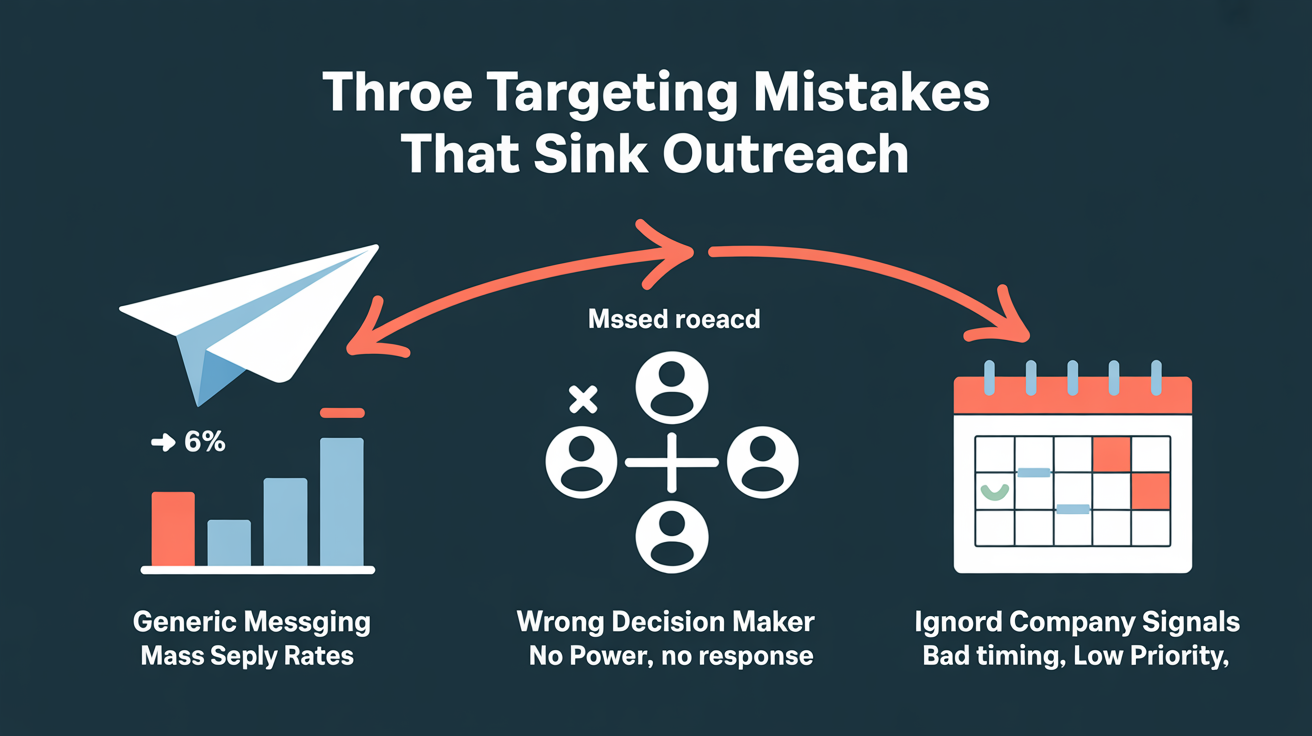
Targeting Traps: The First Three Mistakes Sabotaging Your Outreach (And How To Unwind Them)
Blanketing a massive company list with generic messages tanks your reply rate. Mid-career job seekers do this all the time - then wonder why fewer than 5% of their emails get any response. Below: the three targeting mistakes that gut your outreach before you even start, and how to fix each one.
Mistake #1: Broad, Generic Outreach (The “Spray and Pray” Problem)
Same template. Huge, unfiltered list. That’s the pattern that fails. People chase speed, but all it does is flag you as noise. Reply rates drop to 1-5% when outreach isn’t tailored by company type or role - industry data confirms it. Recipients tune you out or hit spam.
The fix: segment before you send. Sort your list by role, company size, and industry. Then inject details - reference a recent funding round, a sector-specific challenge, or a LinkedIn post from their team. Use a modular message structure so you can personalize at scale without rewriting everything. For tactical steps, see how to scale personalized outreach without losing the human touch.
Mistake #2: Pitching The Wrong Decision Makers
Most emails land in HR or generic inboxes. Dead end. Real decisions? Those happen with managers, team leads, or department heads - not the gatekeepers who filter cold emails daily.
- Pinpoint decision makers using LinkedIn Sales Navigator. Filter by team, title, and reporting lines to find people with hiring power.
- Check their recent activity. Anyone talking about team growth, open roles, or business challenges in the last 90 days is a strong lead.
- Verify emails with data enrichment tools. Cross-check with public sources before you hit send.
- Reference something specific - recent work, a business milestone - to show you did your research.
Want a deeper process? Use how to find the right hiring decision-makers at companies you want to join to avoid black hole inboxes and wasted effort.
Mistake #3: Ignoring Company Intent and Timing Signals
Random outreach with zero context rarely works. Most job seekers skip signals like new C-suite hires or fresh VC funding. That lack of timing means your pitch shows up cold and gets ignored. These signals are public, but the research feels slow - so people guess. And miss.
The fix: time your outreach to visible triggers. Scan news, press releases, or executive LinkedIn updates for signs - funding rounds, product launches, layoffs. If a company announces an expansion, reference that directly in your subject and first line. It shows you’re tracking their moves. For a step-by-step approach, start with the 12-point candidate research checklist for high-converting outreach and see how we research and prioritize companies at the right moment.
Precision beats volume every time. For the full system, follow proactive job search fundamentals to build lists that convert and avoid these silent killers.
Advanced Targeting Pitfalls: The Subtle Errors That Keep You Invisible
The advanced mistake that quietly wrecks most outreach? Single-channel dependency. If you’re stuck on just email or only LinkedIn, you’re not reaching enough decision-makers. Multichannel outreach isn’t hype - benchmarks show reply rates jump as much as 287% when candidates use more than one channel. Still, most people skip this step. So do plenty of B2B teams.
Mistake #4: Sticking to One Channel (and Tanking Your Reach)
Using only one outreach method means most of your target audience never sees you. Sending more emails doesn’t fix that. LinkedIn DMs alone won’t either. Email reply rates average 3–5%, while LinkedIn messages or InMail usually land between 7–25% depending on personalization. The biggest lift? Using both. Multichannel touchpoints get noticed, remembered, and answered.
Rotate channels. Use LinkedIn, email, even warm referrals or phone calls. Each channel hits a different segment. Track which personas show up where, then double down on the best mix. Need sequencing details? Our guide on how we research and prioritize target companies spells out what channel to use - and when.
Mistake #5: No A/B Testing or Data Tracking (Guessing, Not Improving)
Most outreach is a guessing game. One message, blasted everywhere, and hope for the best. No split tests, no tracking by segment, no learning - just noise. But every persona and style performs differently. If you’re not measuring, you’re stalling out. Top teams test and tweak weekly, not quarterly.
- Segment by function, seniority, or industry. Build targeted lists for each group.
- Test variables - subject line, first sentence, CTA style. Change one per test for clean results.
- Review response rates and meetings weekly. Waiting months wastes time and data.
- Document what works. Drop what flops. For details, see how we measure outreach performance and run tests that improve reply rates.
Mistake #6: Weak or Irrelevant Profiles (Sunk Before You Start)
Your LinkedIn profile gets checked - every time - after you reach out. If your headline’s bland or your summary misses the mark, even great messaging gets ignored. Default bios, irrelevant job history, random skills? That’s an instant mismatch. No replies, no second chance.
Reverse-engineer your profile from your audience’s perspective. Ditch “open to new opportunities.” Use a headline that speaks directly to the role or industry you want. Swap duties for impact. Use problem-solution stories. For a breakdown, see our proactive job search fundamentals. Example: aiming for SaaS sales? “Driving Pipeline Growth for B2B SaaS - Quota Surpassed 3 Years Running” beats “Experienced Sales Professional Open to Opportunities.”
Skip these advanced targeting traps and you’ll move faster. Multichannel outreach plus audience-focused branding - those are the levers. For specifics, check the 12-point candidate research checklist for high-converting outreach or see how to scale personalized outreach without losing the human touch. Outbound is a system. Not a lottery.
Build a No-Mistake Targeting System: Habits and Frameworks That Keep Your Outreach On Point
Momentum comes from process. Top performers treat targeting as a living system, not a one-time setup. They track, adapt, and sharpen every week - like elite sales teams do.
- Rebuild your ideal candidate or company profile monthly using real outreach data. Update lists based on actual replies and recent signals, not guesswork.
- Segment contacts by function, title, and engagement. Skip mass blasts - adjust your message and channel for each group. For the full workflow, see our prioritization guide.
- Automate a weekly metrics audit. Track connection rates, replies, conversions by channel. Use a dashboard or spreadsheet. Consistency beats fancy tools.
- Make signal-tracking and profile updates routine. Refresh your LinkedIn headline, summary, and recent activity every month. Audit against your audience’s needs - see our search fundamentals for tactics.
- Run campaign retros every Friday. Pick one test - subject, CTA, timing - to tweak next week. Log what gets traction. Scrap what doesn’t. For A/B testing, check our outreach measurement guide.
Stack these habits and your targeting gets sharper - fast. Small tweaks compound. Segmenting lists, tuning copy, and reviewing profiles drive better conversations and more replies. Treat outreach as a campaign you track and improve, not as a static list. To put this into action, use our 12-point research checklist or see scalable personalization tactics. The difference: systematic action beats guesswork.
The Clearest Lesson: Targeting Makes or Breaks Your Mid-Career Search
The biggest mistake mid-career candidates make? Treating targeting like a side detail. Sending more messages or chasing every open job won’t help if you’re aiming at the wrong audience. Low reply rates, missed interviews, dead-end conversations - nearly always the result of a fuzzy target list or sloppy segmentation. That’s where most strong candidates stall and never see it coming.
The fix is a tight, repeatable system - no shortcuts. Start with methodical research and keep your target list current. Run weekly audits on who responds, how often, and why. Use that data to double down on companies and decision-makers who actually fit, using strategies in proactive outreach playbooks. Personalization and segmentation aren’t optional. Track your follow-ups. Reply rates climb when you treat this like a process, not a numbers game.
Even a 1% improvement compounds fast. Candidates who work the system get noticed - and turn conversations into interviews. Next move: sharpen your outreach with proven routines like follow-up sequences for stalled leads and measure everything with weekly outreach audits. Targeting isn’t a checkbox. It’s the edge that cuts through noise and gets you offers.
Build an Unfair Advantage Proactively and Update Your Job Search Strategy to Today's Job Market.
$197
Learn MoreFrequently Asked Questions
How can I reliably identify the actual hiring manager or decision-maker at a company when job titles are vague or multiple people could be involved?
Target the person one level above the open role in the same function (e.g., Product Manager → Director of Product) by checking the job posting’s “reports to,” the company’s Team/About page, LinkedIn (Sales Navigator or Boolean searches), and recent org announcements. Verify names and email formats using Hunter.io, RocketReach, Clearbit or by matching a known employee’s email pattern ([email protected] or [email protected]), and if unclear call the company’s switchboard/HR to confirm who owns hiring for that role. If multiple stakeholders are likely, email the recruiter plus the department head (1–2 levels up) to ensure you reach the decision-makers.
What specific criteria should I use to prioritize which companies and open roles to contact first during a mid-career search?
Prioritize roles where your skills and outcomes match ≥70% of the listed requirements, the role is at your current level or one step below, and the compensation/seniority meets your target. Next rank companies by hiring velocity and access: companies that raised funding in the last 6 months or posted the opening within 30 days, teams with explicit headcount needs or small teams (<50 people) where you can reach the hiring manager, and where you have a warm intro. Score opportunities to decide order (example weights: skills match 40%, hiring velocity 20%, network access 20%, comp/seniority fit 10%, strategic upside/brand 10%).
What is a short, actionable checklist I can use to audit my target list for quality before I start outreach?
Checklist - tick each before you send: verify fit (investor thesis, recent portfolio moves, typical check size), confirm contact data (full name, current title, verified email, LinkedIn URL) and connection context (how you found them, mutuals). Clean and segment the list (remove duplicates, verify emails with a tool; aim bounce <2–3% and pause/clean if>5%), map outreach cadence with clear CTAs and follow-up plan. Record outreach history and personalization notes, then bench test performance (expect open 30–50%+, reply 8–15%, meetings 2–5%), A/B subject/CTA if metrics fall short.
Which affordable tools, LinkedIn features, or browser extensions are best for finding verified emails and decision‑makers’ contact details?
Use LinkedIn Sales Navigator (or Recruiter Lite) plus email‑finder extensions like Hunter, Snov.io, ContactOut or Lusha, and verify addresses with lemlist Email Checker or Hunter Verifier. Sales Navigator runs about $60–$100/month and Recruiter Lite ≈ $170/month; Hunter offers a free tier (≈25 searches/month) and paid plans, Snov.io and Apollo have free tiers and inexpensive paid plans with Chrome extensions, while ContactOut/Lusha work as high‑match LinkedIn extensions but use limited credits. Combine those with a free CRM (HubSpot) or CSV exports and always run SMTP/verification checks to reduce bounces.
How many outreach attempts and follow-ups per contact are reasonable before I stop pursuing a target?
Aim for 4–6 follow-ups (5–7 total touches including the initial outreach); returns typically diminish after that. Research shows 1 follow-up raises response ~21%, 2 follow-ups ~46%, and 3–4 follow-ups plateau around a 55–60% improvement, while RAIN Group notes 80% of sales require five follow-ups. Space cadence to match your cycle (e.g., 4 days for short cycles or 8–12 weeks for B2B); if still unresponsive after ~4–7 touches, move the lead to a 3–6 month nurture list.
What steps can I take to repair a damaged relationship or 'un-burn' a contact after sending a poorly targeted or generic message?
Send a one-line apology that owns the mistake, then immediately follow with a one-sentence, research-backed personalization (reference a specific signal or metric) and a clear, low-friction value offer or ask (e.g., share a relevant case study or propose two 15‑minute times). Keep it very short, use a soft “warning-shot” subject (e.g., “Haven’t seen you around lately”), follow up once after 7–10 days and then stop - don’t blow them up; timing and patience matter. If there’s no response, try indirect routes (comment on their posts, request a warm intro) - research-driven personalization avoids the 76% of messages that show no understanding and can boost ROI 10–30%.
How should I change my targeting approach when I’m switching industries, moving to a new city, or shifting seniority level?
Target adjacent industries where your transferable skills map clearly, reframe your resume/outreach around those skills and recent wins, get a mentor or reverse‑mentor in the new field, and close any narrow skill gaps with projects or short courses. For a city move, filter targets by local hiring footprint and comp expectations, prioritize warm referrals and local employee connections (LinkedIn 2nd‑degree, alumni) and tailor outreach to company initiatives; when shifting seniority, adjust role level/company stage and your positioning (mid: concrete achievements; senior: leadership/strategy; exec: vision/network). Run a 6–8 week test, double down on tactics that outperform (e.g., video outreach, referrals) and pivot if responses stay <≈5% or feedback repeatedly says you’re over‑ or under‑qualified.
Luis Gamardo built a modern job search framework for a broken recruiting system. His approach teaches how to send cold emails at every stage of the hiring process, so qualified candidates can get noticed by the right people at the right time - including before jobs are even posted.
Sources
- salescaptain.io
- herohunt.ai
- prospeo.io
- fishmanafnewsletter.com
- saleshive.com
- nutshell.com
- sendr.ai
- martal.ca
- bookyourdata.com
- community.hubspot.com
- zanatemarketing.com
- trykondo.com
- quora.com
- senseicopilot.com
- reddit.com
- infraforge.ai
- axterior.com
- askamanager.org
- warmforge.ai
- hubspot.com
- sopro.io
- belkins.io
- growbots.com
- b2brocket.ai
- primeforge.ai
- koncert.com
- payproglobal.com
- superhumanprospecting.com
- thescalelab.com
- mailtrap.io
- zaphyrpro.com
- arminsworld.medium.com
- mailforge.ai
- amplemarket.com
- hunter.io
- leadspicker.com
- leadsatscale.com
- salesmotion.io
- gem.com
- expandi.io
- sendr.ai
- saleshandy.com
- skrapp.io
- copilotai.com
- expandi.io
- cleverly.co
- upwork.com
- trykondo.com
- joinvalley.co
- isazeni.com
- donemaker.com
- artemisleads.com
- abstraktmg.com
- theroundpie.com
- herohunt.ai
- monday.com
- heyreach.io
- lockedinai.com
- ecp-careers.com
- toptechnewsletter.com
- brunel.net
- jobscan.co
- chiefjobs.com
- lobehub.com
- juicebox.ai
- jobtarget.com
- nureply.com
- perspect.ai
- additionsolutions.co.uk
- gem.com
- reachgiant.com
- aisdr.com
- onecoldemail.com
- zackarnold.com
- herohunt.ai
- resources.workable.com
- scale.jobs


