
Designing Follow-Up Sequences That Reclaim Lost Opportunities
Weak follow-up is the main reason strong candidates get ignored: research shows follow-up can boost response rates by up to 65.8%, and most replies arrive after the opener when others have already stopped. Use a multi-channel, multi-touch sequence - 3–5 distinct email/LinkedIn/phone touches over 10–14 days with varied, personalized content - to reliably recover attention and generate replies.
Build an Unfair Advantage Proactively and Update Your Job Search Strategy to Today's Job Market.
$197
Learn MoreWhy Most Opportunities Die: The Hidden Cost of Weak Follow-Up
Most job seekers drop off after one email. That’s where the majority lose out. Research shows follow-up can increase your response rate by up to 65.8%. Miss this step and you’re buried with everyone who gave up too soon. Over 80% of responses come after the first message. If you stop early, you’re not even in the running.
Weak follow-up isn’t a minor slip - it’s the main reason strong candidates get ignored. Hiring managers deal with a flood of emails daily. If you don’t return to the top of their inbox, you disappear. Cold outreach response rates hover under 5% on the first try. Consistent follow-up flips the odds. One email gets overlooked. A smart sequence puts you back in play.
This guide breaks down a system that actually gets replies. The proactive job search playbook transforms a single ignored message into a sequence that recovers lost ground. You’ll see how timing and cadence change the outcome, why message variety matters, and which follow-up mistakes kill your chances. Real numbers. Case studies. A step-by-step checklist so you never forget what works. You’ll walk away knowing exactly how to build a five-step sequence and how drip outreach keeps your search alive when others stall out. Want consistent interviews instead of silence? You’re in the right place.
The Modern Follow-Up Sequence: Multi-Channel, Multi-Touch, Maximum Impact
Single-channel outreach caps your results. Multi-channel beats it - every time. Email, LinkedIn, phone. Cycle through all three, and your reply rate climbs. Sequence matters: three to five distinct touches, spaced out, each with a new channel or angle. Do this well, and you engineer responses instead of hoping for them.
Single-Channel vs. Multi-Channel Sequences
Stick to email and you’re easy to ignore. Mix in LinkedIn and phone, and you show up wherever the hiring manager spends time - different inbox, different day, different mood. The right blend multiplies your odds of landing on their radar. For sequence models and timing, see the proactive job search playbook and what drip outreach is and how it works.
Touchpoint Cadence and Timing
Reply rates follow a pattern: few answers on the first touch, more on the second, and most on the third or fourth. The most effective sequences hit three touches in 10-14 days - first follow-up drops 2-3 days after your opener, then each gap widens. Early messages test for interest. Later ones catch shifting priorities. Details and sample schedules: beginner’s guide to follow-up timing.
Personalization and Message Variety
Repetition kills your chances. Each follow-up needs new context - a useful article, quick comment on their latest project, or a short story that proves you get their world. Not just “checking in.” Message variety signals effort and relevance. See what works in the four follow-up messages that re-engage busy hiring managers and the framework for writing short, confident messages.
Common Mistakes and Sequence Pacing
Most people blow it by sending daily pings or stopping after one nudge. Three or four spaced touches - each with a new angle - hit the sweet spot. Too frequent, and you’re spam. Too few, and you disappear. See which mistakes shut you down in why most follow-ups fail and get the data behind sequence length in our follow-up success rates roundup.
Systemizing for Consistency and Results
Consistency beats cleverness. Plan your sequence in advance, rotate channels, and track which step gets replies. Use the five-step follow-up checklist for structure, and see a real-world walkthrough in our five-step sequence tutorial. For proof this works, check the case study on converting follow-ups into meetings.
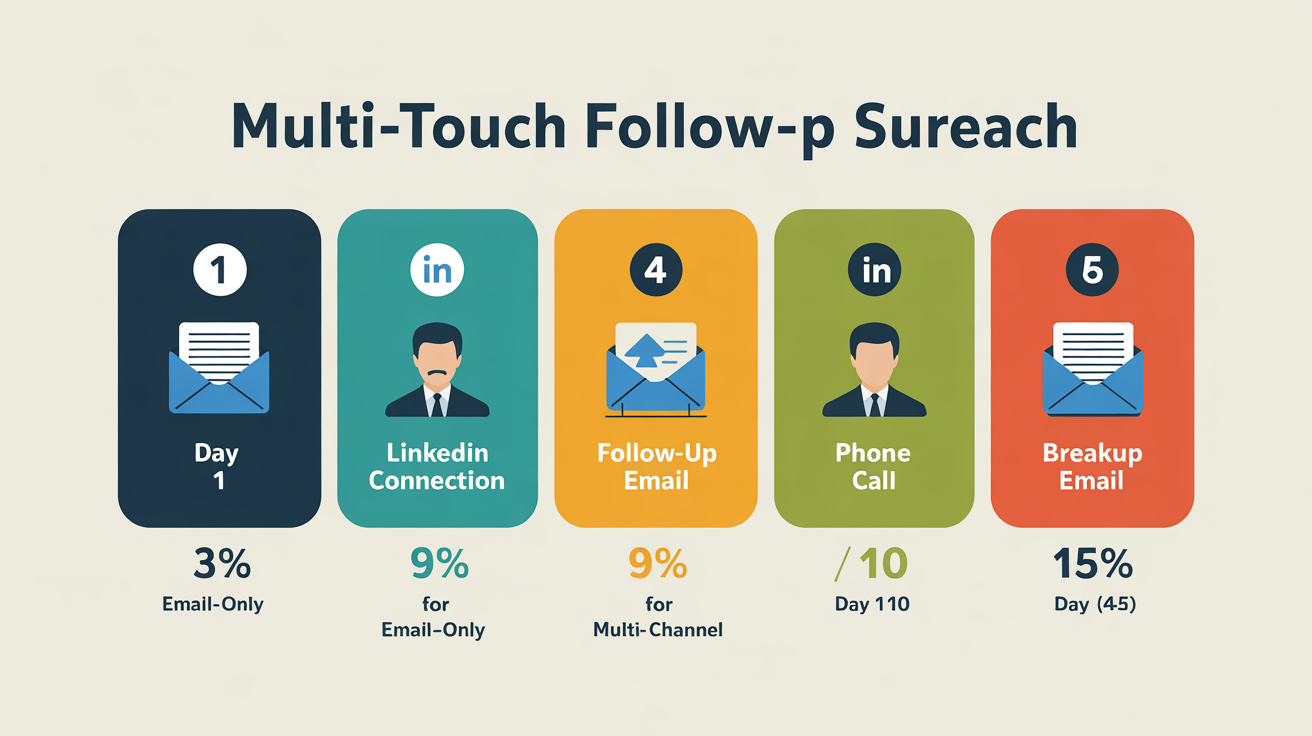
Sequencing Decisions That Make or Break Your Response Rate
The biggest mistake? Sending one message and quitting - or flooding daily follow-ups with no plan. Your results depend on sequence discipline: enough touches to get noticed, not so many you get filtered or flagged. Guesswork leaves you invisible. Data-backed planning gets you replies.
How Many Touches is Enough?
One message rarely works. Most replies show up after the third or fourth touch - not the first. Analysis of a thousand outreach campaigns shows reply rates climb with each well-timed follow-up, then stall or reverse after four or five. Push past that, and irritation becomes your new response. The data-backed range: three to five thoughtful touches, spaced for attention, not annoyance. Adjust your cadence using the detailed timing guide. See actual outreach data in conversion case studies.
Choosing and Mixing Your Channels
Email alone won’t cut it. If hiring managers ignore their inbox, you’re invisible. Add LinkedIn DMs or a quick phone call. Strong sequences mix channels. Each one brings tradeoffs: email is trackable, LinkedIn gets seen when inboxes pile up, calls break through but cost time. Compare channel performance in the multi-channel outreach breakdown. See how experienced job seekers build their own channel stacks in the proactive outreach playbook.
Value Per Message: What Do You Add?
“Just following up” is noise. Each message needs a reason to exist - share a relevant article, add an insight, tie back to what matters for them. Repeat yourself, and you’ll get ignored. Bring something new, and you signal you’re listening. For message templates, check the proven approaches that get replies. Want sharper scripts? Start with the concise communication framework.
Stopping, Switching, or Systemizing
More isn’t always better. If you’ve spaced out your messages, varied your content, and still get silence, stop - or shift to a new contact. Automation helps you stay consistent, but too much and you’ll sound robotic. Use the sequence checklist to decide when to pause or switch tactics. Need a step-by-step process? Follow the five-step follow-up tutorial.
Tracking, Testing, and Constant Iteration
If you’re not tracking what triggers replies, you’re guessing. The top job seekers test weekly: adjust timing, swap channels, tweak message content. Data - not hunches - drives their next move. For measurement tactics, see the outreach performance guide and spot common mistakes in why follow-ups fail. Consistent testing and adaptation - not brute force - separate average from standout.
The Seven Follow-Up Fails That Cost You Interviews
More messages won’t rescue a weak sequence. The real risk? You blend into the noise - ignored, archived, or flagged as annoying. If your follow-ups sound like everyone else’s, you kill your shot at a reply.
- Repetitive or generic messaging: If every follow-up repeats the same pitch or uses a tired template, your emails get deleted. See the sequence-killing mistakes in the follow-up failure breakdown.
- All-in on one channel: Relying on just email or LinkedIn cuts your odds. Multi-channel sequences work - see approaches in the proactive outreach playbook.
- Poor timing and frequency: Follow up too fast and you look desperate. Wait too long and you’re forgotten. Get specifics on spacing in timing your follow-ups.
- No new value per touch: “Just checking in” wastes inbox space. Every message needs to bring something fresh - insight, resource, or context. See examples in the value-first message types.
- Aggressive or abrupt closes: Breakup emails or guilt trips (“Why haven’t you replied?”) kill rapport fast. Spot the behaviors to avoid in the common sequence mistakes.
Miss these traps and your reply rates rise. Research shows 42% of positive responses happen after the first touch - if your sequence stays sharp and relevant. Want real stats on what works? Benchmarks live in the follow-up stats roundup, and see actual outreach results in case studies.
Guesswork gets you ghosted. Use the sequence checklist to know when to keep going, switch channels, or stop. For hands-on tactics, build out your process with the step-by-step sequence tutorial. Review and tweak your approach - learn how pros adjust timing and content in the drip outreach breakdown.
Take Action: Build Your Own High-Converting Follow-Up Sequence
If you want more interviews, start with a proven five-step follow-up sequence. Most replies don't come from the first email. In fact, 42% of positive responses show up after the second or third touch. Skip the guesswork - walk through the step-by-step sequence tutorial to build your foundation.
Need benchmarks on timing, spacing, and when to stop? Go straight to timing your follow-ups. Not getting replies? Pinpoint what’s stalling your outreach with the failure breakdown or check real-world sequence results to see what works. To sharpen your messaging, study the value-first message types. If you’re unsure how many touches get results, the data in the follow-up stats roundup has you covered. Want a checklist to know when to switch tactics or channels? The sequence checklist will keep you on track.
Ready to skip months of trial and error? Use the proven outreach playbook for step-by-step templates and data-backed strategies. Get organized, get systematic, and give yourself an edge most job seekers never find.
Frequently Asked Questions
What is the optimal spacing (in days) between follow-up touches for junior vs. senior roles or for different industries?
Junior/early-career: initial follow-up at 3–7 days, then every 7–10 days, wrapping the sequence in 4–6 weeks. Senior/executive: initial follow-up at 7–14 days, then every 14–21 days, stretching outreach over 8–14 weeks. Adjust by industry: use 3–7 day spacing in very fast markets (construction averages 12.7 days to hire), 7–10 days for startups/SMBs, 7–14 days for tech (avg ~33 days), and 14–21 days for slower sectors like healthcare (avg ~49 days) or government (41–54 days). A practical cadence is 4–6 touches with a Fibonacci/back‑off pattern (e.g., 3, 7, 14, 28 days) and a courteous break‑up after ~14 days of silence; compress or extend based on signals (positive engagement → persist longer; no interest → pivot).
Which follow-up email subject lines consistently produce higher open rates and response rates?
Top performers are short, curiosity-driven questions and continuation cues - e.g., "Quick question" / "Quick question for…", "Got something for you", and "Next steps." "Next steps" has shown up to a 70.5% open rate and 49.6% reply rate, "Got something for you" reported an 87% open rate, and "Quick Question" captured 66.7% of replies in tests; question subject lines generally lift opens by about 10%. Keep lines <50 characters, personalize and thread where useful, but split-test and swap subjects (changing them can raise opens ~15–20%).
What order of channels (email, LinkedIn, phone, voicemail) works best in a multi-channel sequence?
Start with LinkedIn engagement (profile view, short connection message or content interaction), then send a personalized email with a clear value piece and CTA, follow up with a phone call, and leave a concise voicemail if they don’t pick up. LinkedIn builds awareness/social proof, email delivers detail and tracking, and phone/voicemail are highest‑signal for scheduling - pace the touches over 2–4 weeks and vary the message to reinforce memory.
How many follow-ups should I send before stopping, and how do I write an effective 'breakup' email?
Send about four follow-ups and make the fifth message your polite “break-up” (5 touches over 2–4 weeks is standard; some teams extend to 7–8 touches or add one optional re‑engagement 30–60 days later). Keep the breakup very short: acknowledge you haven’t heard back, say you’ll stop contacting them because it’s probably not a priority, offer a simple way to reopen the conversation (e.g., “Permission to close your file?” or “Reply if you’d like me to follow up next quarter”), and mention one specific value or initiative. If there’s no reply within ~1 week, remove them from active cadence and move them to a long‑term (quarterly) nurture stream.
How should I respond to vague, non‑committal replies like “we’ll keep your resume on file” - and when should I follow up again?
Reply once with a brief thank-you that reiterates interest, asks for the hiring timeline or feedback, and offers something useful (an updated resume, a short work sample, or specific availability). Send one polite follow-up 5–7 business days later and a final follow-up 7–14 days after that - guidance supports 1–2 (and up to 2–4) reminders spaced 2–7 days apart; always add new value or a clear question rather than just “checking in.” If there’s no response after 2–3 attempts, move on but optionally check back in 6–8 weeks or when a new role posts, and balance waiting against the opportunity cost of other options.
What tools or simple CRMs are recommended to track multi-channel follow-up sequences and avoid duplicate outreach?
HubSpot CRM (free tier + Sales Hub) or Pipedrive are good simple CRMs with built‑in duplicate detection and shared activity timelines; Close CRM is a compact all‑in‑one for email/phone/SMS sequences. For richer multi‑channel sequencing and automatic suppression/overlap prevention use Sales Engagement platforms like Outreach, SalesLoft or Reply.io (they include suppression lists and sequence overlap rules). Add a dedupe/sync layer (Insycle or Zapier/Make rules) and enforce a single unique identifier (email/CRM ID) plus shared suppression lists to reliably avoid duplicate outreach.
Are there legal or privacy considerations (e.g., GDPR, CAN‑SPAM) I need to follow when doing multi-channel outreach across different countries?
Yes - you must follow country‑specific laws when doing multi‑channel outreach (e.g., GDPR in the EU, CAN‑SPAM in the US, CASL in Canada, PECR/UK rules, and sector/state laws like CCPA/CPRA). Key differences: GDPR treats emails as personal data and generally requires opt‑in or a lawful basis plus data‑subject rights and documented consent and restricts cross‑border transfers (use SCCs/adequacy); CAN‑SPAM allows opt‑out but mandates accurate headers, a working unsubscribe, and a physical address; CASL requires express consent (very limited implied exceptions) and prompt unsubscribe. Non‑compliance carries heavy penalties (GDPR up to €20M or 4% global revenue; CAN‑SPAM civil fines roughly up to ~$50k per violation; CASL fines up to CAD$10M) and immediate deliverability harms (blacklisting, damaged sender reputation), so implement consent records, easy opt‑outs, lawful bases, data‑transfer safeguards, and localize practices per jurisdiction.
Luis Gamardo built a modern job search framework for a broken recruiting system. His approach teaches how to send cold emails at every stage of the hiring process, so qualified candidates can get noticed by the right people at the right time - including before jobs are even posted.
Sources
- scale.jobs
- instantly.ai
- tario.ai
- careerprinciples.com
- wallstreetoasis.com
- instantly.ai
- growthlist.co
- betterproposals.io
- careerlaunchpad.io
- woodpecker.co
- quora.com
- trykondo.com
- growthrhino.com
- criminallyprolific.com
- trykondo.com
- forbes.com
- hunter.io
- indeed.com
- close.com
- liveagent.com
- listkit.io
- instantly.ai
- upwork.com
- instantly.ai
- findem.ai
- sendr.ai
- pursuenetworking.com
- gem.com
- herohunt.ai
- instantly.ai
- indeed.com
- mailforge.ai
- mailforge.ai
- resources.workable.com
- coldlytics.com
- gem.com
- tealhq.com
- callboxinc.com
- askamanager.org
- experienceleague.adobe.com
- engineerica.com
- lobehub.com
- heyreach.io
- docs.cloud.google.com
- 20minutemarketing.com.au
- qualtrics.com
- goodwinrecruiting.com
- learn.microsoft.com
- iritt.medium.com
- fullenglish.co
- russellreynolds.com
- printify.com
- adp.com
- gailgoldenconsulting.com
- foxbusiness.com
- weforum.org
- leadsatscale.com
- qa.com
- remitly.com
- clearout.io
- salesmotion.io
- hubsell.com
- payproglobal.com
- superhumanprospecting.com
- listkit.io
- nimble.com
- oppora.ai
- quora.com
- support.outreach.io
- leadspicker.com
- boostmediagroup.com
- allegrow.co
- onurgenc.com
- instantly.ai
- kristina.substack.com
- copilotai.com
- artisan.co
- levelingup.com
- autobound.ai
- propellercrm.com
- martal.ca
- writemail.ai


