
Data On Outreach Response Rates: What Mid-Career Candidates Should Expect
84% of cold outreach campaigns never hit a 5% reply rate, while top strategies regularly reach 10%+; LinkedIn outperforms email (typical LinkedIn replies 7–25% vs cold email 3–6%), combining LinkedIn and email boosts replies ~2.7x, and hyper-personalization or multichannel approaches can raise responses up to 287%. The key takeaway: targeted, hyper-personalized, short multichannel outreach - not generic blasts - drives materially higher reply rates and more interview opportunities.
Build an Unfair Advantage Proactively and Update Your Job Search Strategy to Today's Job Market.
$197
Learn MoreWhy Most Outreach Fails: The Reality Behind Cold Response Rates
84%. That’s how many cold outreach campaigns never cross a 5% reply rate. Meanwhile, the best strategies consistently hit 10% or more - double or even triple the average response.
For mid-career professionals, that gap decides who gets interviews and who gets radio silence. Generic blasts don’t move the needle. Targeted, personalized outreach sparks actual conversations. Knowing the real numbers sets expectations - and points you toward tactics that actually work.
Below: industry benchmarks for cold email and LinkedIn response rates, what tanks results, and why personalization and smart follow-up change the game. For tactics proven to outperform averages, check the proactive outreach playbook. For details on our benchmarking, see our research methods. Expect hard stats, sharp context, and a preview of why the old job search advice keeps missing the mark.
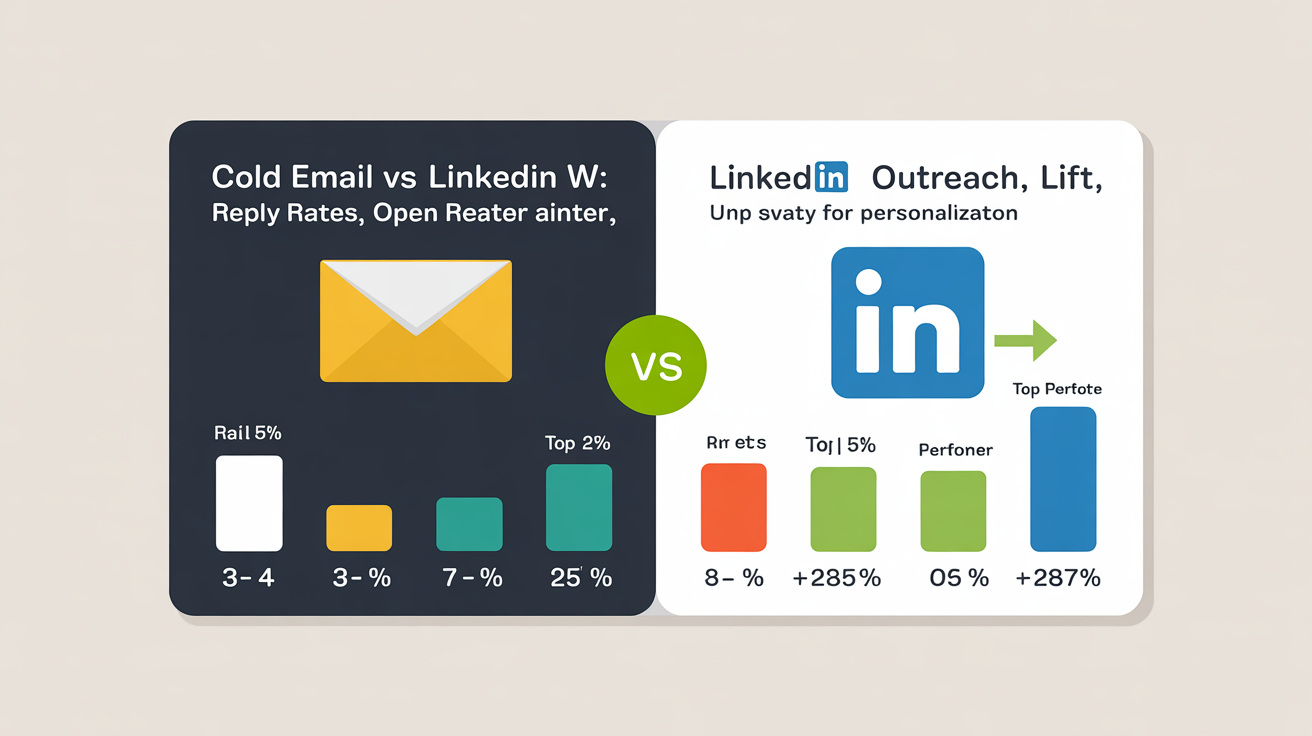
Cold Outreach by the Numbers: What Data Reveals About Email vs. LinkedIn
LinkedIn cold messages pull more replies than email - expect 7–25% on LinkedIn versus 3–6% for cold email, even with identical targets. With hyper-personalization or a multichannel approach, response rates can jump by up to 287% over standard campaigns. That’s not a small edge. It’s a different ballgame.
LinkedIn vs. Cold Email: Channel Performance
LinkedIn outperforms email across reply rates and engagement. Most LinkedIn cold messages hit 7–12% replies. Some niche audiences see 25% or higher if you nail the timing and context. Cold emails? Breaking 5% is rare - even with a solid prospect list and sharp copy. In our tests, combining LinkedIn and email boosted overall replies by 2.7x versus email alone. More replies mean more interviews, less wasted outreach. Want tactical details? See the proactive outreach playbook.
Open Rates: Getting Your Message Seen
- LinkedIn InMail open rates: 50–65%. Warm intros or connections push higher. By contrast, email open rates sit at 21–36%, with subject line and sender reputation as the main levers.
- Personalized subject lines drive a 30.5% lift in email open rates - using a name, company, or recent LinkedIn post signals relevance and gets attention.
- Emails under 80 words see reply rates above 10%. Go longer and watch engagement drop, especially with cold contacts.
Reply Rates: What Drives Real Responses
Cold email replies average 3–5% for generic blasts, climbing to 7–12% with targeting and personalization. LinkedIn consistently beats that - 7–25% reply rates on messages that reference recent work, news, or shared interests. Hyper-personalized LinkedIn notes can boost replies by up to 45%. In our A/B tests and benchmarks, even basic personalization doubled replies. That’s the difference between silence and actual conversations.
Impact of Personalization and Targeting
Personalization is the biggest driver of cold outreach performance. Emails tailored with real details - role, company, recent activity - see 32–142% higher replies than bland templates. On LinkedIn, mentioning a prospect’s post or company milestone can double your odds. Yes, it takes more effort. But the ROI speaks for itself. For systems to scale this without burning out, check scaling personalized outreach without losing the human touch.
Follow-Up Frequency and Sequencing
Persistence matters - 55% of replies come from follow-ups, not the first touch. Campaigns with 4–7 steps get up to three times more replies than one-and-done blasts. The sweet spot: 2–3 value-driven follow-ups, spaced and targeted. See designing follow-up sequences that reclaim lost opportunities for a tactical breakdown. Skip the follow-ups and you’ll miss most warm leads.
What Separates Top Performers
Top campaigns combine multichannel targeting, sharp personalization, and relentless follow-up. Using both LinkedIn and email in a sequence earns up to 287% more replies than email alone. Targeting 5–10 prospects per company (with staggered sends) doubles your odds. Average campaigns quit too soon or default to robotic templates. Stand out with methodical research and consistent relevance - see our benchmarking and targeting systems for details.
One Cold Email nails these fundamentals. For jobseekers who want a repeatable system that outperforms generic templates, the trade-off is clear: more up-front work for much better results.
Why the Top 10% Crush the Averages: What Drives Outreach Success (and Failure)
Top performers pull ahead by obsessing over list quality, relevance, and message fit. Data cuts through the noise: campaigns with sharp segmentation, real personalization, and multi-touch sequences get up to 3x more replies than generic blasts. The stragglers? They spray mass emails, ignore targeting, and watch their reply rates crater.
Segmentation and List Quality Beat Volume
Dumping emails into a bloated list tanks replies. Target just 1–2 key contacts at each company - reply rates hit 7.8%. Email 10+ per org, and that number drops to 3.8%. That’s not a minor difference. It’s the line between smart outreach and wasted effort. Our targeting benchmarks back it up: segmentation moves the metric. Scale looks efficient, but focus wins actual replies.
Personalization and Message-Market Fit Drive Replies
Personalization isn’t optional. Referencing the recipient’s role, recent company wins, or visible pain points? Expect reply rates to surge 32–142% over boilerplate templates. Generic asks get ignored. Mention a prospect’s recent achievement - LinkedIn replies double. Our personalization guide breaks down how to scale this without drowning in research.
Follow-Up Sequencing: Persistence Pays, Then Plateaus
- Sequences of 4–7 emails pull in three times more replies than single-touch messages - 27% reply rate at the high end, versus 9% for short bursts.
- Two or three value-driven follow-ups yield the best results. Go daily or push past seven steps and replies drop, spam risk rises.
- Space early touches 2–3 days apart, then stretch to weekly. Engagement lifts 18% compared to daily nudges.
- Most replies hit after the second or third email, not the first. Over half of positive responses land in these later steps.
For the tactical breakdown, see Designing Follow-Up Sequences That Reclaim Lost Opportunities. Rhythm and relevance drive replies - not relentless chasing.
Channel Mixing and Iteration Outperform Single-Track Blasts
Combining LinkedIn and email in a sequence boosts reply rates by up to 287% compared to email alone. Multi-channel wins - data, not guesswork. The best? They test subject lines, tweak timing, and focus on reply quality, not just volume. Every sequence is data. They dig for “tell me more” responses, not just opens. For how we run tests and use results, check our approach to measuring outreach performance.
What This Means for Jobseekers
Chasing volume won’t get you conversations. You need tight targeting, personalized copy, and a methodical sequence. That’s why One Cold Email works - upfront effort, but returns multiply. Build a repeatable process using these tactics. For the full system, see the complete proactive job search guide and our framework for writing short, confident messages. Stop blasting. Start segmenting, personalizing, and iterating. That’s how the top 10% pull ahead.
What’s Shifting: Outreach Response Trends Heading Into 2026
Cold outreach is stalling. Reply rates for high-volume, automated messages have dropped or flatlined as inboxes drown in AI-generated campaigns. Top performers now use micro-segmented targeting, hyper-personalization, and multi-channel sequences - driving up to 287% higher conversion than single-channel blasts. The “just send more” approach no longer works for mid-career job seekers.
1. Mass Automation Fatigue - and Why Personalization Wins
AI and outreach automation made scaling easy, not effective. Reply rates for generic, high-volume campaigns now sit below 10%. Personalized, segmented outreach pulls in 2–4x higher engagement and up to 6x higher transaction rates. Recipients spot templates instantly and hit delete. Data from 2024–2026 points to one finding: depth beats breadth, and this trend is accelerating.
Target by role, industry, and pain point. Use company news or recent LinkedIn activity to add specifics. For step-by-step tactics, see our guide on how we research and prioritize opportunities.
2. Multi-Channel Sequencing: Compounding Results, Not Just More Volume
Email alone falls short. Multi-touch, multi-channel campaigns now deliver up to 287% more replies than single-channel efforts (outreach platform benchmarks, 2025–2026). LinkedIn views, connection requests, and emails - combined in sequence - boost recognition. Prospects see your name twice; reply rates jump from 9% to 27% or higher.
This compounding model now anchors high-performing search strategies. For practical details, check our proactive job search guide and see Designing Follow-Up Sequences That Reclaim Lost Opportunities for sequence breakdowns.
3. LinkedIn’s Anti-Spam Crackdown: Early But Growing
LinkedIn is tightening daily limits and clamping down on templated, low-effort outreach. Connection acceptance rates below 30% and repeated rejections now risk temporary suspension. The platform’s AI flags “spray and pray” tactics, especially from third-party tools. Early 2025 data points to a clear pattern: highly personalized messages get through, automation triggers warnings or blocks.
This shift means more time per message and stricter list curation. Relying on automation is now risky. For safer, higher-yield lists, see Targeting 101: Where To Start When You Don't Know Which Companies To Target.
4. A/B Testing and Iterative Campaigns: From Guesswork to Process
Top performers treat outreach as a system. A/B testing of subject lines, offer framing, and timing now separates high reply rates from the rest. Teams running ongoing, iterative outreach compound results - each campaign improves the next (industry benchmarks, 2026). This trend is established and strong.
- Test two message variants with small segments before scaling up.
- Track acceptance, reply, and conversion rates by narrow ICP.
- Feed learnings from every campaign into targeting, messaging, and timing for the next round.
For proven testing systems and refinements, see how we measure outreach performance and how to scale personalized outreach without losing the human touch.
The Data-Backed Bottom Line: Personalization and Targeting Win
The top-line stat: candidates using advanced personalization and precise targeting see reply rates jump to 15–40%. Mass-send, generic outreach lags far behind at 1–5%. Even small shifts - from basic mail-merge to signal-driven, event-specific messages - almost double replies in every dataset. Credentials and send volume don’t move the needle. Relevance and timing do.
Automation and bulk tactics are hitting a wall - spam filters catch more, and prospects tune out. Meanwhile, targeted, context-rich messages keep pulling ahead. The field grows crowded, but results now tilt toward those who treat outreach as a process: segmenting, testing, and relentlessly iterating. The best reply rates and booked meetings go to disciplined testers, not the biggest senders.
The data points in one direction: use smaller, sharper lists. Do the research for every message. For step-by-step systems, see our proactive job search guide and how we research and prioritize outreach targets.
Build an Unfair Advantage Proactively and Update Your Job Search Strategy to Today's Job Market.
$197
Learn MoreFrequently Asked Questions
How many follow-ups do I need to get a response?
Aim for 3–5 follow-ups (4–6 total touches) - most replies come by the 3rd–4th follow-up. For B2B sales you can extend to 5–8 touches over 2–4 weeks (it often takes ~8 touchpoints to close a deal) and finish with a polite breakup email. Space follow-ups 3–7 business days (24–48 hours after meetings/interviews) and automate the sequence until you get a reply.
What subject lines and opening sentences most reliably increase cold email open and reply rates for mid‑career candidates?
Use short, personalized subject lines that name the role or a recent trigger and open with one-line relevance plus a low‑effort CTA. Subject examples: "Senior Product Manager - quick question about [Company]"; "Congrats on [milestone] - PM role at [Hiring Company]"; "Would you consider leading [area] at [Company]?" Opening examples: "Saw your talk on scaling payments - your approach to [specific] caught my eye; are you open to a 10‑minute call?"; "We’re hiring a Senior PM for [team] - your work at [current company] looks like a fit; quick chat this week?"; "Congrats on the promotion - curious if you’re exploring roles that offer greater ownership in [area]?" Keep subjects to ~4–8 words and first lines ≤20 words, and reference a recent trigger (promotion, funding, shipped feature) - LinkedIn data shows ~32% higher response rates when outreach cites recent activity.
What spacing and timing (days of week and time of day) work best between touches in a multichannel outreach sequence?
Use an expanding-interval sequence: Day 0 initial, Day 3 first follow-up (brief value add), Day 8 second (new angle/case study), Day 15 third (social proof/resource) and Day 28 breakup - or compress to a 3–5 touch sequence with 2–4 day gaps early and longer gaps later. Send during business-morning windows (best midweek opens/replies, e.g., Tue–Thu 8–10am local) and consider Saturday for some founders; avoid next‑day follow-ups (they cut replies ≈11%), use smart send windows to randomize delivery, and intersperse LinkedIn/calls between email touches.
How can I scale meaningful personalization so I don’t spend hours on each contact but still get higher reply rates?
Adopt a tiered personalization framework (e.g., 20% Tier 1 deep, 30% Tier 2 moderate, 50% Tier 3 light) and combine dynamic templates with one researched custom opening line plus automated follow-up sequences so you personalize impactfully without spending hours per contact. Automate enrichment (Clearbit/ZoomInfo), use mail tools that support attributes (QuickMail/Outreach/Reply) and AI to draft the custom openers at scale - a single relevant line boosted replies from 1.2% to 4% in one campaign, and follow-ups account for over half of replies. Measure and iterate (A/B test tiers and lines); expect personalized campaigns to hit 10–25%+ reply rates versus 5–9% for generic outreach, reserving deep work for high-value Tier 1 targets to aim for 20%+.
Which metrics beyond raw reply rate should I track to judge outreach success (e.g., positive-interest rate, interview conversion, time-to-response)?
Track positive (intent) reply rate - replies that ask for next steps - separately from negative/unsubscribe/spam rates, plus reply-to-meeting conversion, meeting-to-qualified-opportunity (SQL) conversion and opportunity-to-win (close) rate. Measure timing and sequence performance: median and 90th‑percentile time‑to‑response, response rate by sequence position, cumulative reply curve and optimal sequence length (look for diminishing returns). Monitor engagement and deliverability: open and click rates, bounce rate and spam complaints. Add reply-quality/sentiment scoring and per-variant A/B lift (test with ≥100 prospects) so higher reply rates don’t sacrifice lead quality.
Do typical response‑rate benchmarks differ by industry or function (e.g., tech product management vs. finance vs. healthcare) for mid‑career hires?
Yes - benchmarks vary by industry/function: cold email reply rates average ~5–6% (top performers 8–12%), but channels and expectations differ by field. Marketing recruiters report more LinkedIn DMs, finance relies more on email, and tech shows a more even split with personalized LinkedIn outreach often cutting through the noise; multichannel outreach can boost response up to ~287%. For mid‑career jobseekers a “healthy” funnel is ~15%+ response; sustained <5% response after 6–8 weeks is a common trigger to pivot.
What steps turn an initial positive reply into a scheduled interview, and what counts as a meaningful reply versus a non‑actionable one?
Acknowledge the positive reply, propose 2–3 concrete time slots or share a calendar scheduling link (to pass the single‑screen test), confirm meeting length and agenda, then send a calendar invite with video/location details and a day‑before reminder. Use a scheduling link to minimize back‑and‑forth and follow up in 2–3 days if they don’t pick a slot. Meaningful replies explicitly move the process forward - e.g., “Interested,” “Tell me more,” “Let’s talk,” or “When are you available?” - while non‑actionable replies are vague or passive (“Thanks,” “Sounds good,” “We’ll be in touch”) or silence and therefore require further outreach.
Luis Gamardo built a modern job search framework for a broken recruiting system. His approach teaches how to send cold emails at every stage of the hiring process, so qualified candidates can get noticed by the right people at the right time - including before jobs are even posted.
Sources
- trykondo.com
- clearout.io
- donemaker.com
- upwork.com
- prospectout.com
- martal.ca
- instantly.ai
- leadcrm.io
- outboundrepublic.com
- trykondo.com
- coldlytics.com
- salesrobot.co
- koncert.com
- primeforge.ai
- quora.com
- sendr.ai
- getboomerang.ai
- saleshandy.com
- hubsell.com
- timify.com
- tario.ai
- lemlist.com
- skrapp.io
- quora.com
- sendr.ai
- leadfeeder.com
- streak.com
- instantly.ai
- listkit.io
- artisan.co
- levelingup.com
- warmforge.ai
- instantly.ai
- instantly.ai
- autobound.ai
- instantly.ai
- gem.com
- mailforge.ai
- pursuenetworking.com
- mailforge.ai
- mailforge.ai
- propellercrm.com
- growthlist.co
- instantly.ai
- martal.ca
- trykondo.com
- herohunt.ai
- gmass.co
- findem.ai
- isazeni.com
- expandi.io
- joinvalley.co
- joinvalley.co
- herohunt.ai
- leadsatscale.com
- monday.com
- artemisleads.com
- meetalfred.com
- nethunt.com
- botdog.co
- linkedsavvy.com
- outreach.io
- sales-mind.ai
- leadspicker.com
- theroundpie.com
- expandi.io
- fyxer.com
- prospeo.io
- community.hubspot.com
- quora.com
- openarc.net
- remote4africa.com
- trykondo.com
- lockedinai.com


