
Key Metrics Every Job Outreach Campaign Should Track (And Why They Matter)
About 95% of cold job outreach is ignored: open rates average ~27–42% (27.7% benchmark) but are inflated by privacy/bot noise, median reply sits at ~3.4% (typical 3–5%) and meeting rates fall to ~1%. The key takeaway: prioritize reply rate by tracking, targeting, segmentation, personalization, and follow-ups - these tactics lift replies to 5–10% (and 15–25% when referencing recent events), while spray-and-pray yields near-zero results.
Build an Unfair Advantage Proactively and Update Your Job Search Strategy to Today's Job Market.
$197
Learn MoreWhy 95% of Job Outreach Gets Ignored: The Brutal Math of Cold Email Metrics
95 out of 100 cold job outreach messages get ignored. That’s not just folklore - it’s reflected in 2026 benchmarks: cold email open rates now sit at 27.7%, and replies limp along at just 3–5%. The guesswork? Still rampant. The graveyard of unread messages keeps piling up.
The numbers don’t lie. Most job seekers using mass-blast tactics are invisible. Spray-and-pray isn’t a strategy - it’s a way to burn out your chances. If you aren’t tracking, testing, and personalizing, you’re just noise. Data separates the ignored from the noticed. Miss the metrics, miss the mark.
Here’s what matters: open rates, reply rates, channel performance (email vs. LinkedIn), and the sharp edge of personalization, follow-up, and segmentation. Want the tactical playbook? Start with our guide on measuring outreach performance and the full proactive job search strategy. Up next: subject lines that actually get clicked, message length that gets read, follow-up sequencing, and the triggers that turn numbers into interviews.
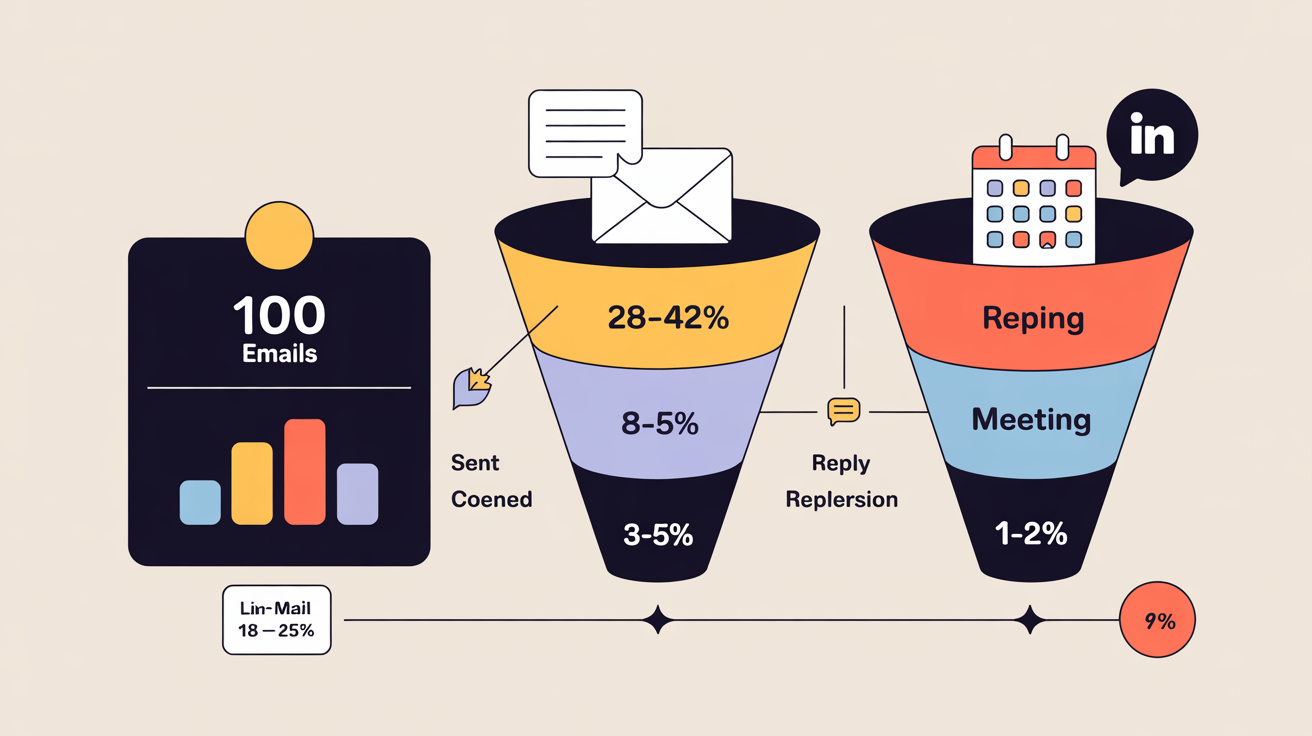
The Metrics That Make or Break Job Outreach: Open, Reply, Meeting, and Beyond
Reply rate trumps every other metric. Most cold outreach scrapes by at 3–5%, but targeted, genuinely personalized campaigns routinely hit 10% or more. Volume doesn’t matter if you’re blasting the wrong people or asking for nothing specific.
Open Rate: Signal or Noise?
Average cold email open rates now land between 27% and 42%. Subject line, sender reputation, and industry move that number up or down. But Apple’s Mail Privacy Protection and security bots have made open rates unreliable - numbers often spike from pixel preloading or bot scans, not real people. If you see 60%+ opens but replies flatline, you’re probably hitting spam or bots. Open rate does affect sender reputation, but don’t obsess - chasing opens over replies wastes time. Real campaigns track engagement, not vanity. For deeper tracking, see our guide on outreach performance metrics.
Reply Rate: The Real Success Indicator
The median reply rate for cold job outreach is 3.4% - that’s your floor. Segment your list, add true personalization, and you’ll see 5–10%. Reference a recent event (“Congrats on your funding” or “Saw you’re hiring”) and rates spike to 15–25%. Spray-and-pray blasts with zero context? Expect 1–3%. If you’re stuck under 3%, the issue is your targeting or relevance, not just your copy. Consistently hitting 5%+ means you’re in the right zone. For more tactics, check our proactive job search strategy.
Meeting Rate: The Brutal Drop-Off
Meetings booked per email sent - this is where most outreach collapses. Even strong campaigns rarely top 2% meeting rates. The average for job-focused cold email sits near 1%. Translation: send 100 targeted messages, land one call. LinkedIn InMail sometimes edges up to 2–3% with tight targeting, but still, most messages won’t convert to a conversation. This is the true filter: how many real conversations did your outreach trigger?
Personalization, Targeting, and Campaign Size
- Batch-and-blast (no personalization): 1–3% reply rate - Templates blasted to giant lists get flagged as spam by people and algorithms alike.
- Basic personalization: 5–9% reply rate - Toss in a first name or company, and you’ll see a bump, but it’s not enough in crowded inboxes.
- Advanced personalization: 9–15% reply rate - Tying in industry pain points or referencing recent news doubles results over basic tweaks.
- Signal-based (event trigger): 15–25% reply rate - Pointing to recent funding, hiring, or product launches proves relevance and multiplies responses.
- Small, segmented lists: 5.8% reply rate - Outperform large, generic blasts (2.1%) by nearly 3x, thanks to tighter fit and relevance.
Each layer of relevance pushes reply rates higher. If you’re still mass-blasting, you’re invisible. Upgrade your process with our guide on scaling personalized outreach.
Timing, Channel Mix, and List Quality
Multi-channel campaigns - mixing email, LinkedIn, and phone - boost engagement by 40%+ compared to single-channel efforts. Monday and Tuesday afternoons (1 PM local time) outperform other send windows. Bounce rates above 7.5% signal a decaying list; you’ll get throttled fast. Nearly 28% of B2B emails go stale every year. Clean your lists or watch your deliverability tank. List quality and disciplined follow-up drive actual results. Find practical routines in our guides on weekly outreach metrics and follow-up sequencing.
One Cold Email forces rigorous targeting and true personalization. That means higher reply rates and a clean sender reputation. You’ll sacrifice volume, but you build stronger pipelines and avoid burning out your list. If you want results, precision beats noise - every time.
What These Metrics Really show: Why Most Outreach Fails (And Where the use Is)
Mass outreach flops because most messages land flat - generic, off-target, sent to lists that haven’t been updated in months. Data shows the highest reply rates come from campaigns that are small, tightly targeted, and use more than one channel. Relying on volume doesn’t just waste effort - it tanks your odds with every send.
Why Generic Outreach Tanks Results
Spray-and-pray is dead weight. Raw numbers: generic cold emails pull a 2–3% response; basic personalization bumps that to 5–9%. Go deeper - reference a real pain point or a recent company move - and replies jump to 15–25%. If your outreach looks and sounds like everyone else’s, you disappear in the noise. Mass blasts don’t just underperform - they erode goodwill and trigger spam filters, dragging down future results. Shift to a personalized outreach routine and watch your numbers.
Small, Segmented Lists Outperform Big Blasts
Quality wins. Lists under 100 contacts, curated by real signals, hit 5.8% reply rates - almost triple the 2.1% for large, generic lists. Smaller lists mean every message lands with context and relevance. This keeps your sender reputation intact and dodges the bounce-rate spiral that kills bulk campaigns. Build signal-based lists using company research and prioritization methods.
Multi-Channel Is Now Mandatory
- Combining channels (email, LinkedIn, calls) increases engagement by 40% or more over email alone.
- Multi-channel campaigns can pull up to 287% better results than single-channel efforts.
- Timing counts: Monday and Tuesday afternoons around 1 PM local time see the best open and reply rates.
- Follow-up isn’t optional. Most replies come after the first touch, not the first send.
Single-channel? That’s a losing strategy. Multi-touch, multi-platform pushes your message in front of targets from more angles - and it works. The lift isn’t incremental; it’s exponential.
Bad Lists and Neglected Hygiene Destroy Deliverability
Bounce rates above 7.5%? Red alert. Nearly 28% of B2B contacts go stale each year. Send to dead lists and you’ll get flagged, throttled, and buried in spam. Once your sender reputation tanks, even your best-crafted messages get filtered out. Clean lists, routine updates, sharp targeting - non-negotiable. See our routines for weekly outreach metrics and follow-up sequencing.
Where the use Is: Personalization, Timing, and Iteration
The pattern’s clear: every layer of true relevance and every follow-up multiplies your results. If you’re not measuring and refining, you’re leaving easy wins on the table. Start with sharp segmentation, move to multi-channel, and ditch the one-size template. One Cold Email is the standout for those ready to overhaul their approach - it forces you to trade mass output for real, interview-generating connections. Downside: you’ll spend more time per message and can’t automate everything. Upside: you actually get responses that count. See how we measure outreach in our outreach performance framework.
If your reply rate isn’t clearing 5% consistently, rebuild your process. The advantage is in the details. Success in today’s market means quitting the volume game and switching to a smarter, targeted approach. For the full step-by-step, see our proactive outreach playbook.
What’s Shifting in Job Outreach Metrics: The End of Spray-and-Pray and the Rise of Multi-Channel Mastery
The mass-blast approach is collapsing. Generic, low-personalization outreach now gets ignored - reply rates for bland email sequences have tanked as inboxes swell past 121 emails per worker each day. The strongest trend: candidates layering email, LinkedIn, and calls see up to 40% higher engagement and 287% better reply rates than single-channel campaigns. Multi-channel isn’t just better. It’s the new baseline.
Strong Trend: Multi-Channel Beats Single Channel - By a Mile
Sequences that mix email, LinkedIn, and calls drive up to 287% more replies than email alone. Sales teams running multi-touch follow-ups across platforms have boosted MQL-to-SQL conversion by 28% over single-channel efforts. For job seekers, this means combining LinkedIn messages, targeted emails, and the occasional call - no more relying on one channel. Proactive outreach playbooks demand this mix. One Cold Email is built for layering touchpoints, not just blasting emails. Downside: more steps, a bit more manual work. Upside: more interviews, more traction.
Confirmed: List Hygiene and Deliverability Are Non-Negotiable
Bounce rates over 7.5% threaten your sender reputation and future outreach. About 28% of B2B contacts go stale every year. Dirty lists tank open rates and get you filtered to spam or blocked by outreach tools. Weekly list cleaning and data enrichment - see our weekly outreach metrics routine - is now standard. The best campaigns obsess over data accuracy, not just volume.
Early Signal: Engagement Spikes with Cohort Segmentation and Micro-Personalization
Segmented outreach - targeted by industry, role, or trigger event - consistently lifts reply rates. Split lists into cohorts of 50-200 prospects and customize messaging. Even small-scale tests show measurable engagement jumps. The biggest gains come from layered, relevant personalization across channels. One Cold Email supports deep segmentation, but expect more up-front research. See our process for prioritizing target companies and scaling human-driven outreach.
Confirmed: A/B Testing and Iteration Drive Compound Results
Campaigns that A/B test subject lines, message bodies, and CTA placement see steady, compounding improvement. Teams running experiments on every send report double-digit percentage gains each quarter. Small lifts in open or reply rates stack up fast. Treat every outreach as an experiment, and review results through outreach performance metrics.
Watch List: Automation and AI - Assist, Don’t Replace
AI-driven outreach tools now recommend send times, message variants, and next steps. Still, human judgment drives the best results. Leaders use tech to automate repetitive tasks, then focus manual effort on personalization and relevance. Track these developments, but don’t hand off relationship-building just yet.
The One Stat That Predicts Your Next Interview - And How the Outreach Game Has Changed
Reply rate is the single best predictor for landing interviews now. If you’re stuck at 3% or less, you’re falling behind. Sequenced, targeted outreach now averages 10% or higher. One-off emails and mass blasts barely move the needle.
The rules have shifted. Multi-touch, multi-channel campaigns with sharp targeting and fast iteration drive results. Sequences of four to seven emails spaced over several weeks triple replies compared to single shots. Not just more volume - more quality touchpoints. Tight segmentation and timing matter. Personalization isn’t optional.
Track reply rates every week. Each percentage point is ground gained. Use your numbers to fine-tune messaging, targeting, and timing. For tactical details, see the outreach performance measurement guide and the proactive outreach playbook. Review your system and iterate until you see a real jump in interviews booked.
Build an Unfair Advantage Proactively and Update Your Job Search Strategy to Today's Job Market.
$197
Learn MoreFrequently Asked Questions
How exactly do I calculate reply rate, meeting (or interview) rate, and conversion-to-offer rate - with example formulas and a sample calculation?
Reply rate = (Replies ÷ Total messages delivered) × 100; Meeting (or interview) rate = (Meetings booked ÷ Total messages delivered) × 100; Conversion-to-offer rate = (Offers made ÷ Meetings held) × 100. You can also report meeting rate per reply: Meeting rate per reply = (Meetings booked ÷ Replies) × 100. Example: 1,000 emails delivered → 120 replies → 40 meetings → 8 offers: Reply rate = 120/1,000 = 12%; Meeting rate = 40/1,000 = 4% (or 40/120 = 33.3% per reply); Conversion-to-offer = 8/40 = 20% (overall offers per emails = 8/1,000 = 0.8%).
If open rates are unreliable because of Apple Mail Privacy Protection, what alternative engagement metrics should I track and how do I measure them?
Track Reply Rate (replies ÷ delivered emails - delivered = sends − bounces; target 5–10%), Inbox Placement Rate (measure inbox vs. spam with seed inbox tests or deliverability tools like GlockApps/InboxPlacement), and Bounce Rate (bounces ÷ sends - keep <1–2%). Also measure Click‑Through Rate (unique clicks ÷ delivered) and downstream conversion metrics - meetings booked, qualified conversations, opportunities or offers per 1,000 sends - by tagging replies (positive/negative/OOO/unsubscribe), using CRM tracking, calendar links and UTM parameters so you can attribute real human outcomes versus bot activity.
What are the best ways to detect and fix deliverability problems when I see high open rates but low replies (or lots of bounces/spam complaints)?
Detect problems by monitoring bounce rates by ISP and bounce codes, spam-complaint trends (keep complaints well below 0.3% and bounces <2%), Google Postmaster and Microsoft SNDS for domain/IP reputation, blocklist checks, inbox-placement/seed tests, and engagement velocity (opens/clicks within 1/6/24 hours) - remember Apple Mail Privacy Protection skews opens so prioritize clicks and reply rates. Fix immediately by pausing suspect sends, suppressing/removing hard bounces, complainers and spam-trap hits, cleaning/validating lists (double opt‑in, address verification, sunsetting unengaged users), and throttling or re-warming IPs as needed. Ensure SPF/DKIM/DMARC are correct and aligned, inspect SMTP bounce codes for root causes, remove spammy content/poor subject lines and add a one‑click unsubscribe, and use an ESP or deliverability specialist with FBL integration, real‑time suppression, and ongoing monitoring to prevent recurrence.
How do I benchmark my outreach performance by industry, role seniority, or geography so I know whether my reply rates are good or need improvement?
Segment your sends by industry, seniority, and geography and compare reply and meeting-booked rates to published benchmarks (Nonprofits/Religious ~16.5%+, IT Services/Consulting ~3.5%, Biotechnology ~3.2%, Financial Services ~3.39%, Technology ~1.87%, Software <1%; general B2B cold email band 3–5.1%). Use statistically meaningful samples (≥100 sends per segment or run until 95% confidence), control for sequence length (single-touch often outperforms and adding a third email can cut reply rates by ~20%), and prioritize fixes where your reply or meeting-conversion is materially below the benchmark (for example>20% worse) by tightening targeting, personalizing hooks, and A/B testing; also track reply-to-meeting conversion and time-to-reply over time.
Which outreach and analytics tools integrate smoothly with applicant tracking systems or CRMs to automate metric collection and reduce manual work?
Use Apollo.io, Lemlist, HubSpot (sequences), Greenhouse or Avature, and LinkedIn tools like Expandi or LinkedHelper - each either has native ATS/CRM connectors or clean Zapier/Make bridges. Apollo and HubSpot offer direct Salesforce/HubSpot syncing to push contacts, opens/clicks/replies and sequence activity into your CRM; Lemlist integrates with HubSpot/Pipedrive and adds deliverability controls; Greenhouse and Avature natively map campaign results to ATS stages; Expandi/LinkedHelper can export LinkedIn conversations into CRMs to automate metric collection and pipeline updates.
How can I personalize messages at scale - what parts should be templated vs. customized, and how much time should I spend per contact to see meaningful lift?
Template the structure - subject-line frameworks, an opening/context placeholder, a 1-sentence value prop, a 1-line case/social proof slot, a clear CTA and defined follow-up cadence - and use frameworks (not rigid boilerplate) so reps can vary language. Customize the opener and one meaningful line: reference a trigger/event or role-specific pain, cite a relevant metric or recent milestone, and tie a specific benefit to their situation (avoid name-only personalization). For scale, spend ~30–120 seconds per contact for light personalization (trigger + one tailored line) to get meaningful lift, and invest 3–5 minutes for high-value targets for deeper research and bespoke insight; 50% of companies say increasing personalization can boost engagement.
How do I calculate the ROI of a proactive outreach campaign (cost per interview, cost per offer), and what inputs should I include (time, tool subscriptions, paid credits)?
Cost-per-interview = Total campaign cost ÷ number of interviews booked; cost-per-offer = Total campaign cost ÷ number of offers (or offers accepted); ROI = (Value delivered by hires − Total campaign cost) ÷ Total campaign cost. Include all direct costs (tool subscriptions like ATS/LinkedIn Recruiter, outreach platform fees, paid credits/ads, assessment or background-check fees), full-time-equivalent people time monetized at fully‑burdened hourly rates (sourcing, messaging, screening, interview panels, offer negotiation, onboarding), plus indirect/opportunity costs (lost alternative work, employer‑branding content, candidate reimbursements). Track conversion metrics (response → interview → offer → hire), pick an attribution window (e.g., 90 days), and use hire value (revenue contribution, productivity savings, or LTV) to compute ROI.
Luis Gamardo built a modern job search framework for a broken recruiting system. His approach teaches how to send cold emails at every stage of the hiring process, so qualified candidates can get noticed by the right people at the right time - including before jobs are even posted.
Sources
- upwork.com
- trykondo.com
- donemaker.com
- clearout.io
- trykondo.com
- skrapp.io
- quora.com
- martal.ca
- tario.ai
- quora.com
- instantly.ai
- skylead.io
- saleshandy.com
- leadcrm.io
- sendr.ai
- salesrobot.co
- extern.com
- prospectout.com
- close.com
- listkit.io
- blog.heyeveryone.io
- isazeni.com
- instantly.ai
- autobound.ai
- prospeo.io
- expandi.io
- community.hubspot.com
- artemisleads.com
- allegrow.co
- mailforge.ai
- instantly.ai
- leadsatscale.com
- herohunt.ai
- fyxer.com
- artisan.co
- quora.com
- warmforge.ai
- instantly.ai
- tradepressservices.com
- oppora.ai
- growbots.com
- emailtooltester.com
- getboomerang.ai
- outreach.io
- sparkle.io
- wowledge.com
- hubspot.com
- sendr.ai
- quora.com
- close.com
- knowledge.hubspot.com
- dotdigital.com
- trykondo.com
- experienceleague.adobe.com
- alore.io
- dynamicyield.com
- university.outreach.io
- forum.thethinksters.com
- mediacause.com
- productmarketingalliance.com
- salesforge.ai
- cinz.nz
- support.demandbase.com
- dynamicyield.com
- linkedsavvy.com
- nethunt.com
- herohunt.ai
- growbots.com
- botdog.co
- saleshive.com
- lemlist.com
- joinvalley.co
- nureply.com
- toptechnewsletter.com
- theroundpie.com
- qubit.capital
- juicebox.ai
- monday.com
- gem.com
- saleshandy.com
- findem.ai
- indeed.com
- instantly.ai
- propellercrm.com
- gem.com
- instantly.ai
- saleshandy.com
- coldlytics.com
- mailforge.ai
- mailforge.ai
- reply.io
- martal.ca
- tryapt.ai
- gmass.co
- resources.workable.com
- levelingup.com


