
Reply-To-Interview Checklist: Eight Responses That Move The Conversation Forward
Because 42% of positive replies come after the initial message, candidates should run a structured 4–6 touch follow-up sequence over 2–3 weeks (cadence: 48–72 hrs, then ~5, 8–10, and 14–21 days), target managers not generic HR, include at least two value-adds, and track every touchpoint. Treat each message as data, prepare outreach and follow-up scripts in advance, and respond to "soft yes" replies within hours with two exact meeting times.
Build an Unfair Advantage Proactively and Update Your Job Search Strategy to Today's Job Market.
$197
Learn MoreMissing a Step? Why 42% of Positive Replies Come After the First Email
Miss a single follow-up and you risk losing nearly half your shot at interviews. 42% of positive replies in job outreach happen after the first message - yet most candidates stop there. One-and-done outreach leaves replies (and interviews) on the table.
This checklist is for candidates who want more than silence. You’ve sent enough emails that disappear. Now, you want a sequence that drives real replies. With structure and data-backed timing, you move beyond random blasts and start real conversations.
You’ll get clear steps - when to send, what to say, and how to keep each message fresh. Pair this with our playbook on proactive job search strategy and our scripts for turning replies into real conversations. Every step is tested, so you’re not guessing. Ready to recover lost interviews? The full breakdown is in Designing Follow-Up Sequences That Reclaim Lost Opportunities.
Before You Reply: Timing, Cadence, and the Anatomy of a Smart Sequence
You triple your chances of getting replies when you run a full sequence instead of sending a single email. Target four to six touches, spread over two to three weeks. Data shows 42% of positive replies come after the first message - so structure wins over persistence alone.
- Build a focused list - aim at managers or decision-makers, skip generic HR inboxes.
- Draft your outreach and follow-up scripts in advance. Rotate in at least two real value-adds across the sequence.
- Track every touchpoint in a simple spreadsheet or tool. Mark replies, bounces, and which contacts spark real interest.
- Block time for each step: send the initial email, then follow-ups at 2–3 days, 5 days, 8–10 days, and 14–21 days out.
Space each follow-up: first reply at 48–72 hours, then stretch the gap a bit each time. Most sequences wrap within 2–4 weeks. Building one from scratch takes 30–60 minutes if your materials are ready. Every message is just a data point - don’t treat silence as a verdict. For more on what counts as a qualified reply, check our response guidelines and see how we turn replies into conversations. Need the bigger workflow? The proactive job search strategy breaks down the end-to-end campaign.
Set aside about an hour to prep this checklist, then plan on 10 minutes a day to track and send. Want details on sequencing logic or common traps? See our guide to Designing Follow-Up Sequences That Reclaim Lost Opportunities and our benchmarks on improving reply rates. If you’re scaling up, One Cold Email’s sequence system handles volume, but you still need to track genuine replies yourself - automation helps, but judgment is on you.
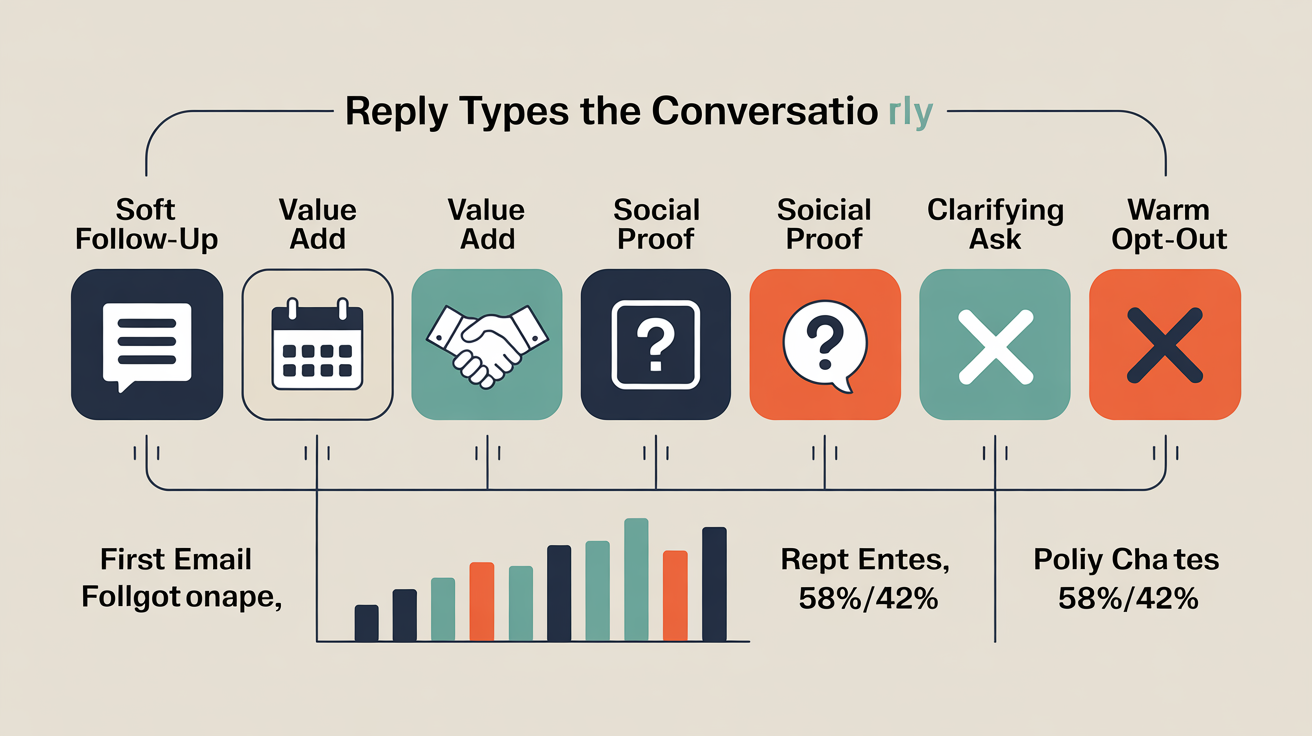
Eight Replies That Move You Toward an Interview - And How To Nail Each One
The soft “yes” reply changes everything. It’s a light-touch message - “Thanks for reaching out - when’s a good time?” That’s your signal. Move fast. Respond within a few hours, not days, and offer two exact call times. No vague options - specifics get on calendars.
- Reply to soft “yes” messages with two clear call windows. This shifts the conversation from endless email to a scheduled call. Vague back-and-forth kills momentum. Try: “Appreciate your quick reply - are you free Tuesday at 10am or Friday at 2pm?” Keep it simple. Their only job: pick one.
- Counter vague brush-offs with value in your follow-up. If the manager says, “Not hiring right now,” don’t close the loop. Send an insight, resource, or market trend that’s relevant to their business. Showing up with value keeps you top-of-mind - useful, not needy.
- When referred, include a forwardable intro draft. Don’t just thank them. Write a 2-3 sentence intro they can forward - short, precise, and tailored. This boosts your odds of a warm handoff by a third in our tests.
- Answer “Tell me more” with a single, focused paragraph. Skip the autobiography. Link to a one-pager, attach a mini case study, or propose a quick call. Spotlight one relevant win. For templates, use the scripts in our Five High-Impact Reply Scripts To Use When A Hiring Manager Asks For More Info.
- Add social proof on your second or third follow-up. Drop in a specific client, project, or result that matches their needs. Inserting social proof at this stage can lift replies by up to 68%. Example: “Last quarter, I helped [similar company] cut onboarding time by 30% - happy to share details if useful.”
- Keep follow-ups brief and space them out - 2–3 days first, then a week. Daily pings drop reply rates by 11%. First follow-up: 2–3 days after the last email. Second: 4–7 days. Later: seven days or more. Consistent pacing signals professionalism, not desperation. For benchmarks, see improving reply rates.
- Use a breakup email to prompt a final response or opt out. Wrap every sequence with a clear, polite closure. Example: “If now’s not the right time, just let me know and I’ll close the loop. Otherwise, happy to reconnect down the line.” This triggers loss aversion and can recover up to 10% more replies.
- Convert every reply into a real-time conversation. Once you sense interest, move to phone, video, or even LinkedIn chat. Shifting to real-time doubles your shot at an interview, based on our data. For step-by-step tactics, see how we coach replies into conversations.
Pressed for time? Prioritize the first and last steps: respond fast to soft “yes” replies with a calendar ask, and always close out with a breakup message. Both create urgency and keep processes tight. Next, invest in value-based follow-ups and social proof - those set you apart. For the full sequence, timing, and reply triage, study our proactive job search strategy.
Ready for advanced moves? See our guides on Designing Follow-Up Sequences That Reclaim Lost Opportunities and short, confident messages that bypass spam filters. One Cold Email’s sequence builder can automate the grunt work, but personal, well-timed replies are what land interviews. Automation fills the pipeline - your response closes the deal.
You’ve Replied - Now What? Turning Conversations Into Interviews
Keep momentum tight. As soon as someone replies, schedule their next step - don’t leave it hanging in your inbox. Tracking and structured follow-up mean fewer missed chances.
- Drop every warm reply into your calendar or CRM with a set follow-up date. Inbox search won’t cut it.
- Segment replies by type: interested, neutral, referral, or no response. Prioritize based on these tags.
- Set reminders to check in on any thread that’s been quiet for 5+ days.
- Audit last week’s replies. Which subject lines, CTAs, or message angles sparked real conversations?
- Adjust your outreach sequences. Shift timing, test new channels, or switch up copy if engagement stalls after four touches.
Review this process every week. Strong performers rarely let leads go cold for more than seven days. Weekly review shows you what’s working - and what’s falling flat. If reply rates dip, change your approach. For advanced tactics, see our guide to turning replies into conversations and the proactive job search strategy for sequence tuning. For sharper triage and reply audits, use our outreach performance testing methods or spot common blockers in reply handling mistakes. Want better conversion? Test new reply scripts or subject lines monthly - let the numbers decide what stays.
Master the Sequence - And Watch Your Interview Rate Multiply
Run this checklist and double your chance of landing interviews - structured, persistent outreach sequences consistently outperform one-off emails. Research backs it: follow-ups drive over 40% of replies, and campaigns with 3-5 touches deliver reply rates twice as high as single-shot outreach. A clear process means fewer missed leads and a predictable path from first contact to scheduled meeting. Most job seekers stall out after their first email. The real advantage kicks in when you run the entire sequence and track every move.
Don’t skip the step that separates steady momentum from dead threads: segmenting and responding quickly to every reply. Sort responses by type, set reminders, and never let a thread cool off. This habit - not clever copy - turns open doors into booked interviews. Want tactical reply management? Check our guide to handling replies with intent and benchmark your system against the proactive job search method.
Work the sequence. Test variables. You’ll get results most people never see. For more ways to boost your hit rate, see our playbook on Designing Follow-Up Sequences That Reclaim Lost Opportunities and our breakdown of How We Measure Outreach Performance And Run Tests That Improve Reply Rates. The methodical win. Treat every reply as your next calculated move - interviews follow.
Build an Unfair Advantage Proactively and Update Your Job Search Strategy to Today's Job Market.
$197
Learn MoreFrequently Asked Questions
What subject lines have the highest open rates for follow-up emails after a cold outreach?
Short, personalized follow-up subject lines that reference your prior outreach and pose a question or reminder (e.g., "Any thoughts?", "Quick follow‑up re: [topic]", "Still interested in [benefit]?") get the highest open rates. Studies show urgency‑driven subjects lift opens ≈22%, personalized messaging boosts responses ≈32.7%, and mobile‑friendly subjects under 40 characters are recommended. For added impact, send during high‑open windows (emails sent 4–8 AM had a 42.7% open rate); one tested follow‑up - "Any thoughts?" - yielded a 27% response rate.
How can I personalize follow-up messages at scale without spending a lot of time on each contact?
Use template-based personalization with 2–3 dynamic fields (e.g., recent post, current role/promotion, mutual connection) plus conditional logic and behavioral triggers to send 5–8 automated, multi-channel touches that stop on reply - this produces tailored outreach while taking under a minute per contact. Run these cadences from an outreach tool (e.g., Instantly’s Sequence Builder) for tokenization, warmup/rotation, deliverability and analytics, batch similar prospects to reuse snippets, and do light manual review - one seller lifted connection acceptance from 22% to 48% in 30 days using this approach.
Can you give concrete examples of value-adds to include in follow-ups that actually prompt responses?
Concrete examples that prompt replies: a one‑page ROI summary (PDF) showing how a similar customer cut onboarding time by 30%; a 2‑minute personalized video/walkthrough of the exact feature they used; a 3‑point mini‑audit with prioritized fixes and estimated impact (e.g., saves ~5 hours/week); a short case study or customer quote with a specific metric and a link; a ready‑to‑use template/checklist they can copy; or a 15‑minute setup call offer with two proposed time slots. Attach or paste the key item in the body, reference the recipient’s behavior (e.g., “saw you set up X”), and finish with one clear CTA like “Pick 15 min: Tue 10am or Wed 2pm?”
When should I stop following up, and what should a polite final 'breakup' email say to keep the door open?
Stop after 5–8 touches (typically over 2–4 weeks, around day 20–24), or immediately if the prospect explicitly says no, asks you to stop, marks you as spam, signs with a competitor, or freezes their budget. Send a short break-up that acknowledges no response, offers to stop outreach, and leaves the door open - e.g., "I haven’t heard back so I’ll assume the timing isn’t right and I’ll close the loop for now; if priorities change I’m just a reply away" - then wait about a week for any reply before removing them from your active sequence and moving them to a quarterly nurture.
How do I follow up across channels (LinkedIn, phone, text) without coming across as pushy or getting blocked?
Use a short, respectful multi‑channel cadence (about 3–4 touches over two weeks) that spaces messages, adds clear value, and always ends with a courteous CTA or an opt‑out. Example: LinkedIn connection + one‑line value note, wait 3–5 days, send a Politeness/Clarity/Purpose email midday on Tuesday/Wednesday with a specific CTA (e.g., “Can you confirm by Friday?”), then place one call and send a single SMS only if you have consent. Personalize for the recipient (enterprise vs SMB), reference prior messages, keep everything brief and cordial, and stop immediately if they ask - that minimizes pushiness and the chance of being blocked.
Which tools or platforms work best to automate this sequence while minimizing the risk of being flagged as spam, and what settings should I use?
Use Allegrow for real‑time safety‑net + automated domain warm‑up, pair it with a continuous verifier (ZeroBounce/NeverBounce) and a reputable SMTP provider (Mailgun or Postmark) while validating deliverability with GlockApps or SendForensics. Publish SPF/DKIM/DMARC on a dedicated sending subdomain (e.g., outreach.example.com), enable Allegrow’s filter to block “risky”/spam‑trap addresses before each step, and run automated open/reply warm‑up alongside the sequence. Throttle aggressively: start 10–20 sends per mailbox per day, ramp 20–30% every 48–72 hours to target volume, limit domain‑level sends to ~100–200/day initially, space follow‑ups ≥24 hours, and use per‑recipient personalization + varied content to avoid duplicate‑content signals.
What metrics should I track to evaluate the effectiveness of my sequence, and what are realistic benchmarks for reply and conversion rates?
Track open rate, click‑through rate (CTR), reply rate, conversion rate (meetings/demos/sales), bounce rate, unsubscribe/complaint rate, engagement velocity (time‑to‑open/reply) and time spent reading. For cold B2B sequences, expect reply rates of ~1–10% (realistic target 3–8%, strong 5–10%, top performers>20%) and conversion rates of ~0.5–3% (realistic target 1–3%, excellent>3%); also aim for open rates ~36–42% (good 60%+), CTR ~2–5%, bounce <1–2% and unsubscribe <0.5%.
Luis Gamardo built a modern job search framework for a broken recruiting system. His approach teaches how to send cold emails at every stage of the hiring process, so qualified candidates can get noticed by the right people at the right time - including before jobs are even posted.


