
How We Coach Replies Into Interviews: Scripts, Timing, And Qualification
Over 95% of cold emails are ignored, and even when multi-touch sequences push reply rates above 20%, most responses never convert into interviews - mishandling replies wastes more than 80% of opportunities. The key takeaway: adopt a reply-to-interview pipeline - direct, low-friction scripts, research-backed timing (start with a 2–3 day gap; follow-ups produce>40% of positive replies), and strict qualification - to reclaim lost opportunities and boost conversion up to 3x.
Build an Unfair Advantage Proactively and Update Your Job Search Strategy to Today's Job Market.
$197
Learn MoreWhy Most Replies Don’t Turn Into Interviews (Unless You Coach the Process)
Over 95% of cold emails get ignored. Even with a strong 4–7 touch sequence that pushes reply rates past 20%, most responses never turn into interviews. Mishandling those replies wastes more than 80% of your hard-won opportunities. Raw replies don’t get you hired; conversion is the metric that matters.
This is where most job seekers stall. You spend hours on outreach, finally get a response, then hit a wall after a vague “let’s connect” or a noncommittal answer. That single gap - between reply and actual interview - is where momentum dies and most candidates slide back into the job board grind. Especially for experienced professionals, basic scripts aren’t enough. You need a reply strategy, real decision frameworks, and precise timing to stay ahead.
This guide strips out the guesswork. You’ll get proven scripts, timing tactics, and qualification methods that actually matter. We flag the missteps that sink your chances and show what separates sequences that book meetings from those that waste your time. Want to see what “good” really looks like? Check the step-by-step reply checklist, dig into real conversion data, and use practical reply scripts that drive results. You’ll find a clear path from your first reply to a booked interview, plus a detailed tutorial for handling short or vague responses. For proof, see how candidates have landed interviews using this approach. Want the full system? The proactive job search playbook ties everything together.
The Reply-to-Interview Pipeline: Scripts, Timing, and Qualification in Action
Most replies aren’t interviews. They’re signals - some strong, most halfway. Three levers control your results: reply scripts that push the conversation forward, timing and sequencing your follow-ups, and qualifying responses so you don’t chase dead ends. Over 40% of positive replies come from follow-ups, not the first message. Campaigns using this system see up to 3x higher conversion. Skip a step, conversion stalls.
High-Converting Reply Scripts
Script quality shapes your pipeline. Direct, low-friction messages work best - no endless back-and-forth, no vague asks. Top scripts anticipate objections, keep it brutally clear, and make next steps obvious. Want examples? Use these five high-impact reply scripts. For a step-by-step breakdown, follow the reply checklist that maps every move from first reply to booked interview.
Timing and Cadence of Follow-ups
Timing drives results. Most hiring managers respond two to seven days after contact, but nearly half of positive replies show up after your second or third follow-up. Start with a 2–3-day gap, then space out further. Too soon and you look desperate; too slow and you miss your shot. Research-backed patterns and sequencing blueprints live in designing follow-up sequences that reclaim lost opportunities. Track what works in the field with real-world reply performance metrics.
Qualification: What Counts as a “Real” Reply
Volume means nothing if the leads go nowhere. A qualified reply signals access, intent, or influence to move you toward a hiring conversation. Not just “thanks, but not hiring.” You need to filter, triage, and escalate the right signals - focus only where you can win. See the detailed criteria in what counts as a qualified reply and avoid pipeline waste with three reply handling mistakes that waste your pipeline.
From First Reply to Booked Interview
Turning a reply into an interview is a process, not a one-off. Each step matters: what you send, how you follow up, handling vague answers, and closing the loop. For a walkthrough, use the first reply to interview guide. Dealing with short, noncommittal messages? Start with the tutorial for handling brief replies.
- Interview conversion benchmarks and reply data - see how your numbers compare.
- Case studies of successful reply-to-interview pipelines - evidence from real job searches.
- Proactive job search playbook - connects every stage from outreach to offer.
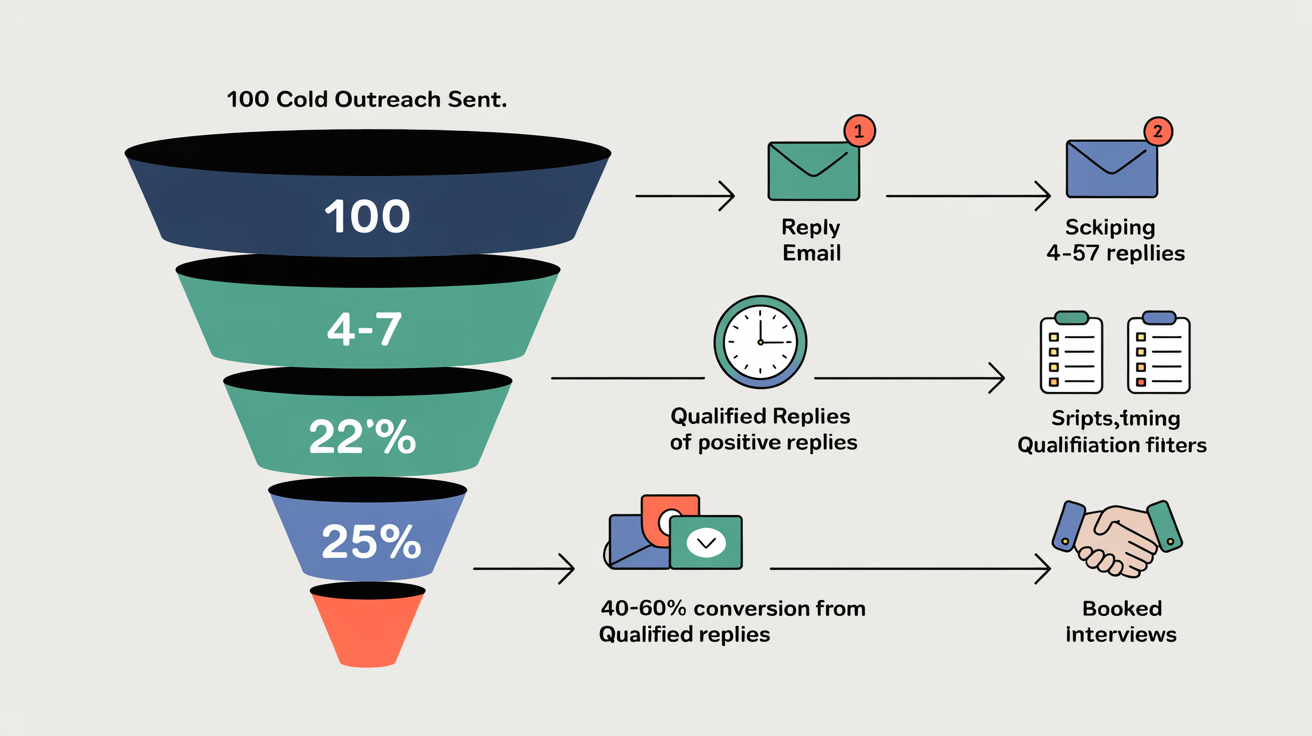
Crucial Choices: Reply Handling, Sequence Cadence, and When to Qualify
Reply handling decides if you book interviews or stall out. Your main call: do you steer each reply toward value, proof, or a direct ask? Sequence timing and escalation shape momentum - move too fast, you burn trust; too slow, and your pipeline fades. These decisions impact quality, not just reply count.
Matching Reply Script to Signal
Every reply shifts the path. Some need a resource or sharp insight - proof you’re paying attention. Others work better with social proof or a direct nudge (“Open to a short call?”). Miss the cue, and the thread stalls. Nail it, you jump straight to the next step. For tactical breakdowns, see five high-impact reply scripts. For mistakes that kill momentum, check three reply handling mistakes that waste your pipeline.
Sequence Cadence and Diminishing Returns
How many messages before it’s too much? Data shows a thread of four to seven emails triples reply rates over single shots. Push beyond ten, and you risk spam filters and prospect fatigue. Start with a follow-up at 2–3 days, then widen gaps - five days, then a week. Each touch must add something new. No repeats. If you have nothing fresh, skip a beat. See designing follow-up sequences that reclaim lost opportunities for blueprints, and compare your reply stats with data-driven outreach measurement.
- Initial email: strongest trigger or signal
- Follow-up 1 (2–3 days): short, direct, adds value
- Follow-up 2 (4–5 days): shift angle, new context
- Follow-up 3+ (every ~7 days): social proof, new CTA, or resource
For structure details and more examples, use the complete proactive job search playbook.
When and How to Qualify for a Call
Don’t chase every reply. Qualify first: does this person have authority, clear intent, or inside info? Only push for a call when you see interest, a referral, or a hiring update. Otherwise, you waste cycles on dead ends. See the criteria in what counts as a qualified reply. Then use the reply-to-interview checklist to decide when and how to escalate. Compare your performance to real-world reply-to-interview rates and review case studies of job seekers who built elite pipelines.
From Thread to Booked Interview
A reply is just the start. You still need to move from interest to a locked meeting. That means handling short or unclear answers, following up with specifics, and closing on a next step. Use the step-by-step reply to interview guide and the tutorial for turning short replies into meetings for tested tactics that convert.
The Hidden Risks: Reply Handling Mistakes That Sink Your Interview Chances
Most people lose momentum right after they get a reply. The fastest way to tank your shot? Firing off a generic, copy-paste response. Especially if you answer in minutes, not hours. That habit signals you’re not invested enough to tailor your answer - and it kills trust fast.
- Chasing every reply without filtering for fit burns time and clogs your pipeline. Always check what qualifies as a strong reply before you escalate.
- Sending “just checking in” or repeating yourself drops reply rates by up to 20% after the third message. See the breakdown in three reply-handling mistakes that lose interviews.
- Replying too quickly - within hours - signals desperation and poor judgment. Check timing best practices in the proactive outreach playbook.
- Generic, scripted replies make your thread easy to ignore. Tailored responses get traction - see the data in real high-impact reply examples.
- Chasing dead ends lowers your response-to-meeting rate and wastes cycles. Benchmark your stats against industry reply-to-interview rates.
Stop treating every thread the same. Filter for quality. Personalize every response. Move the conversation forward with value - never just activity. Use the reply-to-interview checklist to catch mistakes before they sink your shot. For step-by-step tactics, see the beginner guide to moving from reply to interview and the tutorial for turning short replies into meetings. See the case studies of job seekers who built elite pipelines for proof this works.
Start Here: Route Your Next Reply Toward An Interview
Your next reply decides everything. Fumble it, and the thread stalls. Nail it, and you move straight toward an interview. For most, the smartest move is the beginner guide to moving from reply to interview. It breaks down the steps, sample language, and key decisions to convert replies into meetings. Skip the empty thank-you - work every thread with intent.
If you’re unsure how to qualify a reply, use the reply-to-interview checklist to filter which threads are worth your time. If you’re staring at a lukewarm message and can’t tell if it’s real interest, check the traits of a qualified reply. Getting ghosted or stuck? Diagnose your outreach with the critical reply-handling mistakes article - timing and script errors kill momentum fast. Need actual lines that land meetings? Grab the high-impact reply scripts. To see this system in practice, review the case studies and stats - real job seekers, real results.
Ready for the full system? The proactive outreach playbook maps every step, from first message to booked interview. If you need to turn short replies into meetings, follow the step-by-step tutorial. Want the process, scripts, and tracking all in one place? One Cold Email gives you the exact workflow that drives interview rates far beyond what job boards deliver.
Frequently Asked Questions
How should I adapt reply scripts for executive‑level or VP roles versus mid‑level individual contributor roles?
Use concise, strategic, ROI‑focused replies for executive/VP roles and more technical, process‑and-metric oriented replies for mid‑level individual contributors. For execs lead with 1–2 high‑impact achievements (quantified ROI), reference relevant industry concepts (e.g., Lean, Six Sigma, CNC operations) and offer short strategic options or stakeholder‑focused next steps; avoid junior recruiter‑style task questions. For mid‑level ICs include concrete tools/processes, specific metrics, and layered replies (brief answer plus a deeper follow‑up) while mirroring job‑description keywords and language.
What exact qualifying questions can I ask in my first reply to quickly determine whether a role is worth pursuing?
Ask these in your first reply: “What is the salary/hiring range for this role?”; “Is this position onsite, remote, or hybrid and what core hours or travel are required?”; “What are the top 1–3 priorities for the first 90 days?”; “How is success measured and what is the typical promotion/timeline for this role?”; “Who would I report to and what is the team size/structure?”; “What is the interview timeline and earliest possible start date?” These six questions quickly screen logistics (pay/location/hours/timeline) and role fit (immediate priorities, success metrics, reporting and growth).
Which calendar tools and specific scheduling phrasing (e.g., time blocks, offering options) consistently increase meeting acceptance rates?
Use scheduling tools (Calendly or built‑in Google Calendar/Outlook scheduling) and present time‑blocked slots with 2–3 specific date/time options - e.g., “Are you available for a 15‑minute call on Tuesday at 10 AM or Thursday at 2 PM?” Also offer format choices (phone/Zoom/in‑person), state your general availability (e.g., “weekdays 11–4 ET”), and include a direct booking link or send the calendar invite once they confirm to remove friction and boost acceptance rates.
How do I respond when someone asks me to 'send my resume' before talking - what phrasing keeps momentum and avoids being screened out?
"Happy to - before I send a full resume, could we do a quick 15‑minute call so I can tailor it to your needs? I'm available Tue or Thu 2–4pm; in the meantime, here are my top three qualifications: [1–2 relevant internships/roles], [1–2 key skills or tools], [one measurable result]; LinkedIn: [link]. If you prefer, I can send a one‑page resume now." This proposes a specific short meeting to keep momentum, gives screening info up front (3 highlights + LinkedIn), and keeps you from being auto‑screened while still complying if they insist on the resume.
What KPIs should I track to measure reply→interview conversion and what are reasonable benchmark targets by industry or seniority?
Track these KPIs: Connection rate (requests accepted) - target 30–50%; Reply rate (any response) - aim>10% (good), 20–25% great; Positive reply rate (interest‑driven replies) - prioritize quality over volume; Conversion rate (responses → booked meetings) - target>1% of sends and expect ~5–20% of positive replies to become meetings. Benchmarks: cold outreach averages 1–5% reply (top performers 10–15%); deliverability targets: delivery>98%, bounce <0.5–2%, spam complaints <0.1%, inbox placement 80–85%+. By seniority expect lower engagement for executives (~1–3% reply, meetings ~0.2–0.5%), mid‑level (~3–8% reply, meetings ~0.5–1.5%), and junior/IC (~8–15% reply, meetings ~1–3%); use a 6–8 week ramp (wk1–2: 1–2% reply, wk3–4: 3–4%, wk5–8: 5%+).
How can I scale personalized replies across dozens of prospects without sounding templated or losing conversion performance?
Use AI to generate first-draft, prospect-specific openers plus automated, time-zone–aware sequences, apply a tiered personalization framework (heavy manual edits only for top-tier accounts) and enforce a short documentation checklist (examples, tone, tier criteria) so templates guide structure but not copy. This works in practice - Reply.io’s AI sequence builder and AI SDR scaled personalized outreach to 80+ messages/day with only minor edits, HubSpot integration eliminated repetitive data entry saving several hours/week, and adding at least one automated follow-up boosts reply rates (Woodpecker: 9%→13%, experienced users 16%→27%), letting you scale without losing conversion performance.
What’s the best way to recover momentum when a recruiter or hiring manager ghosts after confirming an interview or next step?
Send a brief status-check now: acknowledge the pause, reiterate strong interest, ask for an estimated timeline and offer anything you can provide (e.g., “Thanks - I remain very interested. Do you have an estimated timeline for next steps or anything I can provide in the meantime?”). If no reply, wait ~7–10 days and send one polite follow-up; after ~3 total attempts or ~2–3 weeks without response, multi-thread by contacting another recruiter or the hiring manager (or connect via LinkedIn). Keep every message concise, factual, and helpful so you stay visible without seeming pushy.
Luis Gamardo built a modern job search framework for a broken recruiting system. His approach teaches how to send cold emails at every stage of the hiring process, so qualified candidates can get noticed by the right people at the right time - including before jobs are even posted.
Sources
- listkit.io
- salesmotion.io
- instantly.ai
- boostmediagroup.com
- 2pointagency.com
- instantly.ai
- mailforge.ai
- payproglobal.com
- bookyourdata.com
- instantly.ai
- superhumanprospecting.com
- hubsell.com
- lightercapital.com
- allegrow.co
- listkit.io
- leadspicker.com
- autobound.ai
- close.com
- growthlist.co
- upwork.com
- instantly.ai
- onurgenc.com
- artisan.co
- instantly.ai
- findem.ai
- pursuenetworking.com
- indeed.com
- resources.workable.com
- gem.com
- herohunt.ai
- instantly.ai
- sendr.ai
- askamanager.org
- lampmaa22.medium.com
- help.lemlist.com
- copilotai.com
- saleshandy.com
- coldlytics.com
- saleshandy.com
- gmass.co
- quora.com
- jgsalespro.com
- nesc.com
- careercontessa.com
- criminallyprolific.com
- clearout.io
- blog.heyeveryone.io
- kristina.substack.com
- nimble.com
- quora.com
- careervillage.org
- gmass.co
- careervillage.org
- zymplify.com
- pivotjourneys.com
- coursera.org
- laundryledger.com
- lennysnewsletter.com
- indeed.com
- outreach.io
- community.hubspot.com
- support.outreach.io
- zendesk.com
- chriszervas.com
- medium.com
- wallstreetoasis.com
- resumeworded.com
- resumeworded.com


