
A/B Test Results: Which Subject Line Formats Win For Job Outreach
Top job outreach campaigns hit 40–60% open rates - double the industry average - because concise, personalized subject lines and sharp targeting drive attention, while generic or clickbait lines fall to 15–25% or worse. Most important takeaway: use short (<40-character), context-rich subject lines (name + recent company event or pain point) to lift opens ~26–50% and replies up to ~15%; A/B test formats and prioritize trigger-based segmentation.
Build an Unfair Advantage Proactively and Update Your Job Search Strategy to Today's Job Market.
$197
Learn MoreThe Open Rate Gap: Why Subject Line Choices Make or Break Job Outreach
Top job outreach campaigns hit 40-60% open rates - double the industry average of 15-25%. That gap shapes who gets seen and who gets ignored. It’s not luck. Subject lines and sharp targeting drive these numbers.
If your subject line misses, your message lands in the archive without a glance. Nail it, and you get a shot at attention - even in inboxes packed with noise. The subject line is the filter. No shortcut here. Hiring managers scan fast and click even faster.
This section breaks down A/B test data and campaign benchmarks to show what actually boosts open rates. You’ll get proven subject line formats, see how segmentation impacts results, and learn why short, specific messaging keeps winning over bland, generic pitches. Expect data-backed proactive outreach strategies, mistakes to sidestep, and tactical ways to adjust based on real campaign metrics.
A/B Test Data: Which Subject Line Formats Consistently Outperform in Job Outreach
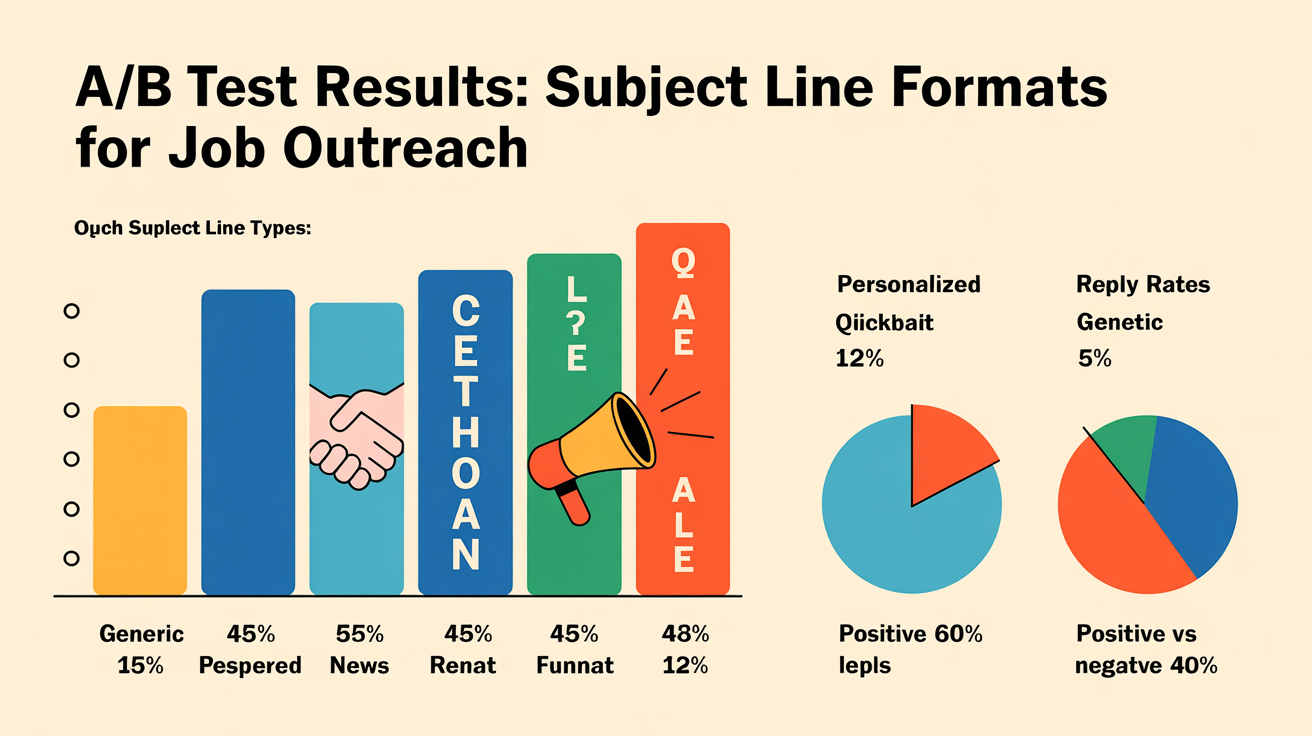
Short, personalized subject lines - under 40 characters - double open rates compared to generic ones. Campaigns in tech and professional services see 40–60% opens with concise, relevant lines, versus 15–25% for standard greetings or vague hooks. Data from hundreds of outreach sequences confirms this: include the recipient’s name or reference a recent company event, and open rates often surge by 30% or more.
Impact of Personalization on Open and Reply Rates
Personalization drives results. In SaaS and agency campaigns, adding a recipient’s name or company context increases open rates by 26–50% over generic lines. Reply rates hit 8–12% with basic personalization, but climb to 15% or higher when subject lines reference recent company milestones or pain points. First name alone? Not enough. Adding context tied to real events wins every test.
Subject Line Length and Specificity
- Short, direct lines (<40 characters): 40–60% open rates - Clear, specific subject lines outperform long or vague ones by up to 2x. Long-winded lines get skipped.
- Generic or “cute” lines: 15–25% open rates - “Quick question!” and “Have a moment?” rarely break through the noise.
- Overly salesy/clickbait: <2% reply rates - Obvious marketing language tanks response rates. Recipients ignore them instantly.
Analysis of nine subject lines that hiring managers actually open confirms it: “Personal + context” beats vague “checking in” language every time.
Trigger-Based and Timely Relevance
Reference recent company activity - product launches, funding, or team changes - and open and reply rates can double. Campaigns tied to a funding round or team expansion hit reply rates up to 15%, nearly triple what generic subject lines achieve. Timing and context drive performance. See our process for how we research and prioritize companies to find these signals.
Industry-Specific Performance Benchmarks
Results vary by sector. In tech, targeted subject lines reach 28–35% open and 12–18% reply rates. Finance and professional services, when referencing relevant details, see 25–32% open and 8–15% reply rates. Manufacturing and healthcare trail, with 18–25% opens - generic messaging falls flat. Precision beats volume. For more segmentation strategies, review proactive outreach strategies for specialists.
A/B Testing Structure and Iteration
Consistent A/B testing is non-negotiable. Preferences shift, and inbox fatigue sets in fast. Top teams test at least two subject line variants per campaign, track open and reply rates by segment, and iterate weekly. Testing “question” phrasing, company news, and ultra-specific role references drives engagement. Track reply quality, not just open rates - our system is detailed in how we measure outreach performance and run tests.
Short, context-rich subject lines outperform. Personalization multiplies results - if it’s more than a name. For a repeatable system, use our framework for writing short, specific messaging. Scaling? See how to scale personalized outreach without losing the human touch. This approach requires research and tight execution. Automate without real signals, and results drop - fast.
What the Numbers show: Patterns and Pitfalls in Subject Line A/B Testing
The numbers are blunt: context drives results. Subject lines tied to actual company news or pain points consistently double open and reply rates. Salesy or bloated subject lines drop below 10% opens. Most job seekers tweak style, not substance - intuition keeps losing to data.
Context-Driven Subject Lines Dominate
Referencing live company events - funding rounds, hiring sprees, new executives - pushes open rates to 30–45%. Replies climb to 12–20%, beating the 5–15% baseline for cold outreach. Templates that just swap in a first name rarely clear 15% opens unless they connect to something real and recent at the company. People notice what's happening in their world - not yours. For a detailed breakdown, see our framework for writing short, specific messaging.
Where Intuition Goes Wrong: The Personalization Trap
Most people settle for shallow personalization - just a name, title, or LinkedIn fact. It doesn't move the needle. These versions rarely top 15% opens. True personalization means referencing a current project, metric, or challenge unique to that company. Without that, your message blends into the noise. Reply rates stall.
Long or Salesy Subject Lines Tank Performance
Subject lines over 8–10 words, stuffed with marketing buzzwords or “exciting opportunities,” trigger Promotions or spam filters. These campaigns average below 10% opens, with replies nearly at zero. If your open rates dip under 15%, suspect your subject lines first. For what not to do, see our breakdown of messaging mistakes that make candidates sound desperate.
Disciplined A/B Testing Outperforms Guesswork
Random tweaks don't cut it. Consistent A/B testing is the only way to surface what actually works. In the data, 1 in 8 subject line variants produces a statistically meaningful lift in opens or replies. Top performers track every variable - audience, timing, even reply quality. Hundreds of campaigns point to these levers:
- Subject lines tied to recent company events: 30–45% opens, 12–20% replies
- Plain language questions about a real pain: 25–35% opens, 10–15% replies
- Generic, salesy, or overlong subject lines: under 10% opens, less than 2% replies
- Weekly iteration focused on reply quality - not just open rates, but actionable responses
Testing forces facts over hunches. Most give up early or tweak the wrong thing. A systemized, data-driven process wins - see our proactive outreach strategies for specialists and our guide to measuring outreach performance for details.
Implications: System Wins, Style Loses
Style doesn't beat substance. Short, relevant, context-aware subject lines backed by real A/B testing outperform clever wordplay. Personalization is worthless without proof you did the research. If you want outsized results, use a toolkit that supports disciplined iteration. Tools like One Cold Email automate the grunt work and speed up experiments, but you still have to dig for insights. Skip the research, and no software will save your numbers.
For tactical steps to scale this approach while keeping quality high, see our guide to scaling personalized outreach without losing the human touch. Want more interviews from your opens? See how we coach replies into interviews with scripts and timing that convert.
2026 Trends: Why Segmentation and AI-Powered Subject Line Testing Are Reshaping Job Outreach
Segment-first A/B testing now sets the standard for job outreach that actually gets results. Candidates who segment by function, seniority, or company size - and match subject lines to the persona - see open rates hit 65% and reply rates above 15%. Blanket blasts barely reach 10% opens, with replies sinking below 3% . Static outreach is obsolete. Testing and personalizing at scale is the new filter for results.
Segmentation Multiplies Response Rates
Segmented cold outreach outperforms generic campaigns by a huge margin. Grouping contacts by seniority, company size, or pain point consistently boosts replies by 2–3x . Multi-million send data shows outreach segmented by job function and timed to hiring signals averages 15–22% replies. Generic, non-segmented campaigns stall at 3–7%. Build segment-specific workflows - see How We Research And Prioritize Companies To Find Hidden Hiring Opportunities for tactics.
This trend is established and backed by hard numbers. Skip segmentation, fall behind.
AI-Driven Subject Line Optimization Scales Beyond Human Speed
AI tools are rewriting the subject line playbook. Instead of testing three subject lines over weeks, AI now generates and analyzes dozens of variants in hours. Platforms like Instantly and One Cold Email surface winning subject lines by persona, learning from campaign data and recipient behavior . In live campaigns, AI-driven subject lines tailored to each segment hit open rates up to 65% - double industry benchmarks .
This is a newer but highly actionable trend. Top teams run subject line experiments, not static subject lines. See How We Measure Outreach Performance And Run Tests That Improve Reply Rates for a repeatable process.
Pain Point Personalization Wins Over Superficial Variables
In 2026, personalization means anchoring to real pain points, not just dropping a first name. A SaaS campaign targeting onboarding roles with messaging focused on onboarding breakdowns tripled reply rates over the non-personalized version . Healthcare outreach referencing hiring surges for front-desk staff doubled replies by addressing specific, current problems.
- Referencing a segment’s actual pain points: 12–20% reply rates
- First-name-only personalization: almost never passes 5% replies
- Generic templates (“I saw your profile...”): under 3% response
Map pain points to each segment before you write - see How To Scale Personalized Outreach Without Losing The Human Touch for steps.
Continuous Testing Replaces Set-and-Forget Approaches
Top candidates treat outreach like a live marketing funnel. Weekly iteration is the baseline. A/B testing subject lines and CTAs by segment, then shifting based on actual numbers, produces more live conversations. Teams who run three or more tests per month on message variables land 2–5x more interviews than static senders .
This trend is proven. If you’re not running ongoing experiments, you’re missing real opportunities. Our framework for writing short, effective messages is built for rapid cycles.
Segmentation and AI-powered subject line testing are now the baseline for high-yield job outreach. Static lists and one-size-fits-all messaging are fading out. Candidates who treat every campaign as a controlled experiment - and use tools like One Cold Email - consistently convert opens into real conversations. For the full workflow, check the complete playbook for proactive outbound.
The Takeaway: Small Subject Line Tweaks = Massive Outreach ROI
Change the subject line and open rates can jump from 15% to 60% - a 4x swing that decides if your message gets seen or trashed. But opens aren’t enough. Personalization, segmentation, and disciplined A/B testing push reply rates above 15%. Generic blasts stall below 6%.
The top performers treat every outreach as an experiment. They segment tightly, test relentlessly, and use data over gut. Clever tricks fade fast. Precision and iteration win. Those who adjust every week - one variable at a time - lead on replies and interviews.
Test one change per campaign. Measure real metrics, not hunches. Iterate weekly. For structure, use our framework for writing short, effective messages and the complete playbook for proactive outbound. To go deeper, review how we measure outreach performance and run tests that improve reply rates, plus our approach to scaling personalized outreach without losing the human touch.
Build an Unfair Advantage Proactively and Update Your Job Search Strategy to Today's Job Market.
$197
Learn MoreFrequently Asked Questions
What is the best time of day to send job outreach emails for maximum open rates?
Mid-morning - roughly 10–11:00 AM local time - yields the highest open rates. Secondary peaks are early morning (about 8:30–9:30 AM) and mid‑afternoon (2:00–3:30 PM) with a smaller bump near 5 PM; avoid late evenings, weekends and typically low-engagement Mondays/Fridays. Use local time targeting (Canada ≈10 AM, USA ≈11 AM, UK/Germany/Spain ≈10 AM, Australia ≈11 AM) and A/B test subject lines for best results.
How can you tell if your subject line is triggering spam filters?
Run inbox-placement tests and A/B subject-line tests and watch deliverability metrics - if seed inboxes show your message in spam or your tester flags the subject/content, the subject line is likely triggering filters. Tools like Everest (which checks SPF/DKIM/DMARC, tests across 70+ mailboxes, and flags content/HTML issues) will show which ISPs send you to spam, and spikes in spam complaints or a Spamhaus SBL listing are clear signals of content-related deliverability problems.
Is AI-powered subject line testing worth it for individual job seekers?
Yes - but only as a brainstorming and personalization tool, not for rigorous A/B testing for most individuals. Reliable A/B differences in open/conversion rates typically require dozens–hundreds of sends, so use AI to generate 3–5 variants and unique tidbits you edit into your voice; if you’re rewriting ~80% of the output or you don’t have volume to test, it’s not worth the extra step.
How many subject line variants should I A/B test at once to get clear, actionable results?
Test 2–4 subject-line variants at once. Change only the subject line and allocate at least 100 recipients per variant (preferably 200–500 if you want to reliably detect a 1–2 percentage-point lift), since you need sufficient sample size for statistical significance. Avoid spreading your list across many variants (tools can run up to 26), because that fragments samples and makes results inconclusive - iterate continuously with one variable at a time.
What sample size and testing duration do I need to achieve statistically significant A/B test results for subject lines?
Use a power calculator: with α=0.05 and 80% power, required N depends on baseline rate and the minimum detectable effect (MDE). Examples: for open rate baseline 30%, detecting a 5 percentage-point lift (30%→35%) needs ≈1,400 recipients per variant (~2,800 total); detecting a 1pp lift needs ≈33,000 per variant. For reply rate baseline 5%, detecting a 1pp lift (5%→6%) needs ≈8,150 per variant. Testing duration = whatever it takes to hit that N while avoiding timing bias (run at least one full week); e.g., at 1,000 sends/day split evenly you’d need ~3 days for the 5pp-open test but ~66 days for the 1pp test. If you can’t reach large N, test for larger MDEs (3–5pp) or run quick 200–500-send pilots to pick promising winners before scaling.
Do emojis, punctuation, or ALL CAPS in subject lines improve open or reply rates for job outreach?
Emojis may lift opens but won’t reliably increase replies and can hurt professionalism: Campaign Monitor reported a 56% increase in unique open rates for brands using emojis, yet best-practice guidance warns against emojis in initial outreach and never using ALL CAPS or excessive punctuation. Personalization is a far stronger lever - personalized subject lines get ~50% higher open rates and multiple personalization fields can boost reply rates up to 142% - so prioritize concise, relevant subject/first lines and measure replies (not just open-rate pixels, which are noisy).
What subject line strategies work best for follow-up emails to increase reply rates without sounding pushy?
Use short, personalized subject lines that state the ask or benefit (e.g., "Quick question for [Name] at [Company]" or "Reminder: [request]") and avoid vague or needy phrasing. Personalization boosts response rates ~30.5% and follow-ups can raise replies ~22% (with over 60% arriving after the 2nd–3rd touch), so keep subjects concise, specific, and value-focused (mention a result, next step, or peer proof). A/B test name vs. benefit vs. question formats and rotate neutral reminders, a short value hook, then one curiosity/deadline line to stay persistent without sounding pushy.
Luis Gamardo built a modern job search framework for a broken recruiting system. His approach teaches how to send cold emails at every stage of the hiring process, so qualified candidates can get noticed by the right people at the right time - including before jobs are even posted.
Sources
- skrapp.io
- herohunt.ai
- instantly.ai
- prospeo.io
- fishmanafnewsletter.com
- saleshive.com
- saleshandy.com
- outboundly.ai
- community.hubspot.com
- zaphyrpro.com
- copper.com
- abstraktmg.com
- forbes.com
- growbots.com
- hypergen.io
- sendr.ai
- pclub.io
- salescaptain.io
- lavender.ai
- lavender.ai
- isazeni.com
- close.com
- findem.ai
- aisdr.com
- zendesk.com
- inboxlogy.com
- zanatemarketing.com
- hubsell.com
- instantly.ai
- trykondo.com
- freelancecake.com
- superhumanprospecting.com
- prospectout.com
- klaviyo.com
- oppora.ai
- intentsify.io
- herohunt.ai
- blog.hubspot.com
- lob.com
- moengage.com
- sopro.io
- saleshandy.com
- beehiiv.com
- primeforge.ai
- writemail.ai
- belkins.io
- campaignmonitor.com
- campaignmonitor.com
- support.outreach.io
- growthlist.co
- nureply.com
- upwork.com
- kristina.substack.com
- hubspot.com
- growbots.com
- bookyourdata.com
- mailforge.ai
- careercontessa.com
- autobound.ai
- artisan.co
- salesforge.ai
- woodpecker.co
- gmass.co
- brafton.com
- help.lemlist.com
- salesforce.com
- streak.com
- sopro.io
- listkit.io
- medium.com
- expandi.io
- breakcold.com
- clearout.io
- mailshake.com
- mailpool.ai
- outreach.io
- sendmails.io
- saleshandy.com
- salesmotion.io
- hunter.io
- leadcrm.io
- paylocity.com
- smartbrief.com
- leadspicker.com
- coldmail.app
- generect.com
- instantly.ai
- sendr.ai
- growbots.com


