
How Many Follow-Ups Are Necessary? Data From One Thousand Outreach Campaigns
Data from 1,000+ campaigns shows a single cold email averages ~4–5% replies while multi-touch sequences (3–5 emails) raise reply rates to ~8–12% or more, with follow-ups contributing up to 55% of total replies (58% first, 22% second, 13% third, 7% fourth, <2% thereafter). Most important takeaway: consistent, value-driven follow-ups spaced ~2–3 days apart are essential - stopping after one email forfeits roughly a third of potential replies, while touches beyond the fourth show diminishing returns and higher unsubscribe risk.
Build an Unfair Advantage Proactively and Update Your Job Search Strategy to Today's Job Market.
$197
Learn MoreWhy Most Replies Don’t Arrive After the First Email: The Reply Rate Data No One Talks About
More than half - up to 55% - of cold outreach replies come from follow-up emails, not the initial message. The average reply rate for a single cold email sits around 4%, but multi-touch sequences with three to seven emails push that number up to 8–10% or more. Persistence doubles your odds. Stop after one attempt and you miss most of the action .
Every ignored cold email is a missed shot at a real opportunity. The idea that one perfect message is all it takes keeps job seekers waiting for replies that rarely come. Data shows the real shift happens with strategic follow-up - consistent, spaced, and value-driven. Relying on a single email hands your chances to luck instead of stacking them in your favor .
As you add follow-ups, reply rates climb. No single email delivers the majority of responses - each touchpoint adds its own slice. Sequencing matters more than chasing the mythical “perfect” opener. Fine-tuning your approach, testing timing and content, and sticking to a disciplined cadence flips the odds. For practical tactics, review the structure and cadence that drive real-world results and compare with today’s most effective job search playbooks. Ignore the follow-up data, and you leave replies - and offers - on the table.
How Many Follow-Ups Actually Work? Stats from 1,000+ Campaigns
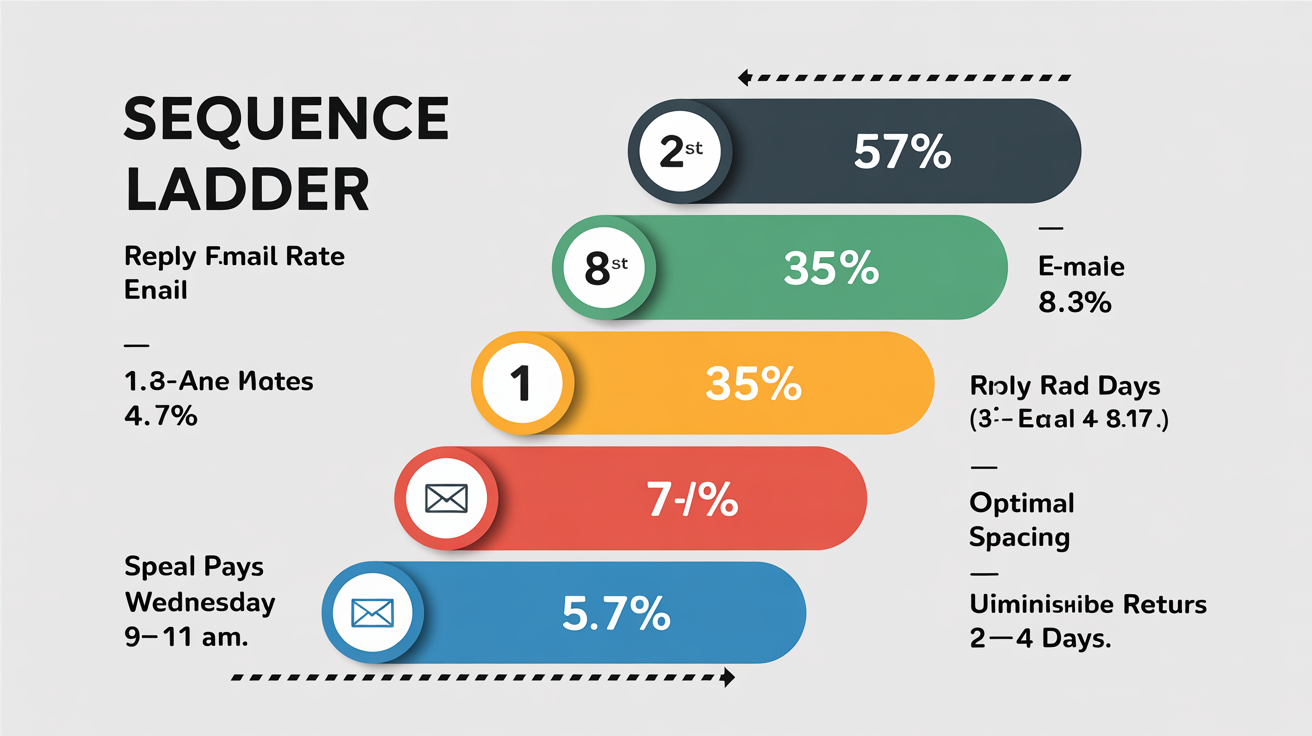
Sending just one cold email? Expect a 4–5% reply rate. Sequences with 4–6 touches triple those results, reaching 12% or more. The initial email grabs the spotlight, pulling in 58% of total replies, but the next three steps do the heavy lifting - accounting for another 35% of responses. Single blasts leave a third of your results on the table. Consistent follow-up isn’t optional if you want real engagement.
Reply Rates by Sequence Length
Stop after one email and you average 4.1% replies. Push to three or five emails, and that jumps to 8–12%. Longer sequences - up to 7–10 touches - work in complex or high-stakes scenarios, but returns diminish sharply after the fourth or fifth email. Unsubscribe rates start climbing at this point. More isn’t always better; it’s about timing and relevance.
Which Step Gets the Most Replies?
- 58% - The first email. Most people who will reply do it here.
- 22% - The second email. Nearly a quarter of all replies land now.
- 13% - The third email. Persistence matters; this step pulls in real results.
- 7% - The fourth email. Useful for stragglers, but the curve flattens fast.
- Less than 2% per email - Steps five and beyond. Marginal gains, higher risk of unsubscribes.
Stop at the first message and you lose 35% of potential replies. Steps two and three drive most of what the first email misses. The fourth email can be worth it, but every message past that delivers less and raises your risk. For a breakdown of reply patterns and sequence design, see the structure and cadence that drive real-world results.
Timing and Cadence: What Works Best?
Wait 2–3 days between emails. Next-day follow-ups drop reply rates by 11%. Early touches should be close - 48 to 72 hours apart - so you stay top of mind without being pushy. After email three, stretch the interval: five days, then a week, sometimes two. That spacing respects the recipient’s attention and keeps you visible without becoming a nuisance.
Optimal Send Days and Times
Wednesdays, 9–11 a.m. - that’s the sweet spot for replies. Tuesday mornings trail close behind. Skip Mondays (backlogged inboxes) and Fridays (checked-out prospects). Batch your sends midweek, pair with sharp copy, and you’ll see a measurable lift. For concise message tactics, check writing short, confident messages hiring managers will read.
How Sequence Length Differs by Target
Enterprise or high-competition roles take more persistence - 7–10 touches isn’t unusual. For smaller companies or less crowded searches, 4–5 emails hit the best balance of replies and low unsubscribes. Push past six, and risk climbs while results stall.
One Cold Email’s system recommends four to five steps for most job searches. That approach maximizes replies, manages risk, and protects your reputation. Targeting major enterprise? You’ll need more patience - and a longer sequence. Their method fits job seekers who want results without burning bridges. For a head-to-head comparison, see today’s most effective job search playbooks.
Persistence Pays, But There’s a Ceiling
Multi-step campaigns double reply rates over one-off emails. The second and third messages pull nearly a quarter of all replies - numbers you can’t ignore. But past the fourth touch, returns drop and unsubscribes creep up. Winning outreach means showing up more than once, but knowing when to stop. For more detail, read how often you should actually follow up and how we measure outreach performance and run tests that improve reply rates. Tactics move the needle, but discipline and data win conversations.
The Persistence Payoff: What These Trends Mean For Your Outreach
Data cuts through the noise: nearly half of all positive replies land after the first follow-up. One cold email? Low odds. Sequenced outreach changes the math. Stop after one, and you’re walking away from replies that would have come with a second nudge.
Follow-Ups Drive Results, But There's a Ceiling
The first email pulls about 58% of replies. The rest - 42% - show up in the follow-ups. Add a second and third message, and reply rates jump by 21% and 25%. That’s double the response rate over single-shot outreach. But keep pushing past five touches, and unsubscribes climb (the average: 2.17%). The sweet spot? Three to five messages, spaced 2–4 days apart, each bringing fresh value. Go further and you risk tipping into spam territory.
Quality and Context Over Quantity
Follow-ups aren’t just reminders. Each should add something new - a case study, a different angle, a timely update about their company. Repeating yourself screams desperation. Mixing it up signals intent. Campaigns that add value with every touch see more real conversations, not just opens. For structure, see our analysis of four follow-up message types that re-engage busy hiring managers.
Adjust Cadence and Count for Region and Role
- Western Europe: Two or three follow-ups work best. Recipients expect directness. Pushing past three usually annoys or triggers spam filters.
- US and Enterprise: Four to seven well-timed emails are fair game. Corporate buyers view consistent, thoughtful follow-ups as professionalism.
- SMBs or informal markets: Four total touches hit the mark. Go lighter if company size or culture signals low tolerance for aggressive outreach.
Running global campaigns? Segment by geography. Adjust your sequence to fit local expectations. More on practical segmentation in our guide on how we research and prioritize companies to find hidden hiring opportunities.
Personalization and Relevance Remain Non-Negotiable
Personalized, relevant emails get answered. Using two or more personalization fields can lift replies by up to 142%. Each follow-up should reference something specific - role, pain point, a recent event. Templates help you scale, but generic blasts tank your metrics. See how to scale personalized outreach without losing the human touch for a practical blueprint.
Respect Fatigue - And Know When to Walk Away
Persistence works, but only up to a point. Watch for unsubscribes, negative replies, or open rates dropping after follow-up three. The best campaigns are steady, not relentless. If you’ve sent five spaced, value-driven emails and still get silence, move on - no burned bridges. More on this in why your follow-ups fail and how to adjust in real time.
The numbers are clear: strategic, respectful persistence multiplies your chances - if every touch adds value and fits your target’s context. For a full system, check our playbook on the most effective job search outreach strategies today. For advanced sequencing, see designing follow-up sequences that double reply rates.
What’s Changing in Follow-Up Strategy: From One-Size-Fits-All to Hyper-Personalized Cadence
Late-stage follow-ups now drive the bulk of positive cold email replies - over half come on the fourth message or later. High-performing campaigns have ditched fixed schedules. Instead, they use flexible cadences that react to data and context.
Longer, Targeted Sequences for High-Value Prospects
Six to ten touchpoints have become standard for enterprise and high-value leads. Campaign data shows sequences with at least seven steps pull in up to 27% more replies than those ending at three. Timing shifts the math: spreading outreach across three weeks (not one) bumps response rates by as much as 18%. This matters most with busy decision-makers.
But volume alone fails if every touch isn’t relevant. Each message must add something new - no copy-paste repeats. For C-suite or director-level targets, use sequencing methods proven to double reply rates.
Segmentation and Behavioral Triggers Replace Generic Drip Tactics
Uniform drip sequences are fading. Segmentation by title, industry, or pain point now links to up to 35% higher reply rates, based on aggregate outreach stats. Behavioral triggers - like sending a custom follow-up after an open or click - are gaining traction. Early signal: fully adaptive campaigns are next.
Conditional logic and dynamic content drive this shift. Campaigns that adjust next steps based on engagement outperform linear, single-path approaches by 22%. For details, check how to scale personalized outreach without losing the human touch.
Personalization Is Mandatory, Not Optional
Personalized subject lines lift unique open rates by at least 26%. Add two layers - reference a company event plus a role-specific challenge - and reply rates can double versus generic. The numbers draw a line: 70% of recipients ignore emails that feel templated or irrelevant.
Review your metrics in how we measure outreach performance and run tests that improve reply rates to spot drop-off points and dial in your personalization depth.
Backlash to Aggressive Tactics - Unsubscribe Rates as a Warning Sign
Relentless or impersonal sequences now push unsubscribe rates past 2%. Cross that line and your cadence or targeting is off. Data from top outreach platforms confirms it: daily follow-ups or repeated, generic content tank both reply rates and brand perception.
- Reply rates fall up to 40% after more than four generic follow-ups in a week.
- Negative replies and spam flags spike when outreach ignores prior engagement.
- Opt-out spikes now flag a failed campaign strategy early.
See our analysis of why your follow-ups fail for specifics on when to push and when to pull back.
Brute-force volume is finished. Data-driven, adaptive sequences win. Top performers combine segmentation, behavioral triggers, and live testing. Build your own adaptive system with frameworks from the most effective job search outreach strategies.
Takeaway: Respectful Persistence Wins - But Only If Your Sequence Adds Value
Nearly half of cold outreach replies land after the first email. That means disciplined, value-driven follow-ups aren’t optional. A sequence of 3–5 personalized, well-timed emails delivers higher reply rates and protects your reputation. Push past that and unsubscribe rates jump - trust erodes fast.
The trend is clear. Predictable, spaced messaging works only when each touch adds something new - a fresh angle, a sharp insight, or context that matters to the recipient. Redundant nudges get ignored. Obvious templates backfire. The best sequences adjust to recipient behavior and keep the focus on their needs, not yours.
Track every step. Don’t trust your gut. Build your sequence around the data. Use the benchmarks and frameworks in designing follow-up sequences that consistently drive replies and the most effective job search outreach strategies. Keep it tight. Let recipient data dictate your next move.
Build an Unfair Advantage Proactively and Update Your Job Search Strategy to Today's Job Market.
$197
Learn MoreFrequently Asked Questions
What is the optimal timing between follow-up emails (days/hours) to maximize replies without annoying recipients?
Send the first follow-up 3–5 business days after the initial email, then one more about 4–7 days later (aim for 2–3 touches over ~2 weeks). Avoid daily pings, limit the sequence to 3–4 total touches, and keep each follow-up short (about 50–125 words), reference the original message, and add brief value to maximize replies without annoying recipients.
How should I vary subject lines and email copy across follow-ups to improve open and reply rates?
Run 2–3 subject-line variants simultaneously and rotate formats across follow-ups: a personalized question (“How is [Company] handling [problem]?”), a short value statement (“Cut [metric] by X%”), and a social-proof/signal line (“Re: [event] - quick thought”). Keep subject lines short (aim 4–7 words or ~36–50 characters), avoid spammy/ALL CAPS language, and prioritize personalization (≈30% lift) and question formats (reported up to ~48% open). Write the email body first, keep follow-ups 50–125 words (ideally <100), personalize the opening with CRM fields, focus on one ask/one CTA, and vary the CTA/tone across the sequence (intro → value/demo → social proof/idea → deadline/close) while A/B testing results.
When is it appropriate to stop following up so I don’t damage my sender reputation or annoy prospects?
Stop immediately if a prospect explicitly says they’re not interested, asks you to stop, marks you as spam, says they’ve signed with a competitor, or reports a frozen budget with no timeline - those signals damage sender reputation and must end outreach. For everyone else, cap outreach at 4–6 follow-ups over ~8–12 weeks, finish with a polite “break-up” email that offers to stop and leaves the door open, and if there’s no reply within a week remove them from active sequences and move them to a long‑term (e.g., quarterly) nurture stream.
How many follow-ups are recommended for different outreach goals (job search, B2B sales, partnership asks)?
Job search: 2–3 follow-ups (first at ~3–7 days, stop after the third) - Hunter and many career coaches recommend capping cold outreach at three. B2B sales: 4–8 follow-ups depending on deal size (SMB/startup ~4–5 over 4–8 weeks; enterprise ~5–7 over 10–14 weeks), since ~80% of sales close after 5+ touches and many replies come on touches 4–8. Partnership asks: 3–6 multi‑channel touches over 4–10 weeks (email plus LinkedIn/Twitter), always add new value each touch and finish with a low‑pressure break‑up message.
Which metrics should I track to judge whether a follow-up sequence is working and when to adjust it?
Track open rate, click‑through rate, reply rate (overall and per touch), conversion rate (meetings/demos/sales), deliverability (bounce rate, spam complaints) and unsubscribe rate, plus reply quality (positive vs. negative responses). Aim for a 5–10% reply rate in B2B (>10% = excellent) and expect ~55% of replies to come from follow-ups; monitor opens/replies by step to see which messages drive engagement. Adjust when reply rate falls below ~5% (rework targeting, subject lines or CTAs), when opens are high but replies are low (shorten gap or change offer), when unsubscribe/spam complaints climb noticeably (reduce frequency/stop) or bounce rate exceeds ~2% (clean list/deliverability fixes).
How can I efficiently personalize follow-ups at scale without spending excessive time on each prospect?
Automate multi-step, behavior-triggered sequences using tokenized templates with spintax (e.g., 5–8 touches, 24–48 hr follow after a high‑intent action) and stop-on-reply logic so only real conversations pull you out of the flow. Use a platform that handles timing, deliverability (warmup/rotation - e.g., a 4.2M+ warmup network), and centralized reply management to scale across 10–150 inboxes without manual tracking. Continuously A/B test cadence/titles and limit personalization to quick, high-impact signals (recent activity, role change, mutual contact, company news) to keep messages relevant without writing each one.
Do repeated follow-ups increase spam complaints or hurt deliverability, and what steps minimize that risk?
Yes - repeated follow-ups can raise spam complaints and damage deliverability if cadence is too aggressive, lists are dirty, or your domain lacks proper authentication/warmup. Use a widening-gap cadence (2–3 days, then 4–5 days, then 7+ days), send from a personalized person-to-person address, and tailor follow-up counts by market (fewer in sensitive regions like Germany). Maintain strict hygiene and infrastructure: remove hard bounces immediately and keep bounces <2%, aim for spam complaints ≈0.1% (stay <0.3%), verify addresses (e.g., BriteVerify), configure SPF/DKIM/DMARC, warm up/throttle sends (start ~20–30/day, ramp 2–3 weeks), use separate sending domains, and honor one‑click unsubscribes within 2 days.
Luis Gamardo built a modern job search framework for a broken recruiting system. His approach teaches how to send cold emails at every stage of the hiring process, so qualified candidates can get noticed by the right people at the right time - including before jobs are even posted.
Sources
- prospectout.com
- streak.com
- leadfeeder.com
- skrapp.io
- upwork.com
- quora.com
- tario.ai
- levelingup.com
- listkit.io
- artisan.co
- instantly.ai
- sendr.ai
- woodpecker.co
- outboundrepublic.com
- woodpecker.co
- mailin.ai
- blog.heyeveryone.io
- salesrobot.co
- close.com
- instantly.ai
- autobound.ai
- instantly.ai
- lemlist.com
- coldlytics.com
- martal.ca
- instantly.ai
- herohunt.ai
- propellercrm.com
- mailforge.ai
- gem.com
- instantly.ai
- growthlist.co
- findem.ai
- exclaimer.com
- salesmotion.io
- hubsell.com
- payproglobal.com
- boostmediagroup.com
- listkit.io
- superhumanprospecting.com
- woodpecker.co
- onurgenc.com
- leadspicker.com
- kristina.substack.com
- trykondo.com
- artisan.co
- sparkle.io
- b2brocket.ai
- growbots.com
- hubspot.com
- koncert.com
- close.com
- belkins.io
- saleshandy.com
- primeforge.ai
- criminallyprolific.com
- autobound.ai
- amplemarket.com
- warmforge.ai
- hunter.io
- saleshandy.com
- indeed.com
- saleshandy.com
- instantly.ai
- superhumanprospecting.com
- profitoutreach.app
- salesforce.com
- revium.io
- callboxinc.com
- lagrowthmachine.com
- sopro.io
- hublead.io


