Scaling Benchmarks: How Many Messages Per Week For Sustainable Outreach
Cold outreach typically gets just 1–3% reply rates - even with 40–60% open rates that are often inflated by privacy tools - so high-volume, poorly targeted sends waste resources and can wreck sender reputation. The key takeaway: signal-driven personalization and tight targeting (short, company-specific messages) multiply responses - advanced personalization can push replies above 25% and small, hyper-targeted batches can reach ~50% - making scaled outreach sustainable.
Build an Unfair Advantage Proactively and Update Your Job Search Strategy to Today's Job Market.
$197
Learn MoreThe Numbers Game: Why Cold Outreach Is a Low-Conversion (But High-use) Strategy
8.5%. That’s the average cold email response rate. Move to real conversations? Most campaigns manage just 1–3% - even as open rates look healthy at 24–36%.
The math here is unforgiving. Without structure, cold outreach drains resources fast: too many messages, too few results, and a sender reputation that tanks if flagged as spam. To get sustainable results, you need to work those odds at scale - enough volume paired with sharp personalization. Spray-and-pray lands in the spam folder. Consistency and quality keep you in the game. Benchmarks shape every decision; ignore them, and you’ll waste months on tactics that don’t work.
The data below shows what “good” response rates actually look like in 2026, why benchmarks keep shifting, and how modern cold outreach rewards smarter, targeted systems. If you’re ready to upgrade your approach, read up on scaling personalized outreach for higher response rates and the playbook for proactive job search strategy. Next, you’ll see exactly how much outreach it takes each week to break through - without burning your sender reputation.
Cold Outreach by the Numbers: Volume, Response Rates, and Personalization Impact
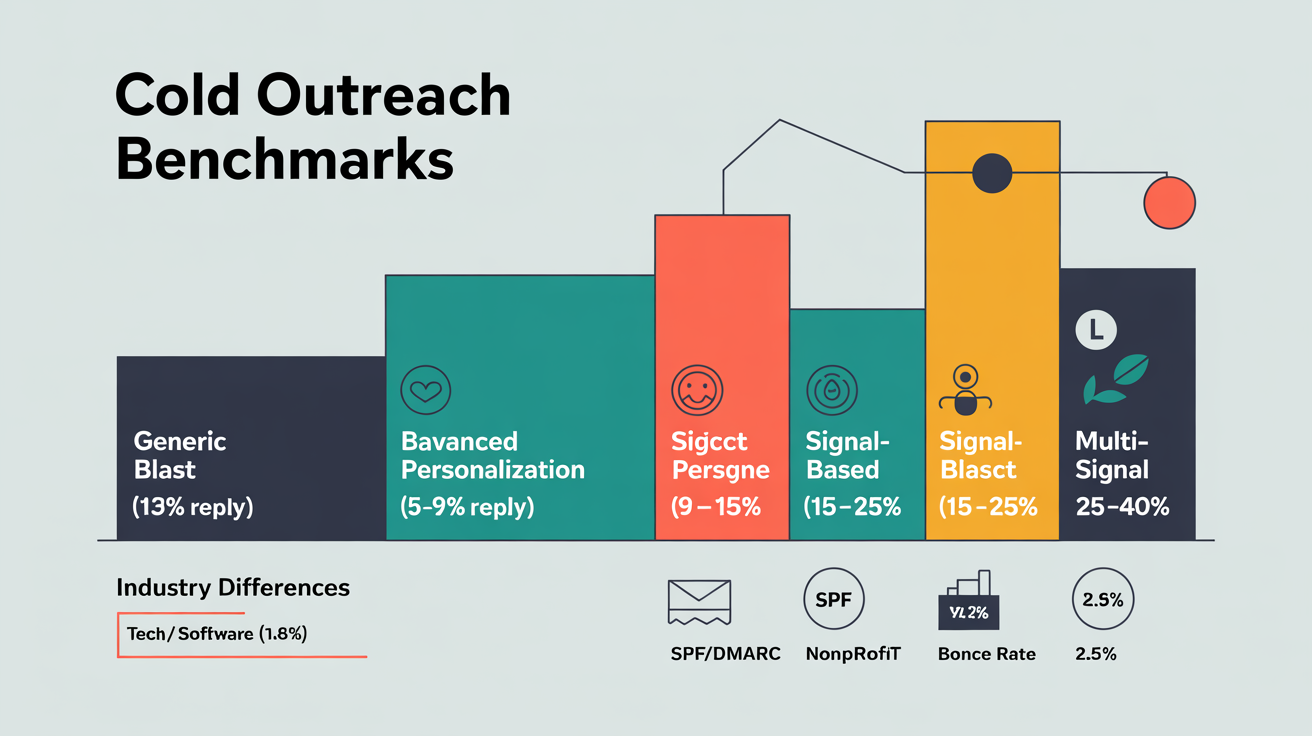
Most cold outreach campaigns struggle to hit a 3% reply rate. Advanced, signal-based personalization can push replies above 25% - but that’s rare. Industry, campaign size, and list quality shape your odds. Miss these details and you’ll waste months chasing silence.
Open Rates: Directional, Not Definitive
Cold email open rates average 40–60% with a clean list and warmed domain. Numbers above 55% can mislead, though. Privacy tools like Apple’s MPP and security bots inflate opens, so don’t treat them as proof of engagement. If your open rate drops below 30%, fix your subject lines or sender reputation. But a high open rate paired with a 1% reply rate? Poor targeting or a weak message. Use opens for signals - never as your finish line.
Reply and Positive Response Rates: The Real Metric
Replies tell you what’s working. The typical reply rate sits at 1–3%. With advanced personalization, replies can climb to 8–10%. Hyper-targeted, signal-driven outreach? Rare, but can break 25%. Positive responses - actual interest, not just any reply - average 2%. If you’re stuck under 1%, overhaul your targeting and copy. High reply rates mean you’re landing the right message with the right people. Track these numbers to diagnose campaign issues. See how we measure outreach performance and run tests that improve reply rates for benchmarks and troubleshooting.
Personalization and Targeting: The Multiplier
Personalization changes the math. Campaigns using company-specific signals - leadership changes, funding news, pain points - outperform generic mail merges by 5–10x. Short, relevant messages (50–125 words, 6–8 sentences) achieve reply rates up to 50% in small, focused batches. Personalized outreach drives six times more transactions than templated emails. The closer your message matches their reality, the more you’ll break through.
Industry Benchmarks: Context Drives Tactics
- Nonprofit/religious: 16.5% reply rate - mission alignment drives higher replies.
- IT services/consulting: 3.5% reply rate - inbox competition is brutal, so sharp targeting is non-negotiable.
- Technology: 1.87% reply rate - market saturation drags results down.
- Software: below 1% reply rate - generic pitches vanish in noise.
- Financial services: 3.39% reply rate - compliance and formal tone slow responses.
- Biotechnology: 3.2% reply rate - niche targeting and technical depth matter most.
Industry averages set your baseline. In crowded, low-response sectors, double down on micro-targeting and researching and prioritizing companies to find hidden hiring opportunities.
Bounce Rates, Deliverability, and Domain Health
Bounce rates expose list quality. Keep them under 2% - anything higher and deliverability tanks. Most campaigns average 7.5% bounces, usually from neglected lists or bad scraping. Small batches (under 50) average 3%; big blasts spike above 8%. Rising bounce rate? Pause, clean your list, re-verify. Domain authentication (SPF, DKIM, DMARC) keeps you out of spam. Even the best copy fails if technical setup is sloppy - rookie mistake, but common.
Volume, Sequence, and Scaling Best Practices
Pace matters. Too few emails, and you miss quota. Too many, and your sender reputation crashes. Sustainable volume is 30–50 emails per sender per day - tight targeting wins, not brute force. Multi-touch sequences help, but a third email can drop replies by 20%. Follow-ups work, but only if they add value. For a full system, see our guide to scaling personalized outreach and tools and templates for scaling outreach.
Track reply rates, bounce rates, industry averages, and personalization depth. This turns your outreach into a system, not guesswork. One Cold Email is a strong starting point for structured outreach - especially if you’re stuck under 3% replies. It handles personalization at scale, offers advanced targeting, and monitors deliverability. Setup takes real effort, and it’s not for anyone chasing instant results. For more strategy, see the complete playbook for proactive candidates.
Small tweaks - list quality, message length, technical setup - compound fast. For specific tactics, see our framework for writing short, confident messages hiring managers will read or explore designing follow-up sequences that reclaim lost opportunities. Metrics aren’t just numbers - they’re your edge over everyone still guessing.
Beyond Volume: What the Data Actually Tells Us About Sustainable Outreach Cadence
Reply rates don’t rise with volume - quality shifts the curve. Data shows advanced, context-rich personalization drives reply rates up to 25–40%. Generic blasts scrape by at 1–3%. Smaller, targeted sends - under 50 recipients - consistently double the response rate per message compared to larger lists.
Every Personalization Layer Multiplies Results
Template blasts get punished. Basic mail-merge (name, company, title) lands in the 5–9% reply range. Reference a real pain point or a timely trigger? Jump to 15–25%. Stack two or more signals - say, a funding round plus a key hire - and reply rates often hit 25–40%. Surface-level tokens can’t compete. Build your process around signal-driven targeting and real context, even if you send less.
Smaller, Sharper Lists Beat “Spray and Pray”
Performance tanks when you chase volume. Campaigns under 50 contacts average a 5.8% reply rate; large blasts drop to 2.1%. Relevance wins. Brute force backfires. If you’re below 3%, your list is probably too broad or stale.
- Targeted lists under 50: avg. 5.8% reply
- Large campaigns: avg. 2.1% reply
- Multi-signal personalization: 25–40% reply (generic: 1–3%)
- Teams using these tactics close deals in 3 months; generic outreach drags past 6
Segment ruthlessly. Prioritize quality over raw numbers. For a walkthrough, see scaling personalized outreach using focused lists.
Deliverability: The Invisible Ceiling
Even the best email fails if it doesn’t hit the inbox. Bounce rates above 5% point to list decay or technical gaps. Ignore list hygiene or skip authentication (SPF, DKIM, DMARC) and your sender reputation nosedives. Top teams treat deliverability as a baseline, not a bonus. Hitting reply plateaus? Audit your technical setup and list quality before rewriting copy. For tactics, see tools and templates for scaling outreach.
Sustainable Cadence: The Long-Game Advantage
Sending 20–50 high-context, high-value messages a week isn’t a blitz. It’s a system. Results compound: reply rates climb, sender reputation strengthens, burnout fades. One Cold Email supports this rhythm - multi-layer personalization, repeatable workflows - but you need setup and discipline. It’s not for mass-blasting. It’s for careerists playing the long game, not list churners. For the full method, see our complete playbook for proactive candidates.
Pattern’s obvious: personalized, targeted, technically sound outreach - done consistently - wins. Rethink “volume.” Fewer, sharper, more relevant touches outperform the rest. For tracking and improvement, see the metrics that actually move reply rates.
The Shift from Spray-and-Pray to Precision: Data-Driven Trends Redefining Outreach in 2024–2026
Personalized, signal-based outreach has taken over. Reply rates for generic mass emails fell under 3% in 2024. Meanwhile, multi-layered, AI-powered personalization routinely hits 20–40%. The winners now send fewer messages, but each one lands with more impact. Micro-segmentation, analytics, and disciplined automation drive results. This change isn’t a blip. Over the next two years, the gap between relevance-first operators and everyone else will only grow.
Micro-Segmentation and Multi-Variant Messaging Dominate
Blasting one-size-fits-all templates is dead. Campaigns segmented by role, industry, or buying signal outperform generic lists by more than 3x. Reply rates for campaigns using three or more segments average 9.2% - broad lists get just 2.8%. Top teams break lists into cohorts of 20–50, then test message variants tied to both title and trigger event. A/B tests surface what works. AI tunes the winners.
Use field-level personalization and cohort-based testing to find signal pockets. Outreach.io and Sendr data confirm this: list size and message relevance now drive replies, not just volume.
AI-Powered Personalization at Scale - But Not Blind Automation
AI research agents have made high-context personalization scalable. Adoption is now common: 54% of sales teams use AI for outbound copy, 45% for research. Teams combining both report up to a 25% pipeline lift. Salesforge and Outreach users see 20–40% reply rates with behavioral and firmographic data layered in - name-only “personalization” lags at 1–3%.
But pure automation backfires. University of Pennsylvania research found 62% of B2B buyers spot AI-generated messages instantly. Robotic tone or odd references trigger spam filters and get ignored. Hybrid is the trend - AI handles grunt work, humans add nuance. For recommendations, see tools and templates for scaling outreach.
Deliverability and Sender Reputation as the New Limiters
Spam filters now punish lazy senders. New authentication standards (SPF, DKIM, DMARC) and real-time AI detection flag high bounce rates and repeated templates. Open rates for bulk campaigns have collapsed - Sendr shows under 10% for generic mailings. Authenticated, personalized sequences land in the inbox 26–42% of the time. Teams that skip technical hygiene see domains blacklisted and results crater.
This isn’t emerging - it’s standard. Technical setup, sender domain warmup, and reputation monitoring are now required. For step-by-step help, use our system for scaling personalized outreach and the complete playbook for proactive candidates.
Emerging Signal: Video and Multi-Channel Outreach
Personalized video is shifting from trend to expectation. By 2026, over 30% of high-performing teams will embed AI-generated video intros into campaigns. Sendr reports reply rates 50–200% higher than plain text for key segments. Early data shows multi-channel sequencing (email, LinkedIn, SMS) delivers a 23% response boost when timing syncs across platforms.
This is still an early signal, not a universal standard, but direction is clear. Buyers engage where relevance finds them. For system builds, see how we measure outreach performance and run tests that improve reply rates.
The Sustainable Outreach Formula: Why Precision and Consistency Beat Volume
Generic cold outreach averages a 1–3% reply rate. Personalization - when done right - pushes that up to 25–40% and keeps sender reputation strong. Multi-signal targeting, relevance, and disciplined sender hygiene drive this gap. Spray-and-pray tactics burn domains and crash results. Focused, intentional personalization delivers real conversations.
Sustainable outreach now means quality over quantity. Buyers ignore irrelevant messages and filters punish lazy blasts. The winning approach: a repeatable process - tight research, measured cadence, and a laser focus on fit. Data-backed personalization outperforms mass sending, and this advantage grows as automation and buyer scrutiny increase.
Track the metrics that count, personalize where it matters, and structure outreach for repeatability and improvement. For consistent results, study our system for scaling personalized outreach and anchor your job search to the complete playbook for proactive candidates. Sustainable outreach is built, not lucked into.
Build an Unfair Advantage Proactively and Update Your Job Search Strategy to Today's Job Market.
$197
Learn MoreFrequently Asked Questions
What are typical bounce rate and spam complaint benchmarks for cold outreach?
Aim for a bounce rate below 2% (ideally <1%) and a spam-complaint rate under 0.1% (anything ≥0.2% is already a warning). If you exceed those thresholds, stop the campaign, clean/verify the list, pause sending and warm up/adjust your sending domain and cadence to protect deliverability.
How long should you wait between follow-up emails in a cold outreach sequence?
Start with a first follow-up 2–4 days after the initial cold email, then space subsequent follow-ups about 3–7 days apart. Run a 3–5 touch sequence (most recommend 3–4), with a polite “break-up” around 14–21 days and optional re‑engagement at 30–60 days. Always add new value or a different angle with each follow-up rather than repeating the same message.
How many cold emails per week should I send from a single sending domain/account to avoid deliverability problems?
Start with 50–100 cold emails per week from a new sending domain/account (≈7–15/day) and ramp volume by ~10–20% every 2–3 days; after 4–6 weeks you can scale toward ~400–1,000/week on a well-warmed domain/IP if metrics remain healthy. Implement SPF/DKIM/DMARC, keep bounce rate <2% and spam complaints <0.1–0.3%, and be aware hard caps include Gmail’s 500/day (free) and 2,000/day (Workspace).
What daily/weekly ramp-up schedule should I use to warm a new inbox or domain during the first 1–4 weeks?
Configure SPF/DKIM/DMARC and create predictable send/receive activity, then ramp slowly (aim for at least a 21-day warm‑up): Week 1 - 20–30 emails/day; Week 2 - 50–75/day; Week 3 - 100–150/day; Week 4 (optional scale) - ~200/day. Use a mix of real opens/replies (or a warm‑up network) and monitor inbox placement and complaints daily; if deliverability drops, pause increases and cut volume ~30–50% until placement recovers.
How many follow-up messages should I include in a sequence before stopping outreach to a lead?
Stop after 3–5 follow-ups (4–6 total touches) and finish with a polite “breakup” email if there’s no response. Use three follow-ups as your default for SMBs/startups to avoid pestering, but plan 5–9 touches for enterprise/executive targets since research shows an average prospect needs about 5 touches and executives can need nearly 9; space them over days/weeks, add new value each time, and switch channels before extending the sequence.
How should I split outreach volume across multiple domains/accounts and inboxes to scale without harming sender reputation?
Use multiple warmed domains/accounts - e.g., 3–5 domains with 1–3 inboxes each - and cap cold sends per inbox at ~150–250/day (new inbox warmup: 20–50/day week 1, 50–100/day week 2, 100–200/day week 3), keeping aggregate volume proportional (small programs ≤1,000/day across all domains). Prioritize personalization and steady cadence, monitor Gmail open rate (a ~50% drop signals Gmail reputation trouble), keep spam complaints ≤0.1% (≤1/1,000), and track engagement velocity (opens/clicks within 1/6/24 hrs) - pause/throttle any inbox or campaign that degrades. Use separate branded subdomains (not your primary domain), enforce SPF/DKIM/DMARC, and rotate IPs/providers as volume grows to avoid single-point reputation damage.
Which early-warning metrics and threshold changes (e.g., sudden bounce spikes, inbox placement drops, complaint increases) should prompt me to pause or reduce campaign volume?
Pause or throttle immediately if any of these occur: hard bounce rate>2% (or a>2× spike vs your baseline), spam complaint rate>0.1% (or a ≥50% relative rise), or unsubscribe rate>0.5% (or doubles suddenly). Also act if inbox placement or ISP-specific open rates drop sharply (a fall of>10 percentage points or>25% relative decline for Gmail/Outlook/Yahoo), engagement velocity (opens/clicks/replies within 1–24 hours) falls by>30–50%, or you start seeing sustained ISP throttling/SMTP 4xx–5xx errors or delivery delays. If two or more signals appear together, stop sends, remove hard bounces/unengaged addresses, verify authentication, and investigate before resuming.
Luis Gamardo built a modern job search framework for a broken recruiting system. His approach teaches how to send cold emails at every stage of the hiring process, so qualified candidates can get noticed by the right people at the right time - including before jobs are even posted.
Sources
- outreach.io
- outreach.io
- altahq.com
- salesforge.ai
- sendr.ai
- generect.com
- sendr.ai
- herohunt.ai
- sales-mind.ai
- expandi.io
- saleshandy.com
- outreach.io
- saleshandy.com
- writemail.ai
- support.outreach.io
- copilotai.com
- anyleads.com
- blog.hubspot.com
- salesroads.com
- richardson.com
- instantly.ai
- warmforge.ai
- artemisleads.com
- mailtrap.io
- lagrowthmachine.com
- herohunt.ai
- senseicopilot.com
- primeforge.ai
- tradepressservices.com
- saleshandy.com
- forum.thethinksters.com
- woodpecker.co
- cleverly.co
- isazeni.com
- lemlist.com
- qxglobalgroup.com
- sujanpatel.com
- freelancecake.com
- close.com
- pitchlane.com
- onurgenc.com
- leavemealone.com
- emailtooltester.com
- mailforge.ai


